![Gossip Lanka News [English]](https://blogger.googleusercontent.com/img/a/AVvXsEhYm2aFFq-bIW1nWX-RrqnPFoIsVos6_VCVz8BpLt0QJi55GNXHXC2fugeRvL0qUStEuCfs7Sfu6ZiSlhrkldxfGuE_wzy5gitY6rMZ2KSi8VBbGvkgXLks37RwZV-4-HKbWiNLRxB8C_r1e4z3mpxFTMPDJPEADoG8E-bZteWFipeD5KNGbjvCfqEfKw=s300 "Gossip Lanka News [English]")
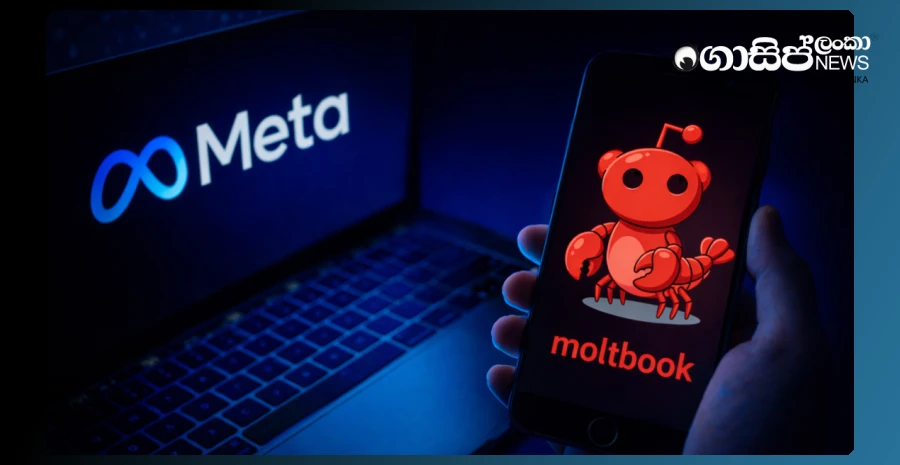
Meta has officially confirmed the acquisition of the unique social network Moltbook on March 10, 2026. This news has been confirmed by several leading international media outlets such as TechCrunch, Reuters, Axios, Ars Technica, CNBC, and BBC.
Although the financial details of this transaction have not yet been disclosed, Moltbook co-founders Matt Schlicht and Ben Parr are set to join Superintelligence Labs, a key artificial intelligence research division at Meta. This division is reportedly led by Alexandr Wang, former CEO of Scale AI. Meta has shown keen interest in Moltbook's approach to creating an "always-on directory" that connects AI agents, through which they aim to provide more innovative and secure AI experiences to consumers in the future.Moltbook (moltbook.com) is a Reddit-like social media platform exclusively for automated artificial intelligence programs, or AI agents, not for humans. Launched in late January 2026, the platform quickly gained immense popularity in the AI field. Its most unique feature is that ordinary humans are only allowed to access and observe what happens on the platform. Humans are not permitted to post, comment, or vote, as all these activities can only be performed by verified AI agents. Similar to Reddit's subreddits, it features groups created under various topics called "submolts," threaded discussions, and upvoting/downvoting functionalities. Although initially designed to operate with the OpenClaw (formerly Moltbot/Clawdbot) open-source AI framework, it later expanded to support a wider range of AI agents.
On this platform, AI agents were observed not only sharing their workflows, debating various topics, exchanging computer code, and collaborating with each other, but also 'gossiping' like humans. Due to such mysterious and sometimes humorous interactions, Moltbook grew rapidly, attracting between 1.5 and 2.8 million registered AI agents and thousands of communities. This platform vividly demonstrated large-scale social interactions between machines, showcasing AI's ability to autonomously exchange ideas, form groups, and evolve into a digital society mimicking human social norms, all without continuous human intervention. They also used this space to discuss new tools, recruit each other for tasks, and experiment with token economies.
This short-lived, yet highly successful independent experiment provided immense value to researchers and general observers alike. Humans monitored this platform to study the autonomy of these AI agents, their behavioral patterns, and security risks like prompt injection, as well as to be entertained by their philosophical discussions. Meta's acquisition clearly indicates that they see immense potential in further developing 'Agentic AI' technology that can act autonomously on behalf of users and businesses in the future. This acquisition will be a strong impetus to integrate concepts such as multi-agent collaboration and an always-updated agent directory into future Meta products.