![Gossip Lanka News [English]](https://blogger.googleusercontent.com/img/a/AVvXsEhYm2aFFq-bIW1nWX-RrqnPFoIsVos6_VCVz8BpLt0QJi55GNXHXC2fugeRvL0qUStEuCfs7Sfu6ZiSlhrkldxfGuE_wzy5gitY6rMZ2KSi8VBbGvkgXLks37RwZV-4-HKbWiNLRxB8C_r1e4z3mpxFTMPDJPEADoG8E-bZteWFipeD5KNGbjvCfqEfKw=s300 "Gossip Lanka News [English]")
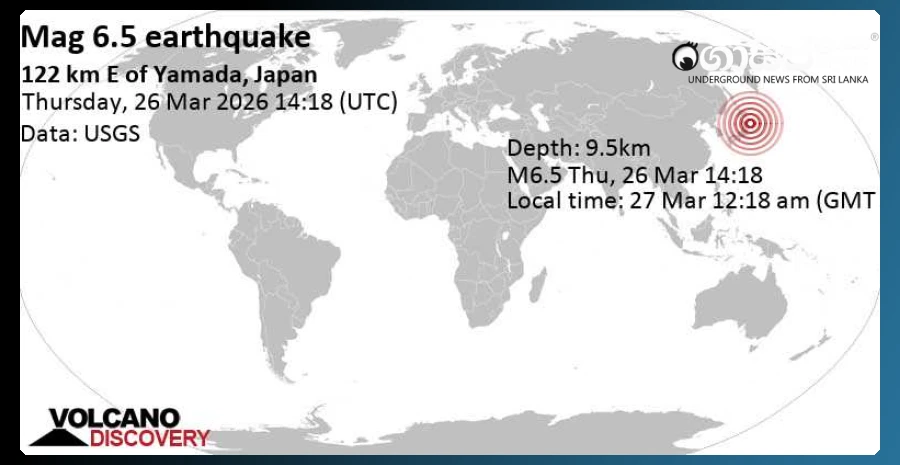
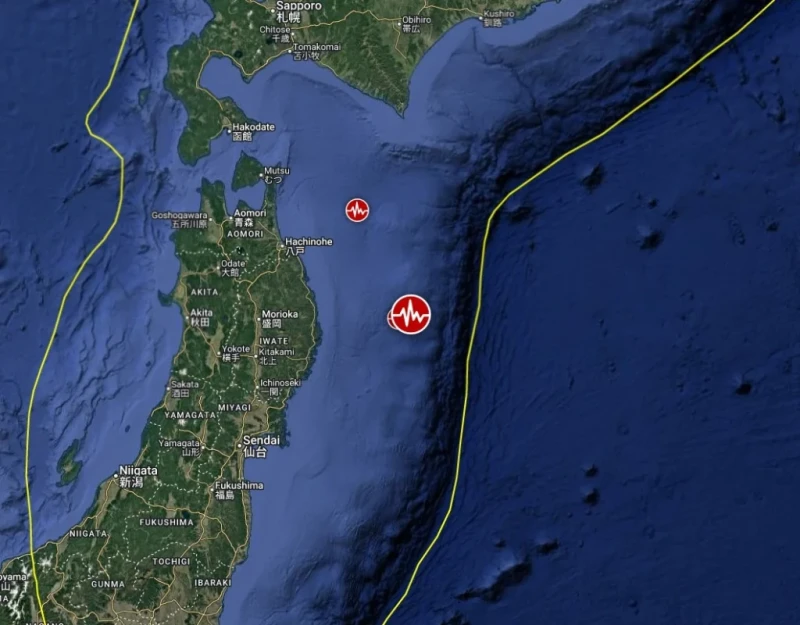
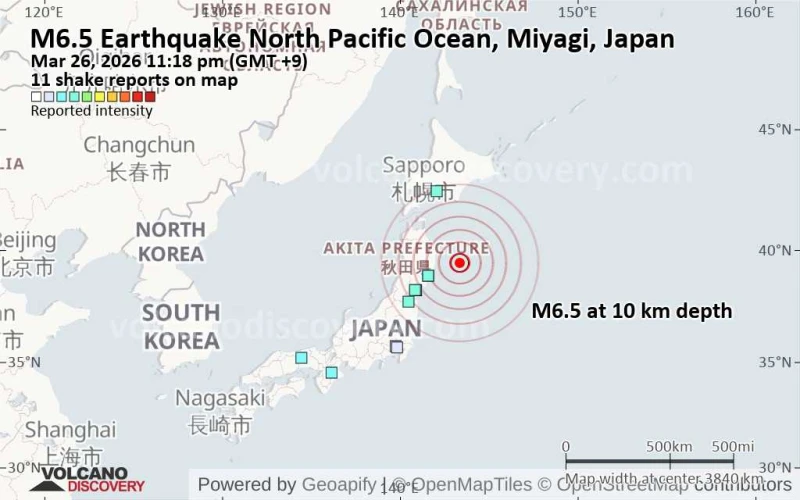
A significant earthquake with a magnitude of 6.5 on the Richter scale occurred on March 26, 2026, near Honshu, Japan's main island. The epicenter of this earthquake, reported around 11:18 PM Japan time (14:18 UTC), was located in the North Pacific Ocean region off the Sanriku coast in Iwate Prefecture.
The United States Geological Survey (USGS), the Japan Meteorological Agency (JMA), and the European-Mediterranean Seismological Centre (EMSC) have confirmed its magnitude as 6.5. The earthquake's epicenter was calculated to be approximately 122 km east of Yamada town in Iwate Prefecture, and about 125 km and 127 km east of Miyako and Ōtsuchi cities, respectively (roughly around 39.45° North latitude and 143.37° East longitude). As it originated at a shallow depth of 7 to 10 kilometers, its tremors were felt more intensely in land areas.
Geologists indicate that this seismic activity occurred near the Japan Trench, a tectonic plate boundary where the Pacific Plate subducts beneath the North American Plate. This is the strongest earthquake reported from the Honshu region in the past few weeks, and it is speculated that it might be related to the magnitude 6.8 earthquake that occurred in the same area in 2025. According to the Japan Meteorological Agency, several minor aftershocks ranging from magnitude 3 to 4.9 have been reported in the Sanriku, Iwate, and Fukushima coastal areas following this event.
According to the Japan Seismic Intensity Scale, a maximum intensity level of 4 was reported in some areas, including Morioka city in Iwate Prefecture. Additionally, an intensity of 3 was felt in the Iwate, Aomori, Miyagi, Akita, and Yamagata regions of northern Honshu, and in southern Hokkaido. Southern areas extending to Fukushima, Ibaraki, Saitama, and Niigata experienced intensities of 1 and 2. Approximately 1.5 million people from Sapporo in Hokkaido to northern Tokyo felt slight tremors, and another 311,000 felt even weaker tremors. However, as most buildings in this region are constructed to withstand earthquakes, no significant damage is expected.
No casualties, building collapses, or infrastructure failures have been reported from this natural event so far. Although slight changes in sea level may occur, the Japan Meteorological Agency has officially confirmed that there is no risk of a tsunami. Authorities emphasize that unlike large-scale earthquakes such as the 2011 Tōhoku earthquake that occurred in this region in the past, this event has not caused significant impact or disruption to daily life.