![Gossip Lanka News [English]](https://blogger.googleusercontent.com/img/a/AVvXsEhYm2aFFq-bIW1nWX-RrqnPFoIsVos6_VCVz8BpLt0QJi55GNXHXC2fugeRvL0qUStEuCfs7Sfu6ZiSlhrkldxfGuE_wzy5gitY6rMZ2KSi8VBbGvkgXLks37RwZV-4-HKbWiNLRxB8C_r1e4z3mpxFTMPDJPEADoG8E-bZteWFipeD5KNGbjvCfqEfKw=s300 "Gossip Lanka News [English]")
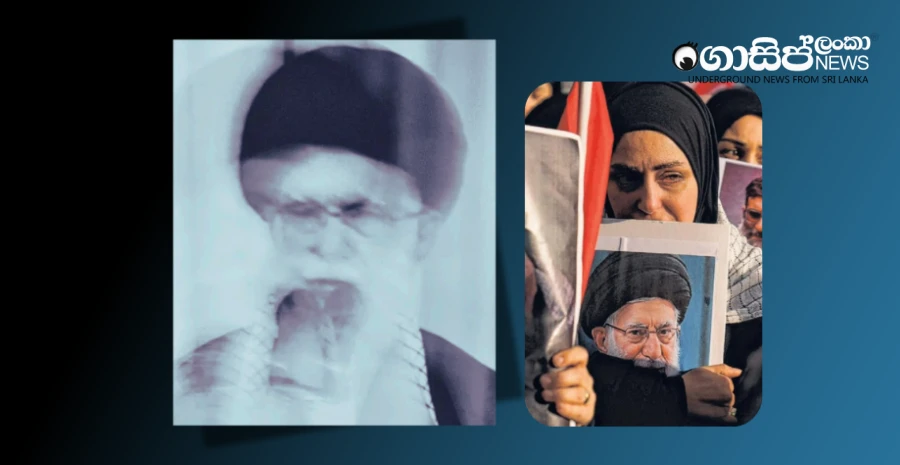
Iran's Supreme Leader Ayatollah Ali Khamenei passed away on Saturday at the age of 86, as announced by US President Donald Trump on social media.
Appointed as Iran's Supreme Leader in June 1989, he is considered one of the world's longest-serving dictators, having ruled the country for nearly four decades. In his inaugural speech, he declared himself a flawed individual and merely a minor religious student, which perfectly reflected the sense of insecurity evident throughout his reign. Did he really need to be killed? The New York Times published an article about it today (2).Khamenei, a challenge to every American president since George H. W. Bush, became the most powerful man in the Middle East, dominating regions such as Syria, Lebanon, Iraq, Yemen, and the Gaza Strip. However, his boundless ambitions and hubris ultimately led to his own downfall. He ruled the country with extreme brutality, based on his firm belief that his own society and the world's most powerful state were trying to overthrow him.
Born in Mashhad in 1939, Ali Khamenei was the second of eight children. From an early age, he pursued religious education, studying at religious schools in Mashhad, Najaf, and Qom. In the 1960s, while studying in Qom, he became a follower of Ayatollah Ruhollah Khomeini, who was then active against the Shah's regime. After Khomeini was exiled in 1964, Khamenei remained in Iran, spreading his teacher's teachings. As a result, he was arrested and tortured six times by Savak, the Shah's secret police.
It is believed that his intense hatred for America and Israel was forged in these prison cells, due to the prevailing belief at the time that the CIA and Mossad had trained the Savak police. After the Shah's regime collapsed through the 1979 Iranian Revolution, Khomeini returned, and Khamenei also entered the political arena as the President of the Islamic Republic. Following Ayatollah Khomeini's death in 1989, Khamenei was appointed Supreme Leader with the support of then-Parliament Speaker Hashemi Rafsanjani. Rafsanjani mistakenly believed that Khamenei would act as his subordinate, leading to a fierce rivalry between the two for nearly three decades.
As a leader, Ayatollah Khamenei's ideology was very simple and unchangeable. His primary strategic policy was resistance against American imperialism, or "global arrogance." Reformist President Mohammad Khatami once stated that Khamenei firmly believed the Islamic Republic needed hostility with America. The slogans "Death to America" and "Death to Israel" were prominent during his rule, and challenging the outside world was his priority over the country's development. Although Khamenei cultivated an image of living a simple life, it is reported that he possessed vast wealth built on properties confiscated from Iranian citizens. Under his rule, Iran was isolated from the global financial system for decades.
The Iranian currency became one of the most devalued currencies in the world, and the internet was heavily censored. Brain drain became a major problem in the country, with approximately 150,000 Iranians leaving the country each year. While the people suffered from sanctions and inflation within the country, Khamenei spent tens of billions of dollars to maintain the "Axis of Resistance" across the Middle East.
Khamenei was one of the few world leaders who praised the Hamas attack on Israel on October 7, 2023.
However, it proved to be a grave miscalculation. In the months that followed, Israel launched severe attacks on Iran's resistance groups, assassinating Hamas leader Ismail Haniyeh in Tehran, Yahya Sinwar in the Gaza Strip, and Hezbollah leader Hassan Nasrallah. In the 12-day war in June 2025, Israel heavily bombed Iranian cities and military bases, and the United States dropped 14 bunker-buster bombs on Iran's nuclear facilities.
Above all, his most brutal violence was directed against his own people. To suppress the nationwide protests that erupted in January 2026 due to the economic crisis, he launched the most severe crackdown in history. The Human Rights Activists News Agency estimated that nearly 6,800 people were killed in this 48-hour crackdown, while Time magazine, quoting two Iranian health ministry officials, reported that the number could be as high as 30,000. Due to his unwillingness to change policies followed for decades, Iran lost half a century and the future of its people entirely, while neighboring Gulf countries became financial and technological hubs.
(The New York Times)