![Gossip Lanka News [English]](https://blogger.googleusercontent.com/img/a/AVvXsEhYm2aFFq-bIW1nWX-RrqnPFoIsVos6_VCVz8BpLt0QJi55GNXHXC2fugeRvL0qUStEuCfs7Sfu6ZiSlhrkldxfGuE_wzy5gitY6rMZ2KSi8VBbGvkgXLks37RwZV-4-HKbWiNLRxB8C_r1e4z3mpxFTMPDJPEADoG8E-bZteWFipeD5KNGbjvCfqEfKw=s300 "Gossip Lanka News [English]")
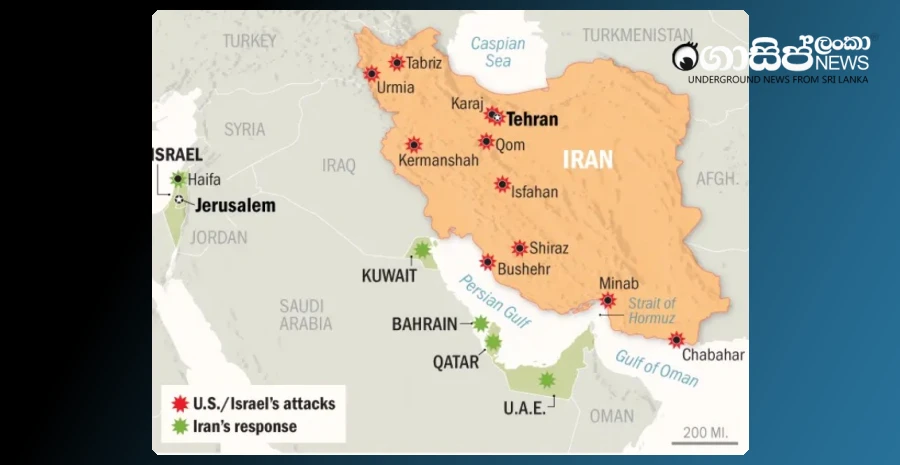
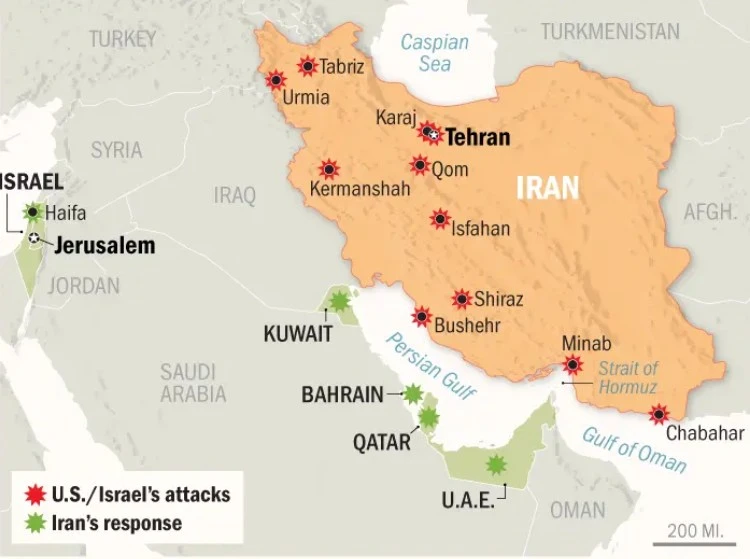
In June last year, Iran responded to attacks by the United States and Israel aimed at destroying Iran's nuclear program with the intention of preventing the situation from escalating into a regional war. However, following President Donald Trump's order to launch a massive and continuous operation aimed at removing the Iranian regime and the assassination of the country's Supreme Leader Ali Khamenei, Iran's current response has exceeded previous limits.
In the first few hours after this round of American and Israeli attacks, Iran launched a massive series of missile strikes targeting US bases across the region and densely populated civilian areas in allied countries. American and Israeli bombings have caused significant loss of life in Iran, with state media quoting Red Cross data reporting that approximately 201 people have died and over 700 have been injured across Iran. Although IRNA news agency stated that over 100 children died in an attack on a girls' school in southern Iran, these figures have not been independently confirmed.
These attacks by Iran have severely shaken the image of security that the Gulf region had built by attracting foreign investment, expatriate workers, and tourists. With luxury tourist areas in Dubai, apartments in Bahrain, and several international airports in the region being damaged by Iranian missiles, drones, or their debris, the security foundation of many Gulf nations' relationships with America has also been severely impacted.
The primary target of the first series of missile attacks on Saturday morning was Israel. By noon that day, approximately 35 missiles had been launched towards Israel, and a woman was killed by falling debris in the Tel Aviv area. Subsequently, on Sunday afternoon, a ballistic missile attack on the Beit Shemesh area in central Israel killed eight people and injured about 20 others. Although Israel is protected by the sophisticated 'Iron Dome' missile defense system, created with American support and over $1 billion in funding, some missiles and drones managed to bypass these systems in the past 48 hours, as they did last June.
Iran had previously warned of attacks on US bases in the Middle East, and before the attacks began, US forces had started withdrawing from several bases, including Al Udeid Air Base in Qatar. However, US bases in Bahrain, Qatar, the United Arab Emirates, Kuwait, Jordan, and Saudi Arabia became targets on Saturday. Authorities confirmed that 44 missiles and 8 drones were launched at Al Udeid, the largest US base in the region located in Qatar, and 45 missiles and 9 drones were launched at the US Fifth Fleet headquarters in Bahrain. Although their air defense systems managed to destroy most of the 97 ballistic missiles and 283 drones launched towards Ali Al-Salem Air Base in Kuwait, one foreigner was killed and over 30 other foreigners were injured there. Commenting on this, Iranian Foreign Minister Abbas Araghchi informed the United Nations Security Council on Saturday that all enemy bases and facilities in the region are considered legitimate military targets.
In addition to military targets, several civilian areas in US-allied countries in the Gulf region, which had remained distant from US-Iran conflicts for years, have also been attacked. According to a list released by the US Central Command, these include Dubai and Kuwait International Airports, Zayed International Airport in Dubai, Erbil Airport in Iraq, Dubai Port, as well as hotels like Fairmont Palm and Burj Al Arab in Dubai, and Crowne Plaza in Bahrain. Furthermore, Beit Shemesh and Tel Aviv in Israel, Era Views Towers in Bahrain, and residential areas in Qatar have also been targeted. An attack on a building on Dubai's famous Palm Jumeirah artificial island injured four people, and debris falling on the Burj al-Arab hotel caused a fire. Although the majority of the 165 ballistic missiles, 2 cruise missiles, and 541 drones launched at the United Arab Emirates were destroyed, 21 drones hit civilian targets, killing three migrant workers from Pakistan, Nepal, and Bangladesh. In light of this situation, flights in the Middle East have been suspended, and the airspace over Iran, Iraq, Kuwait, Israel, and Bahrain remains almost entirely empty. The crash of an Iranian 'Shahed' drone into an apartment building in Manama, Bahrain, and the thwarting of an attack on the capital and eastern region of Saudi Arabia have also been reported.
While Iran has made a symbolic impact across the Gulf region with these attacks, it appears they have failed to inflict significant damage on their adversaries. According to the US Central Command, damage to their bases remains minimal, and no combatants have been killed. In a similar attack launched by Iran last June, 36 Israeli civilians were killed and thousands injured, after which Israel severely damaged Iran's medium and long-range missile program during 12 days of conflict. Although it is unclear how many missiles Iran has left, US officials had previously stated that they were rebuilding their ballistic missile program. On the other hand, Hamas in the Gaza Strip and Hezbollah in Lebanon, who supported Iran, have been significantly weakened by Israeli operations launched after the October 7 attack. Although Hezbollah expressed support for Iran and stated that a major attack would be launched against the US and Israel, they have not explicitly declared their direct involvement. However, Abdul-Malik al-Houthi, leader of the Houthi rebels in Yemen, has stated that his fighters are ready to take any action in cooperation with Iran against American and Israeli rule. (Source: Time)