![Gossip Lanka News [English]](https://blogger.googleusercontent.com/img/a/AVvXsEhYm2aFFq-bIW1nWX-RrqnPFoIsVos6_VCVz8BpLt0QJi55GNXHXC2fugeRvL0qUStEuCfs7Sfu6ZiSlhrkldxfGuE_wzy5gitY6rMZ2KSi8VBbGvkgXLks37RwZV-4-HKbWiNLRxB8C_r1e4z3mpxFTMPDJPEADoG8E-bZteWFipeD5KNGbjvCfqEfKw=s300 "Gossip Lanka News [English]")
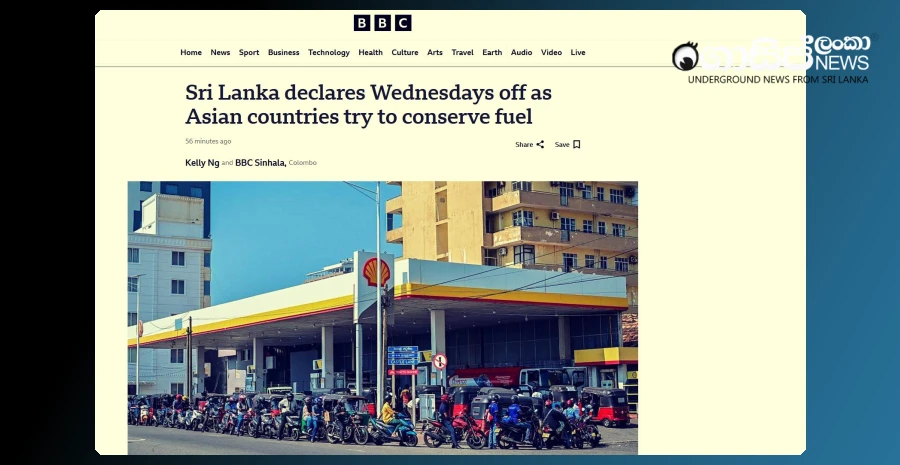
The BBC International website has detailed the recent changes made in Sri Lanka as a preparation for the oil crisis in an article. In addition to Sri Lanka, changes in Bangladesh, Thailand, Myanmar, and the Philippines were also revealed. That description is below.
Due to the current war situation between the United States, Israel, and Iran, Sri Lanka has declared every Wednesday a government holiday as a precautionary measure to successfully face a potential future fuel crisis. Due to these conflicts, which began late last month, the price of a barrel of crude oil in the world market is currently at a high of around $100. In an emergency discussion held on Monday with senior officials, President Anura Kumara Dissanayake stated that "we must prepare for the worst, but hope for the best."Authorities state that this introduced four-day work week applies to government schools and universities, but will not hinder the operations of essential service providers such as health and immigration. Wednesday has been chosen as the additional holiday instead of Friday to prevent government offices from being closed for three consecutive days. Concurrently, the National Fuel Pass, introduced during the severe economic crisis in 2022 when the country's foreign reserves depleted, has been reactivated. Under this system, a limited fuel quota of 15 liters for private cars and 5 liters for motorcycles is issued. However, many Sri Lankans have expressed their dissatisfaction, stating that this quota is insufficient.
This war situation has severely disrupted supplies through the Strait of Hormuz, where millions of barrels of oil are transported from the Gulf region to Asia. Last year alone, the amount of crude oil and gas transported through this strait to Asia, the world's largest oil importing region, accounted for about 90% of the total supply. For this reason, other Asian countries are also adopting various strategies to conserve energy. Accordingly, Bangladesh has introduced planned power cuts and has taken steps to provide Ramadan holidays for universities in advance. The Thai government is urging people to wear short-sleeved clothing to minimize air conditioning use, while Myanmar has restricted private vehicle usage to alternate days based on vehicle registration numbers.
Looking at other countries, in the Philippines, employees in some government agencies are required to work from home one day a week, and President Ferdinand Marcos Jr. has banned non-essential travel in the public sector. Additionally, he announced a cash subsidy of between 3,000 and 5,000 pesos (US$50-84) for tricycle drivers, farmers, and fishermen affected by rising fuel prices. Meanwhile, the Vietnamese government strongly urges its citizens to spend more time at home to conserve fuel, as well as to cycle, carpool, use public transport, and limit the use of private vehicles for non-essential purposes.