![Gossip Lanka News [English]](https://blogger.googleusercontent.com/img/a/AVvXsEhYm2aFFq-bIW1nWX-RrqnPFoIsVos6_VCVz8BpLt0QJi55GNXHXC2fugeRvL0qUStEuCfs7Sfu6ZiSlhrkldxfGuE_wzy5gitY6rMZ2KSi8VBbGvkgXLks37RwZV-4-HKbWiNLRxB8C_r1e4z3mpxFTMPDJPEADoG8E-bZteWFipeD5KNGbjvCfqEfKw=s300 "Gossip Lanka News [English]")
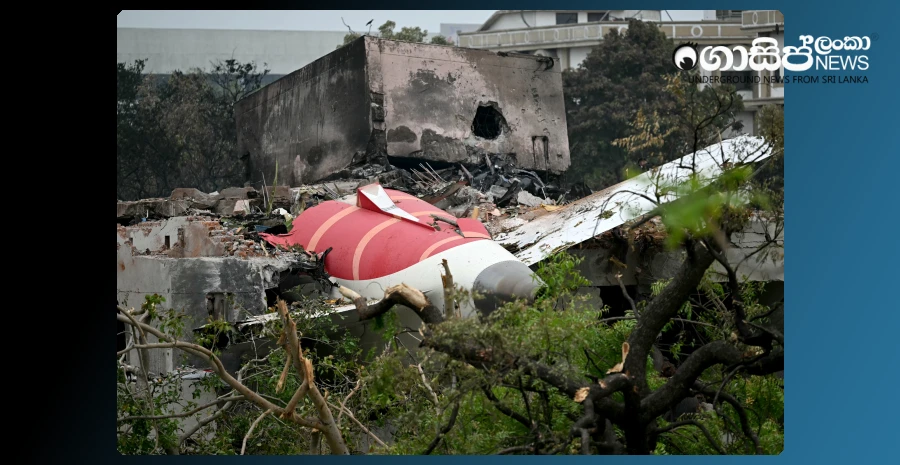
The process of paying final compensation to the families of those who died in the crash of an Air India Boeing 787-8 aircraft, which took off from Ahmedabad, India, bound for London on June 12, 2025, and crashed within seconds of takeoff, has now begun. However, the PTI news agency and the British newspaper 'The Independent' have reported that the airline has imposed a strict condition on the affected families for the payment of this compensation.
According to that condition, families receiving the final compensation must agree not to take legal action against Air India, the aircraft manufacturer, or government agencies in any country or court in the future.After reaching the agreement, family members will have to sign a legal form called 'Discharge and Indemnity,' and the airline has proposed to provide up to 2.5 million rupees as final compensation. This amount may vary depending on legal provisions and the families' circumstances, and if the compensation amount is determined to be less than 2.5 million rupees, the company has also decided to provide an additional 1 million or 2 million rupees. Furthermore, it is reported that each family will separately receive a consolation allowance of 10 million rupees through the AI-171 Memorial and Welfare Trust. An Air India spokesperson stated that the company is committed to providing legally fair final compensation to each family after the initial interim payment.
However, the legal team representing 130 victim families has strongly objected to Air India's conditional proposal. They point out that it is unfair to force them to waive their right to sue when investigations into the accident have not yet concluded and responsibility has not been determined. Furthermore, the legal team has emphasized that medical treatments for some individuals injured in this accident are still ongoing.
Meanwhile, India's Aircraft Accident Investigation Bureau (AAIB) has stated that investigations into the Ahmedabad air accident are still ongoing. The AAIB has confirmed that the report published by Italy's 'Corriere della Sera' newspaper, citing unknown sources, claiming the accident was not due to a technical fault but rather the pilot deliberately disconnecting the fuel supply, is completely false. As no final conclusions have been reached yet, they have requested the media to refrain from premature conclusions. On the other hand, the Flight Safety Foundation (FAS) in the United States speculates that the accident may have occurred due to a breakdown in the aircraft's electrical system, causing systems to fail one by one.
The Indian Supreme Court has also intervened in this tragedy, ordering the central government on February 11 to submit a report on the investigation process within 3 weeks. Lawyer Prashant Bhushan, representing the NGO Safety Matters, argued before the Supreme Court that all 5 members of the AAIB investigation committee were appointed by the Directorate General of Civil Aviation (DGCA) and that over 8,000 pilots consider Boeing 787 aircraft unsafe, thus flights should be halted. He therefore pointed out that a separate Court of Inquiry is needed for this accident. In response, Solicitor General Tushar Mehta, representing the central government and the DGCA, stated that the only way the lawyer would be satisfied is if a committee was appointed under his own initiative. However, the bench led by Chief Justice Suryakant has stated that a decision cannot be made until the results of the AAIB investigation are received.
According to Flightradar24 data and India's civil aviation regulator, DGCA, the ill-fated AI 171 aircraft took off from runway 23 at 1:39 PM on June 12, and after reaching a maximum altitude of 190 meters (625 feet), the pilot issued a Mayday call to air traffic control. Before a response could be received, the rear section of the aircraft crashed into a medical dormitory building in a residential area. 242 people were on board the aircraft, including the chief pilot with 8,200 hours of flight experience, the co-pilot with 1,100 hours of experience, and 10 crew members. This tragedy resulted in the deaths of 270 people, including 60 foreign nationals, as well as 241 passengers and crew members who were on board the aircraft. Only one passenger on board the aircraft survived the accident.