![Gossip Lanka News [English]](https://blogger.googleusercontent.com/img/a/AVvXsEhYm2aFFq-bIW1nWX-RrqnPFoIsVos6_VCVz8BpLt0QJi55GNXHXC2fugeRvL0qUStEuCfs7Sfu6ZiSlhrkldxfGuE_wzy5gitY6rMZ2KSi8VBbGvkgXLks37RwZV-4-HKbWiNLRxB8C_r1e4z3mpxFTMPDJPEADoG8E-bZteWFipeD5KNGbjvCfqEfKw=s300 "Gossip Lanka News [English]")
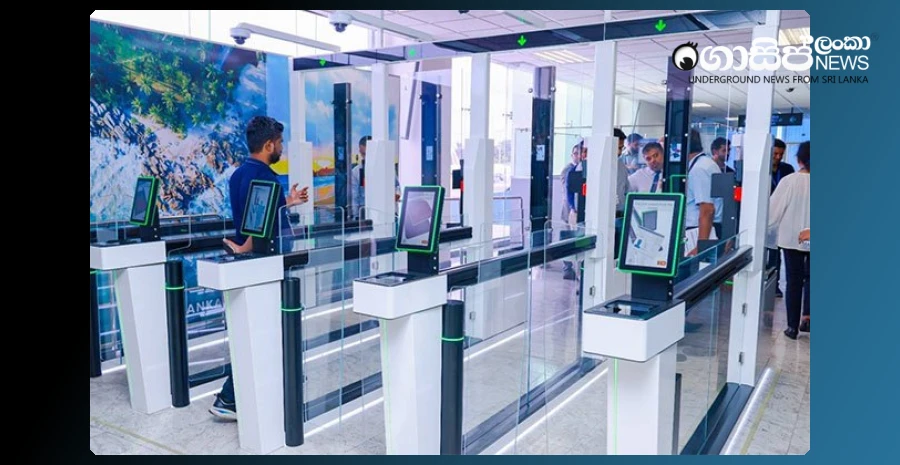
It is reported that passengers arriving from abroad are facing severe inconvenience due to the malfunction of the newly installed automated border control, or e-gate, system at Katunayake Bandaranaike International Airport, which was set up for passenger convenience. Since its official introduction on the 28th, the system has failed to properly scan passports, leading to a somewhat chaotic situation in the airport's arrival terminal, and accusations have been made that this is causing passengers to waste unnecessary time.
The primary objective of this system, built under the USD 84 million financial allocation provided by the Japanese government, was to read passport data using technology without the intervention of an immigration officer. However, due to the system not delivering the expected efficiency, airport authorities have had to deploy additional officers to minimize passenger delays and assist passengers.
Explaining the technical glitch, the Department of Immigration and Emigration points out that the main reason for this is the incomplete data in the Advanced Passenger Information (API) system. According to Mr. Jude Fernando, President of the Immigration and Emigration Officers' Association, the failure of relevant airlines to provide passenger data on time has hindered the e-gate system's ability to automatically identify passengers.
Despite these obstacles, approximately twenty thousand passenger passports have so far been successfully scanned through this new system, and passengers have had to proceed to regular counters when the system is not operational. Officials point out that even in countries like Austria and Belgium, it took about two years for such systems to achieve 100% success, and they emphasize that efforts are underway to overcome existing issues and provide an efficient service.
Furthermore, the Immigration and Emigration Officers' Association has clarified allegations that Sri Lankan passports cannot be read by e-gate machines at foreign airports. Mr. Jude Fernando further stated that while the current local passport is machine-readable, it is not an e-passport type, and therefore may not be scannable by foreign e-gate systems. He also added that no official complaints regarding this have been received from foreign airports.