![Gossip Lanka News [English]](https://blogger.googleusercontent.com/img/a/AVvXsEhYm2aFFq-bIW1nWX-RrqnPFoIsVos6_VCVz8BpLt0QJi55GNXHXC2fugeRvL0qUStEuCfs7Sfu6ZiSlhrkldxfGuE_wzy5gitY6rMZ2KSi8VBbGvkgXLks37RwZV-4-HKbWiNLRxB8C_r1e4z3mpxFTMPDJPEADoG8E-bZteWFipeD5KNGbjvCfqEfKw=s300 "Gossip Lanka News [English]")
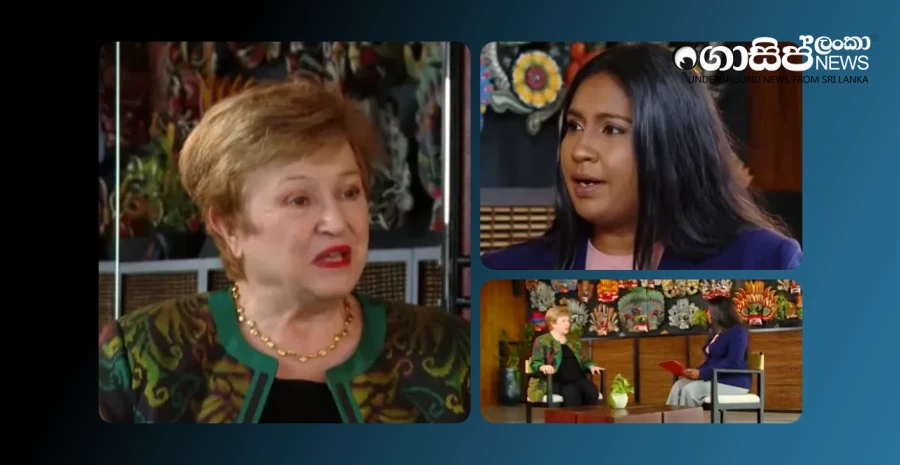
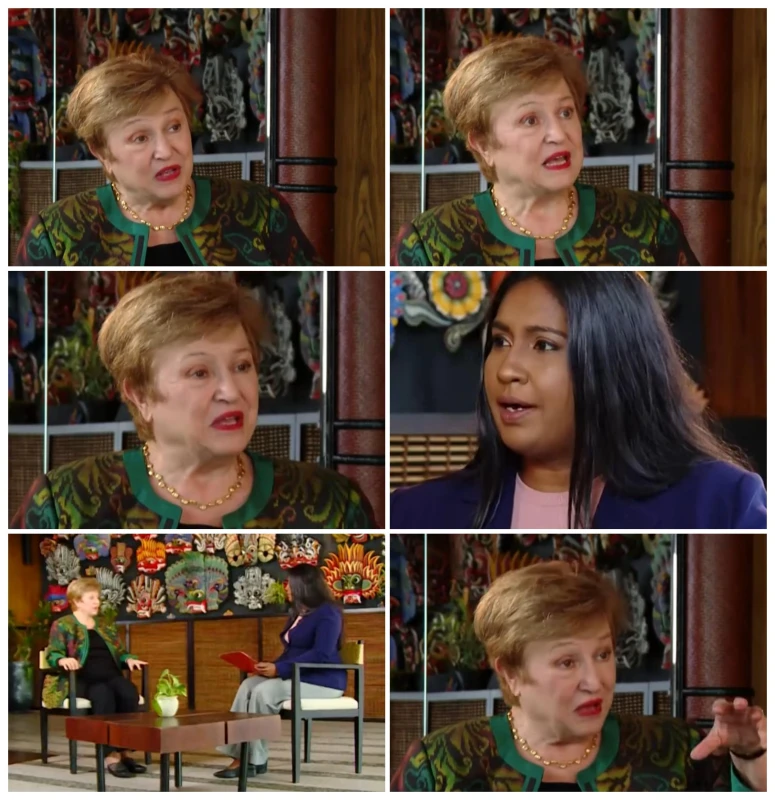
International Monetary Fund (IMF) Managing Director Dr. Kristalina Georgieva is currently in Sri Lanka for her first official visit. After severe blows to the economy due to climatic conditions such as the 'Ditwa' cyclone, Sri Lanka is at a critical juncture in its path to economic recovery, while continuing the IMF-supported reform program. Below is the interview conducted by Derana channel with her regarding the progress made and the risks ahead.
Interviewer: Dr. Georgieva, this is your first visit to Sri Lanka. I want to know what this means for you and for us in Sri Lanka, both symbolically and practically, when it comes to the journey of our economic recovery. Also, what do you highlight as the most important and significant achievements we have made since the IMF program began?
Dr. Georgieva: I am truly delighted to be here, as the country has made tremendous progress from a time when the economy was on the verge of collapse. I extend my congratulations to the government and people of Sri Lanka for the progress you have achieved.
But I am also glad to be here to express our solidarity after the cyclone that devastated certain parts of the country. This has been an opportunity for me to witness the strength of the Sri Lankan people, the resilience you demonstrate, and the unity you have very clearly achieved during this immensely challenging time the country has faced.
Interviewer: I understand that you visited the areas affected by Cyclone 'Ditwa' and met the people there. It seems that this difficult situation Sri Lanka is going through brings a personal closeness to you as well.
Dr. Georgieva: I had the opportunity to meet the community affected by Cyclone Ditwa. I saw how the people remain strong, even though the horror of the disaster is still etched in their hearts. I have previously served as a Humanitarian Commissioner. I have been to many places devastated by natural disasters and conflicts. So, what I can tell you is that you have wonderful people. Even in an extremely painful moment, they come together and think about the future.
I was also very impressed by how quickly and decisively the government took action for this. As the IMF, we were able to provide emergency financial assistance. Over 200 million dollars were received very timely. So these people do not have to bear the pain of their disaster alone.
Let me tell you something else. When I look at the faces of those children, my heart fills with hope for the country. Because I see in them the true nature of Sri Lanka, which is warm and generous. Even though the community has gone through such difficulties, your time and your welcome are very generous.
Interviewer: I believe that in the 10 years since the end of the war, Sri Lanka's economy has been hit by severe shocks, be they financial, external, political, or climatic. As you mentioned, you met the President of Sri Lanka recently, this morning. During this very short visit, you also made time to meet the people affected by the storm. As Sri Lanka continues to be resilient in the face of these shocks, what is your message when meeting political leaders and authorities?
Dr. Georgieva: Indeed, Sri Lanka has faced many challenges over the past decade. It went through a civil war, suffered a terrorist attack, the pandemic affected you, the country was hit by the 2004 tsunami. And then there was social unrest due to the feeling that the government was failing to meet the aspirations of the people.
Now we have a great opportunity for the country. I think for the first time, there is a government that has earned the trust of the people, and they are doing their part to maintain that trust. Based on our experience, I want to say a few things. First, in a short period, Sri Lanka regained macroeconomic and financial stability. Inflation was at 70%. Now it has decreased to 2%. Economic growth was negative. Now we have economic growth of about 5%.
Another very important point is that the government believes there must be trust in public service. That means corruption must be eliminated. Sri Lanka is the first country in Asia that asked us to conduct a governance assessment so that we can help in this fight against corruption. And I saw that the President and members of the government have a genuine interest in the well-being of the people. I know that when a country is united, it achieves success. This government is making great efforts to achieve that.
Interviewer: That takes us back to the time when Sri Lanka decided to agree to an IMF-supported program. That decision in Sri Lanka was controversial at the time, with public protests and some controversial political opposition. But looking at it from where you speak today, in times of acute crisis, countries like ours (emerging markets) have limited choices. Given the significant recovery Sri Lanka has achieved, as you described today, and based on your experience, how do you view that decision?
Dr. Georgieva: The IMF has changed over the past few decades. We are no longer that old traditional IMF. In our programs, we place a great deal of emphasis on people. In fact, when a country goes through a program, we ask governments to set a floor for social spending so that education, healthcare, and social protection are not disrupted. We currently have 50 programs. Five, zero. Why so many? Because we live in a rapidly changing world. It is a world more prone to shocks, and many countries have needed the financial assistance of the IMF.
Think of it as your right. Your right to not be isolated in a difficult moment, to receive a helping hand, and to gain the expertise of IMF staff to help turn the country onto a better path. We have 191 member countries. We learn from each of them, and we share these experiences with others. We are like a conduit that transmits best practices from one country to another.
I am European. So I will tell you this, Portugal, Ireland, and Greece, which have the best economic performance in Europe today, all implemented IMF programs recently. So I say to the people of Sri Lanka, we are your friend, we come to serve you. But yes, we ask for attention to the problems that need to be solved.
Number one, fiscal strength. Just as a family should not spend more than it earns, a country should not spend more than it earns. Secondly, having an independent central bank that can make decisions on price stability so that people are not burdened by inflation, especially the poor. Thirdly, thinking about an economic growth strategy. Exploring how we can open up space for the private sector to develop in a way that generates jobs for the youth of Sri Lanka.
Interviewer: You have consistently described uncertainty as the "new normal." And we talk about risks from the global economy, financial tightening, and capital flows. So what is the role of the IMF for small countries like Sri Lanka in navigating this difficult and uncertain period? And how can small nations expect IMF support?
Dr. Georgieva: Geopolitical factors play a much larger role today than they did some time ago. Trade policy is changing, technology is transforming how we live and work. In addition, there is climate change. All of this combined creates an unusually high and persistent uncertainty.
As the IMF, what we do is gather information from all countries and create a clear picture of where the world is today and where it is heading. In uncertain times, we provide more confidence to each of our members. Together, we can define what the way forward is that will be beneficial for the people of the country. Sri Lanka is wonderful. This is a beautiful country, and its people are very warm and kind. We want to see you have a very good future, and we are ready to put all our knowledge at your service.
Interviewer: In the face of the risks and frequent shocks we discussed earlier, what kind of safety buffers do you recommend governments should have to protect their economies and people, and maintain resilience?
Dr. Georgieva: Our recommendation is, first, to maintain good foreign exchange reserves. In fact, we are working with Sri Lanka to increase that reserve level. Secondly, build fiscal buffers by maintaining a strong fiscal policy. Then, when a shock occurs, you can protect your people and businesses. Thirdly, have a growth strategy that relies more on the creativity and adaptability of the private sector. Because in times of rapid change, it is more difficult for governments to identify real economic opportunities, and businesses can adapt to changes faster.
Interviewer: We talked about small economies, but when we see geopolitical tensions and climate shocks, I want to emphasize again and ask you about the impact on these small economies. So, what are the recurring risks?
Dr. Georgieva: Small open economies are expected to be affected by changes made by other countries. My message is "first put your house in order." It is up to you to keep your house in order. While you cannot influence what others do, you can influence your own destiny. And we strongly recommend that small economies unite with like-minded ones. We promote regional integration more. In fact, here in South Asia, there is room for countries to trade more with each other to build economic cooperation that can help them in this world with more significant changes.
When we look around, we see reflections from many regions that global cooperation may be more difficult now. So let's mitigate that by deepening our regional cooperation. We see it in the Gulf Cooperation Council (GCC), and in ASEAN, your neighbors here in Southeast Asia. We certainly would like to see more of that here too.
Interviewer: That brings us to the debt issue. Debt has been a major problem for Sri Lanka's economy. The IMF stepped forward to assist Sri Lanka in debt restructuring. But when we talk about debt, what policy advice can you give not only to Sri Lanka but to economies that find themselves in such a situation?
Dr. Georgieva: The best thing to do to avoid dealing with debt is not to build up debt in the first place. So we work very closely with our members to establish strong debt management policies and offices to prevent debt accumulation. If it has already happened, act decisively and quickly. Sri Lanka has taken steps to restructure its debt, and it is rightly, largely completed by now. Our advice as you move forward is to be vigilant. Do not allow debt to accumulate again.
Interviewer: As Sri Lankans enduring difficult changes, we are wondering when relief will finally come and when the kind of economic prosperity everyone hopes for will reach the grassroots level of our society. So Madam, what message would you like to give to the people of Sri Lanka?
Dr. Georgieva: Stay together and cherish your unity. Become stronger and make the most of the unique qualities the country possesses. This is a country full of hospitality, very suitable for tourism. Tourism is also an important sector for Europe. It is a country full of entrepreneurship, so new businesses and new ideas can be implemented. This is a country where people facing difficulties can rely on each other. You also have a trustworthy government now. Work together for a better future.
Interviewer: I trust that next time you visit, you will have some time to travel around Sri Lanka. There is so much to see in Sri Lanka.
Dr. Georgieva: Yes, I know there is a lot to see. I have a plan for a personal visit. I will bring my grandchildren here so they can enjoy the beauty of Sri Lanka and the hospitality of the Sri Lankan people.
Interviewer: Thank you very much. We look forward to welcoming you back to Sri Lanka. Thank you again for your time.
Dr. Georgieva: Thank you.