![Gossip Lanka News [English]](https://blogger.googleusercontent.com/img/a/AVvXsEhYm2aFFq-bIW1nWX-RrqnPFoIsVos6_VCVz8BpLt0QJi55GNXHXC2fugeRvL0qUStEuCfs7Sfu6ZiSlhrkldxfGuE_wzy5gitY6rMZ2KSi8VBbGvkgXLks37RwZV-4-HKbWiNLRxB8C_r1e4z3mpxFTMPDJPEADoG8E-bZteWFipeD5KNGbjvCfqEfKw=s300 "Gossip Lanka News [English]")
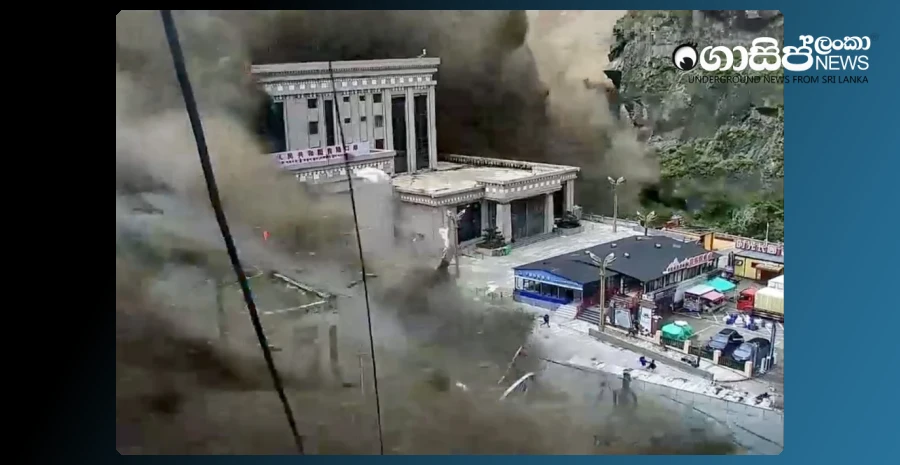
On August 26, 2026, at approximately 10:30 AM, a massive landslide and snow avalanche originating from the Nepal border struck the Gyirong Port area in Shigatse, China, causing an extremely destructive disaster at the China-Nepal border crossing. This high-speed flow of earth completely disrupted roads, electricity, and communication links in the region. By August 27, search operations for hundreds of missing people had intensified, involving helicopters, drones, firefighters, units of the Chinese People's Liberation Army, and engineering teams.
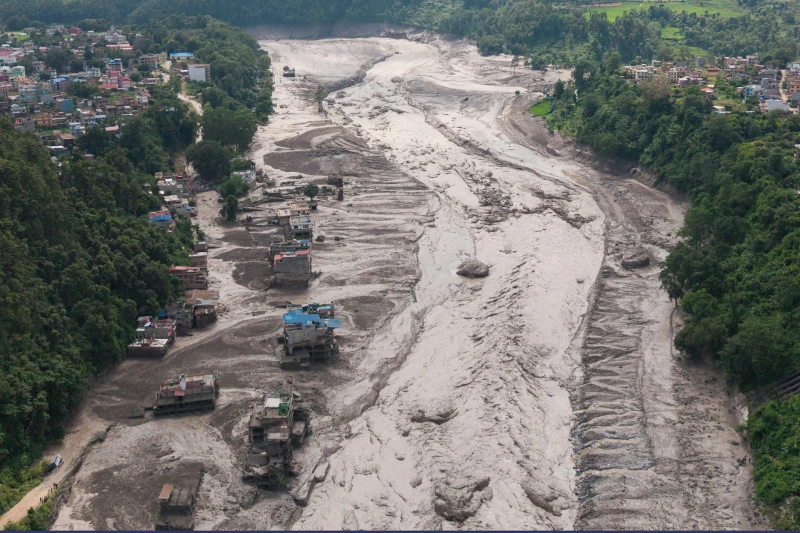
This cross-border incident began with the collapse of a high-altitude glacier located in Nepal. The resulting flow of mud and debris first impacted the Chinese border port, then flowed downwards along Nepal's Trishuli and Bhote Koshi valleys, destroying numerous villages, bridges, and hydropower plants.
The source area was located at an altitude of between 5,200 and 5,500 meters above sea level. The debris flowed approximately 20 kilometers towards Gyirong Port, situated at an altitude of 1,830 meters, at a speed of 50 meters per second, in a short span of about seven minutes. According to security camera footage, within seconds, testing buildings and parking lots were covered by a mud layer more than 1.5 meters thick, and the disaster zone spans an area between 15 and 20 square kilometers.
According to data received by August 27, 3 deaths have been confirmed on the Chinese side, and 558 people are missing, including 260 foreigners. 499 villagers and construction workers have been relocated to safe areas, and 555 tourists from Gyirong town have been successfully evacuated. On the Nepali side, along the Trishuli Corridor, the death toll has risen to between 350 and 390, and over 900 people, including Indian and American pilgrims on Kailash pilgrimage, are missing. Thus, the total number of dead or missing has risen to 1851.
Chinese geologists such as Guo Zhaocheng from the Ministry of Natural Resources and Xu Chuang from Chengdu University of Technology indicate that the landslide was intensified by the significant scouring of soil and glacial sediments on the path when a part of the glacier collapsed. The location of Gyirong Port in a narrow Himalayan valley, which became a major international trade and pilgrimage route after the 2015 earthquake, also contributed to the extent of the destruction. A flood situation was also reported here in 2025.
Under the instructions of Chinese President Xi Jinping, 220 million Yuan has been allocated for emergency relief and rehabilitation, and Premier Li Qiang has also visited the area for inspection. The Chinese Ministry of Emergency Management, fire brigades, Y-20 transport aircraft and Mi-171 helicopters of the People's Liberation Army, Wing Loong drones, and Chinese Anneng engineering teams are engaged in operations, equipped with 3D scanner devices.
Due to the disaster, the river has been blocked, creating an artificial barrier lake of approximately 2 million cubic meters of water, and there is a risk of its capacity further increasing if rain continues in the coming days. 800 meters of the G216 access road, which was covered by debris, has now been cleared. However, continuous rain and the large amount of debris have made search operations extremely difficult.