![Gossip Lanka News [English]](https://blogger.googleusercontent.com/img/a/AVvXsEhYm2aFFq-bIW1nWX-RrqnPFoIsVos6_VCVz8BpLt0QJi55GNXHXC2fugeRvL0qUStEuCfs7Sfu6ZiSlhrkldxfGuE_wzy5gitY6rMZ2KSi8VBbGvkgXLks37RwZV-4-HKbWiNLRxB8C_r1e4z3mpxFTMPDJPEADoG8E-bZteWFipeD5KNGbjvCfqEfKw=s300 "Gossip Lanka News [English]")
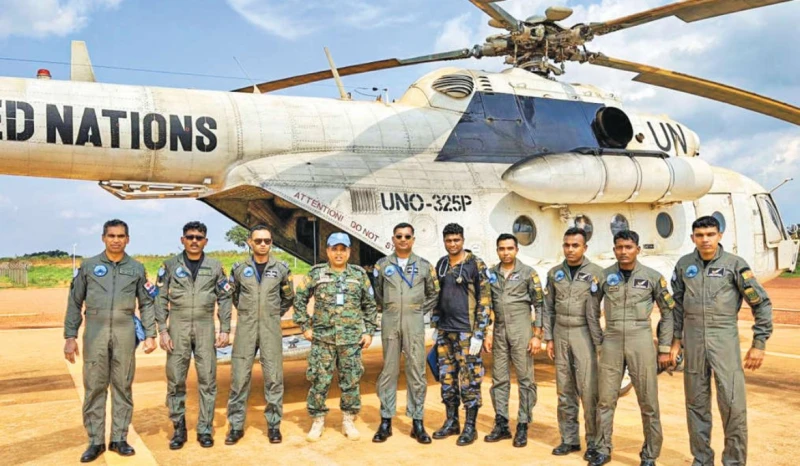
The Sri Lanka Air Force (SLAF) contingent engaged in peacekeeping duties in the Central African Republic has successfully saved the lives of 14 individuals, including peacekeepers, amidst fierce enemy attacks, disregarding their own lives. Sri Lanka Air Force Media Spokesperson Group Captain Nalin Wewakumbura states that this incident will be recorded in history books as the first instance in the United Nations' peacekeeping aviation history where such a large number of injured persons were rescued simultaneously during an emergency operation.
The unparalleled heroism displayed by the Sri Lankan troops has received the highest commendation from the United Nations Peacekeeping Force Commander, further enhancing the international credibility and reputation of the Sri Lankan Armed Forces.This extraordinary incident originated from a fierce attack launched by an unidentified armed group targeting Zambian peacekeeping battalion soldiers who were on patrol in the 'Am Dafok' region of the Central African Republic. In this horrific attack that occurred on the 30th, Zambian soldiers, local civilians, and members of the country's security forces were among those seriously injured.
As the situation became extremely critical, an attempt was initially made to call in a Pakistan Air Force helicopter to rescue the injured. However, due to prevailing adverse weather conditions, the Pakistani contingent either declined the challenging mission or it proved unsuccessful. Consequently, the Force Commander immediately assigned the responsibility for this critical life-saving mission to the Sri Lanka Air Force unit.
Fully understanding the severe risks and adverse weather conditions, the Sri Lankan contingent's commanding officer, Group Captain Asiri Pathirage, and his crew prepared for the mission without hesitation. Accordingly, the Sri Lanka Air Force Mi-17 helicopter, bearing the call sign UNO 325P, commanded by Group Captain Asiri Pathirage and co-piloted by Flight Lieutenant Dilhash Athapaththu, took off from Bria Airport at 07:30 AM that day.
This courageous crew included Flight Sergeant Hettiarachchi as the Flight Engineer, Flight Sergeant Manoj as the Load Master, and Corporal Wijetunga and Leading Aircraftman Abeysinghe as the Air Gunners. The Aeromedical Evacuation Team (AMET) on board the aircraft comprised Flight Lieutenant Yadeesha Ratnasiri, Warrant Officer Sumathipala, and Flight Sergeant Ruwankumara. Although initially planned to carry additional troops, the pilots decided to fly directly to the battle zone as per the Force Commander's orders, due to the rapidly deteriorating situation in the combat area.
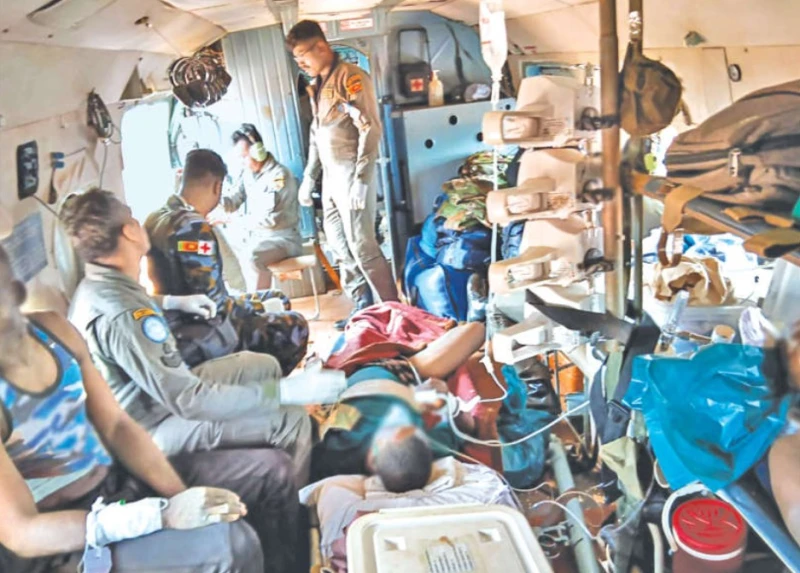
After two hours and ten minutes of continuous and arduous flight, the aircraft reached the extremely dangerous combat zone where enemy attacks were ongoing. Even landing the helicopter was highly unsafe, and the exact location of enemy fire remained uncertain. However, the Sri Lankan pilots, putting their lives at risk, managed to load all 14 injured persons onto the aircraft in a very short time, with engines running, and immediately flew out of the area. Throughout the flight, the Sri Lankan aeromedical team on board, despite limited space and medical facilities, fought a difficult battle to stabilize the lives of the injured, thus excellently accomplishing this humanitarian mission.