![Gossip Lanka News [English]](https://blogger.googleusercontent.com/img/a/AVvXsEhYm2aFFq-bIW1nWX-RrqnPFoIsVos6_VCVz8BpLt0QJi55GNXHXC2fugeRvL0qUStEuCfs7Sfu6ZiSlhrkldxfGuE_wzy5gitY6rMZ2KSi8VBbGvkgXLks37RwZV-4-HKbWiNLRxB8C_r1e4z3mpxFTMPDJPEADoG8E-bZteWFipeD5KNGbjvCfqEfKw=s300 "Gossip Lanka News [English]")
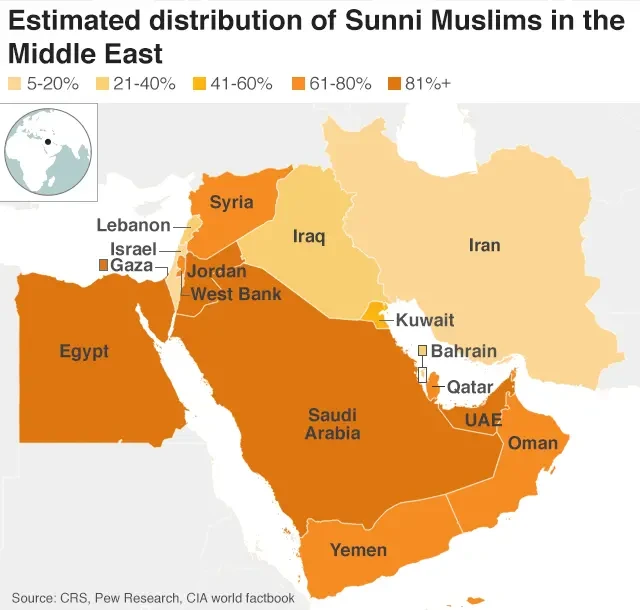
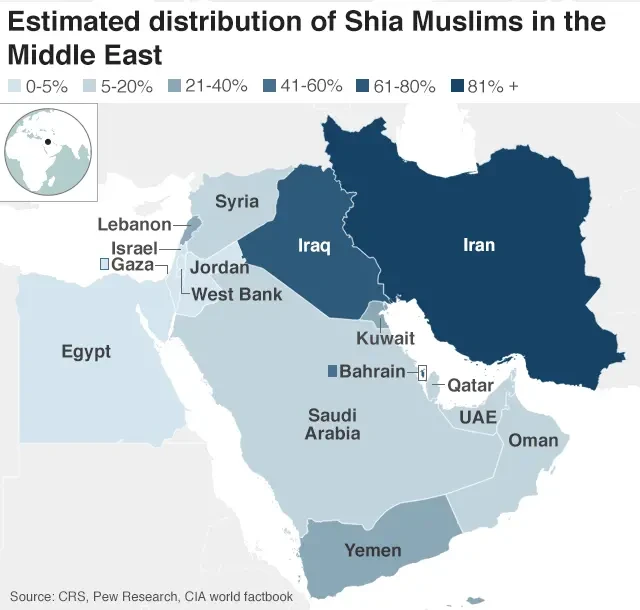
Between 85% and 90% of the global Muslim population follows Sunni Islam, while 10% to 15% follow Shia Islam. In Iran, which has a Shia majority, between 85% and 90% of the Muslim population belongs to Twelver, or Ithna Ashari Shia Islam, which is the country's official religious branch.
Its Sunni Muslim minority accounts for 7% to 10% and is mainly concentrated among Kurdish, Baloch, Turkmen, and some Arab communities. Globally, a small percentage of communities in Oman and North Africa follow Ibadi Islam, while many in Africa, Central Asia, and the Balkans identify simply as general Muslims, not belonging to any specific sect.Several other countries with similar religious backgrounds to Iran are located in the Middle East and surrounding regions. Between 65% and 75% of Azerbaijan's Muslim population, 60% and 70% of Iraq's, and 60% and 70% of Bahrain's are Shia Muslims. Additionally, 45% to 55% of Lebanon's total population, 35% to 40% of Yemen's population (primarily Zaidi Shia), 15% to 20% of Syria's population, and 20% to 25% of Kuwait's population consist of Shia or related communities. Countries like Saudi Arabia, Pakistan, Turkey, and Egypt are Sunni-majority states, but they also host significant Shia minorities.
Although this religious division has profoundly impacted the region's political and security relations, it is not merely a religious matter but a geopolitical power struggle. The pro-Iranian camp, known as the "Axis of Resistance," includes Iraq's Shia-majority government, Syria's Assad regime, Lebanon's Hezbollah, and Yemen's Houthi organization. Conversely, Saudi Arabia, the region's main Sunni state, leads the pro-American camp and considers Iran its primary regional rival. The United Arab Emirates, Bahrain, Egypt, and Jordan also represent this Saudi-American-aligned bloc. However, countries like China, Russia, and India maintain economic and diplomatic relations with both sides, not based on this Sunni-Shia divide.
The conflict between Iran and Saudi Arabia is often described as a "cold war," and while it has a religious dimension, its primary objective is to establish dominance in the Middle East. These two countries exert their influence against each other through proxy wars in Syria, Yemen, Iraq, and Lebanon. Historical events such as the 1979 Iranian Islamic Revolution and the Iran-Iraq War in the 1980s have further intensified this regional power struggle. Furthermore, dominance in the global oil market and relations with Western countries are significant factors contributing to the political rivalry between these two states.
The latest escalation of this regional crisis can be seen in the joint Israeli-American military attacks that began on February 28, 2026, and continued until March 1. These attacks reportedly killed high-ranking leaders, including Iran's Supreme Leader Ayatollah Ali Khamenei, and targeted Iran's nuclear and missile facilities. In response, Iran launched missile and drone attacks on Israeli settlements as well as Gulf countries such as Bahrain, Kuwait, Qatar, Jordan, the United Arab Emirates, and Saudi Arabia, where American military bases are located. According to reports, this is not a religious war based on the 1400-year-old Sunni-Shia divide, but a massive geopolitical military situation between Iran and the American-Israeli alliance. It has been confirmed that Israel did not launch any attacks on Saudi Arabia or the United Arab Emirates, and the attacks on those countries were merely retaliatory strikes by Iran targeting American military bases.
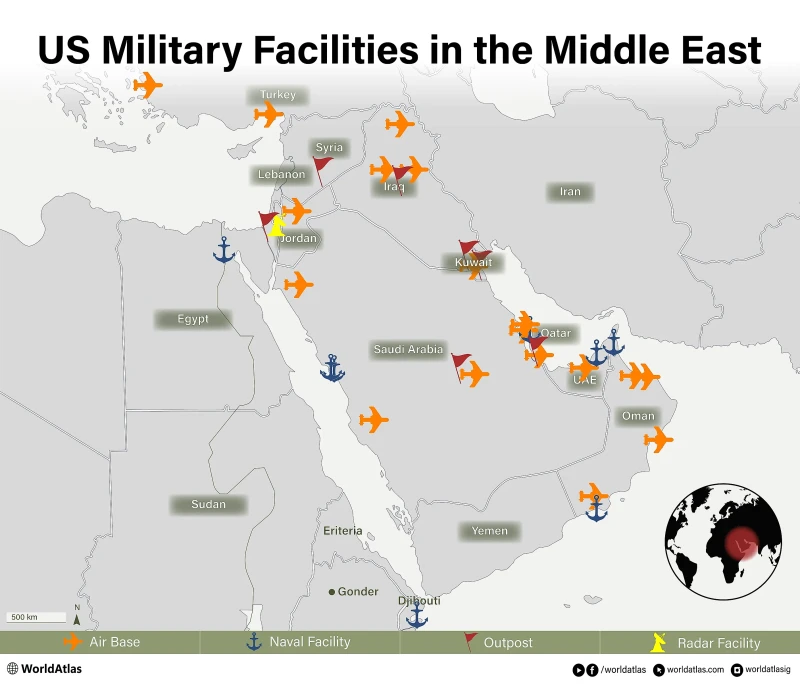
The United States maintains an extensive and complex network of military bases in the Mediterranean region, particularly centered in the Persian Gulf Arab countries and surrounding states. Thousands of troops, fighter jets, unmanned aerial vehicles, and naval forces are stationed across the region, with these military centers serving as key facilities providing necessary support. According to analysts, there are between 16 and 19 American military presences in the Mediterranean region, with eight bases in Bahrain, Egypt, Iraq, Jordan, Kuwait, Qatar, Saudi Arabia, and the United Arab Emirates identified as major permanent locations.
Al Udeid Air Base in Qatar is considered the largest American base in the entire Mediterranean region and serves as the forward operating headquarters for U.S. Central Command (CENTCOM). Approximately over 10,000 troops are stationed here, coordinating numerous regional security operations. Meanwhile, Kuwait also plays a crucial role through key logistics and command centers like Camp Arifjan, as well as locations like Camp Buehring, which support operations in Iraq and Syria.
Regarding naval operations, the headquarters of the U.S. Fifth Fleet, based in Manama, Bahrain, holds particular significance. This headquarters oversees naval security and surveillance not only in the Persian Gulf but also in the Red Sea and parts of the Indian Ocean. Al-Dhafra Air Base, near Abu Dhabi in the United Arab Emirates, is another powerful center used for advanced fighter jets like the F-22 and for aerial surveillance.
In Iraq, the United States has continued to maintain airbases such as Ain Al Asad and Erbil to conduct counter-terrorism operations and advisory missions. In Jordan, airbases like Muwaffaq Salti in Azraq are used to provide logistics and air support. Additionally, numerous smaller bases supporting air power and special operations exist in Saudi Arabia and Syria, all collectively contributing to strengthening the American military presence in the region.