![Gossip Lanka News [English]](https://blogger.googleusercontent.com/img/a/AVvXsEhYm2aFFq-bIW1nWX-RrqnPFoIsVos6_VCVz8BpLt0QJi55GNXHXC2fugeRvL0qUStEuCfs7Sfu6ZiSlhrkldxfGuE_wzy5gitY6rMZ2KSi8VBbGvkgXLks37RwZV-4-HKbWiNLRxB8C_r1e4z3mpxFTMPDJPEADoG8E-bZteWFipeD5KNGbjvCfqEfKw=s300 "Gossip Lanka News [English]")
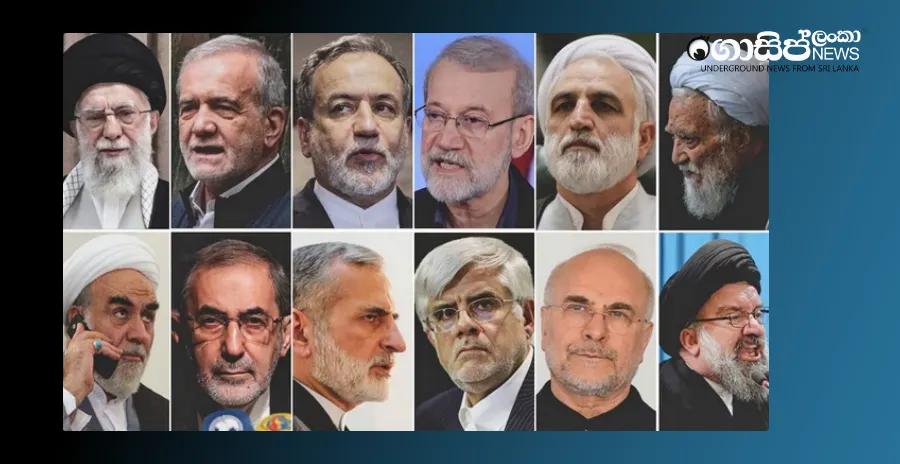
Last Saturday, a massive American and Israeli attack on Iran killed the country's 86-year-old Supreme Leader Ayatollah Ali Khamenei, as well as several high-ranking military officials including Defense Minister Aziz Nasirzadeh and Army Chief General Abdol Rahim Mousavi. US President Donald Trump has called on the Iranian people to rise up against the Islamic leadership that has ruled the country since 1979 and take their destiny into their own hands.
Ali Khamenei, who became Iran's Supreme Leader after the death of Ruhollah Khomeini in 1989, served as the head of the country's armed forces and the final arbiter of all policies and religious matters. With his demise, rumors are spreading that his second eldest son, Mojtaba Khamenei, a mid-level cleric with close ties to the Revolutionary Guard Corps, will be appointed as the next Supreme Leader to fill the void.Iran's political structure is an Islamic Republic composed of a mixture of elected and appointed institutions. The current head of government is President Masoud Pezeshkian, a reformist and former cardiac surgeon who took office on July 28, 2024, supported by First Vice President Mohammad Reza Aref. The president is elected for a four-year term, and if no candidate receives more than 50% of the votes in the first round, a second round of voting is held between the top two candidates. Foreign affairs are managed by Foreign Minister Abbas Araghchi, a key negotiator of the 2015 nuclear deal. The country's legislative process is carried out by the Islamic Consultative Assembly, or Parliament, which consists of 290 members, with conservative politician Mohammad Bagher Ghalibaf re-elected as its Speaker on May 27, 2025. The judicial system is led by hardline Chief Justice Gholam Hossein Mohseni Ejei. However, significant influence in state policy-making was exerted by Khamenei's close associates, such as advisors Ali Larijani (state policy), Ali Akbar Velayati (international affairs), Kamal Kharazi (foreign policy), and Chief of Staff Mohammad Golpayegani.
Iran's electoral and legislative processes are strictly controlled by a powerful mechanism called the Guardian Council. This 12-member council, comprising 6 clerics appointed by the Supreme Leader and 6 legal scholars approved by Parliament, has Ahmad Jannati as its secretary. It also includes hardliners like Tehran Friday Prayer Leader Ahmad Khatami. The council has the power to vet and approve the qualifications of all candidates running for presidential, parliamentary, local council, and Assembly of Experts elections, as well as to veto parliamentary bills that contradict Islamic law or the constitution. Due to the disqualification of many reformist candidates, Iranian elections are often criticized as not being fully free and fair, which also contributed to the very low voter turnout in the recent 2024 elections held after President Raisi's death.
Due to the demise of Ali Khamenei, the weighty responsibility of appointing a new Supreme Leader now falls to the Assembly of Experts, led by Mohammad-Ali Movahedi Kermani. This body, composed of 88 Islamic legal scholars, is similar to the Vatican's College of Cardinals. Although its members are directly elected by the people for an eight-year term, they must also undergo strict vetting by the Guardian Council before they can run. The operational and administrative affairs of all elections in the country are managed through the Ministry of Interior.
Iran operates a four-tiered administrative structure to ensure local governance, resource distribution, and central government representation. Its primary administrative units are 31 provinces (Ostān), each governed by a governor appointed by the Ministry of Interior. These provinces are divided into 429 to 484 counties (Shahrestān), centered around major cities and governed by local governors. These counties are further subdivided into over 1,000 districts (Bakhsh), which include urban and rural areas, and finally, these are divided into thousands of rural districts (Dehestān) and independent cities. Although high-level administrators are often appointed by the government, representatives for city and rural councils have been directly elected by the people every four years since 1999 to manage local affairs.