![Gossip Lanka News [English]](https://blogger.googleusercontent.com/img/a/AVvXsEhYm2aFFq-bIW1nWX-RrqnPFoIsVos6_VCVz8BpLt0QJi55GNXHXC2fugeRvL0qUStEuCfs7Sfu6ZiSlhrkldxfGuE_wzy5gitY6rMZ2KSi8VBbGvkgXLks37RwZV-4-HKbWiNLRxB8C_r1e4z3mpxFTMPDJPEADoG8E-bZteWFipeD5KNGbjvCfqEfKw=s300 "Gossip Lanka News [English]")
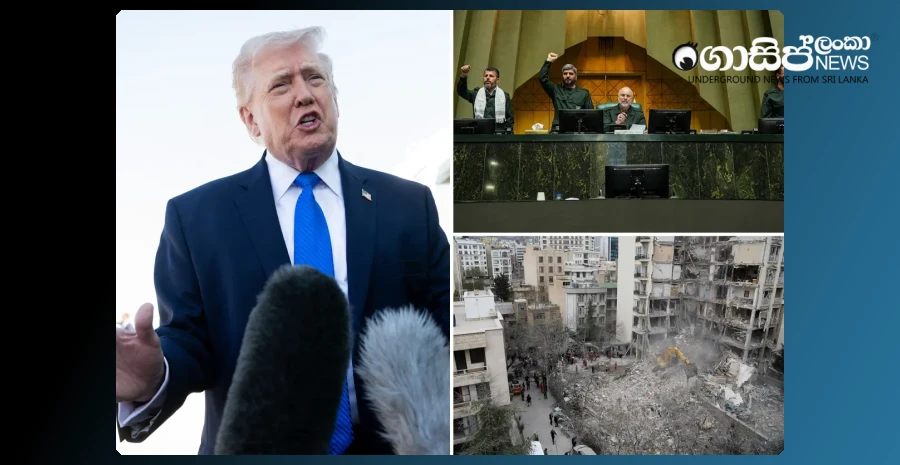
American and Israeli media report that the administration of US President Donald Trump has officially handed over a 15-point peace plan to Iran with the aim of ending the war currently ongoing for the fourth week in the Middle East region. This proposal has been sent to Iran through Pakistani intermediaries and includes a one-month ceasefire for discussions.
President Trump has expressed strong optimism about this peace effort, stating that Iran has already agreed to key issues such as abandoning its nuclear weapons program.This diplomatic step has been taken amidst the ongoing military operations named "Operation Epic Fury" jointly conducted by America and Israel against Iran. The conflict escalated with attacks targeting Iranian nuclear facilities in late February, and in response, Iran also launched missile attacks on Israel and Arab countries. Due to the deaths of several high-ranking officials, including Iranian Supreme Leader Ayatollah Ali Khamenei, in the attacks launched by Israel on the first day of the war, the Iranian leadership is facing a severe crisis. Additionally, global oil and gas prices have rapidly increased due to Iran's actions to block Western shipping traffic through the Strait of Hormuz.
The main intermediary in conveying this peace plan to Iran has been Pakistani Army Chief Field Marshal Syed Asim Munir, who maintains relations with Iran's Islamic Revolutionary Guard Corps (IRGC) as well as with President Trump. Pakistan's Prime Minister Shehbaz Sharif has publicly stated that Pakistan is ready to host meaningful and decisive discussions in Islamabad. The initial framework of this plan was prepared by the American President's special envoy Steve Witkoff and his son-in-law Jared Kushner, and Vice President J.D. Vance and Secretary of State Marco Rubio are also involved in these discussions.
14 out of the 15 points of the proposed plan have so far been revealed to the media. Its main conditions include the complete destruction of all existing nuclear capabilities in Iran, a complete ban on uranium enrichment, and the handover of the current stock of nearly 440 kilograms of highly enriched uranium to the International Atomic Energy Agency (IAEA). This also includes the destruction of the main nuclear facilities at Natanz, Isfahan, and Fordow, as well as granting full access to the International Atomic Energy Agency (IAEA) to all these sites without any hindrance. Furthermore, the plan proposes an immediate halt to the financing and arming of armed groups such as Hezbollah and the Houthis, keeping the Strait of Hormuz completely open as a free navigation zone, and severely restricting Iran's ballistic missile program for self-defense purposes only.
In exchange for agreeing to these conditions, it has been proposed to completely lift all international sanctions imposed on Iran and to provide American support for maintaining a civilian nuclear program. "They cannot keep certain things, it starts with not having nuclear weapons, and they have agreed to that. We are negotiating with the right people, and they desperately want to reach this agreement," President Trump stated, commenting on this matter.
However, Iran has publicly rejected such direct negotiations or agreements, stating that the media reports are false. However, they have hinted that they are open to reasonable proposals and have recently allowed several non-hostile oil tankers to pass through the Strait of Hormuz. Meanwhile, although Israel has been informed of this plan, some Israeli officials fear that a one-month ceasefire would give Iran an opportunity to reorganize. The American White House has emphasized that despite exploring avenues for discussion, there has been no change in the military operations launched against Iran.