![Gossip Lanka News [English]](https://blogger.googleusercontent.com/img/a/AVvXsEhYm2aFFq-bIW1nWX-RrqnPFoIsVos6_VCVz8BpLt0QJi55GNXHXC2fugeRvL0qUStEuCfs7Sfu6ZiSlhrkldxfGuE_wzy5gitY6rMZ2KSi8VBbGvkgXLks37RwZV-4-HKbWiNLRxB8C_r1e4z3mpxFTMPDJPEADoG8E-bZteWFipeD5KNGbjvCfqEfKw=s300 "Gossip Lanka News [English]")
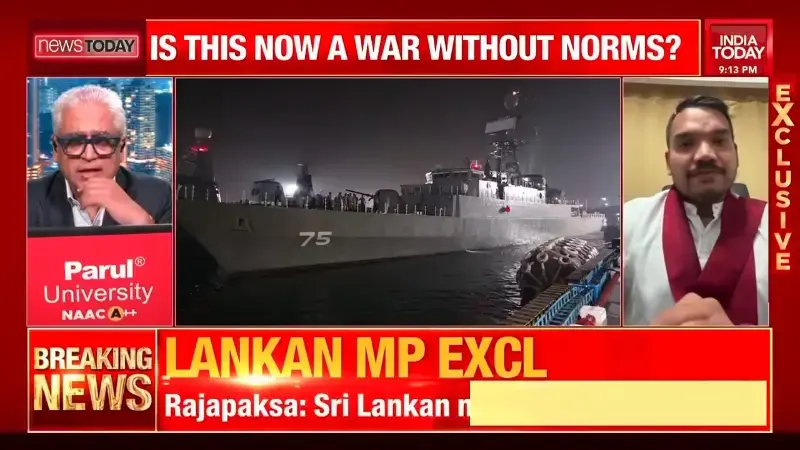
Former Member of Parliament Namal Rajapaksa's comments during a recent interview with an Indian media network have drawn strong criticism and ridicule from social media users. Many suspect whether his statements regarding an attack on a ship in international waters are an attempt to drag Sri Lanka into an unnecessary international crisis or a state of war.
Specifically, those commenting, citing examples of highly secretive operations carried out by powerful intelligence agencies and military groups worldwide, point out that identifying such complex technical attacks is practically difficult for a country like Sri Lanka.Accusations are being made that the former MP's statement claiming this incident occurred within Sri Lankan waters could be a threat to the country's sovereignty and security. Even as America and Iran have acknowledged this attack took place in international waters, many interpret such statements made with the narrow objective of gaining power as an act of treason. Critics say that by criticizing the country's government before foreign media without proper understanding of international maritime law or arguments, he has embarrassed the nation internationally.
The majority responding via social media point out that it is ridiculous for someone who entered parliament from the national list without a mandate to comment on such sensitive foreign policy matters, especially when there is a sitting president or responsible state officials. The former MP's handling of the English language and his style of expressing opinions have also been widely ridiculed, with some saying his attempt to portray himself as the opposition leader is comical. These criticisms make it clear that the public is closely watching such 'political shows' that attempt to betray the country's security for political survival.
Text of Namal's controversial discussion below
Joining me now is Mr. Namal Rajapaksa. He is a prominent face of the opposition in Sri Lanka, and he is joining me because he has expressed very strong views against what has happened here. Mr. Namal Rajapaksa, how do you see the sinking of an Iranian warship by an American submarine in the waters off the coast of Sri Lanka?
Well, I mean, it's not important whether it was an Iranian submarine or if America or another party sank it. What's important at this moment is the security of our region and the Indian Ocean. And I think, within this given time, what is happening in the Indian Ocean is something that nations around Sri Lanka, especially India and other nations, should seriously consider. Because as you know, the Gulf region is another part of the world. I meant, it has now reached our shores as well. Therefore, as a government, the Sri Lankan government, as well as Asian countries, should pay very serious attention to this.
Are you saying that the Sri Lankan government should discuss with the United States the fact that war has been brought to our shores, to our exclusive economic zone, without even an official declaration of war, a torpedo attack was launched on a ship within our maritime boundaries, and then, due to a distress call, Sri Lankans had to rescue several Iranians? If so, isn't it now a matter of your country's sovereignty as well as your territorial sovereignty?
Yes, absolutely. I mean, first of all, I acknowledge that we should appreciate the Sri Lanka Navy acting in accordance with the Merchant Shipping Act, deploying vessels to ensure the safety of people and providing any assistance the Sri Lanka Navy can offer. But at the same time, I think the Sri Lankan government must first answer the people of Sri Lanka whether they were aware of this operation or were kept in the dark, knowing nothing. I am confident they should do that. I am very confident they must definitely discuss this topic with the United States authorities. If they (America) had some understanding, they should declare it in Parliament and ensure the public of Sri Lanka is informed about such an agreement that the Sri Lankan government has entered into. Therefore, the Sri Lankan government must answer the first question: what is the government's position, and were they aware of this or not?
What is your information? When you talk to government officials, was the Sri Lankan government aware of this or not?
Well, I mean, look, because initially the Sri Lankan government denied it was a torpedo attack. Yes, that's what I was trying to tell you. Because they were confusing the public further by giving mixed responses, mixed statements, and confusing statements. So first, I think the Sri Lankan side, as a government, should bring all this together, and without placing the entire blame or responsibility on the Sri Lanka Navy, the government should diplomatically ensure a statement is given about what its position is and whether they were aware of this or not. Then, if they were (aware), they should ensure to inform the public of Sri Lanka and the leaders of our region why they made that decision. If they were not, they must definitely discuss this topic with the relevant heads of state. Okay, I'll stop it there.
Namal Rajapaksa, one of the leaders of the opposition in Sri Lanka. Thank you very much for joining me on this exclusive news story.
Thank you very much.
