![Gossip Lanka News [English]](https://blogger.googleusercontent.com/img/a/AVvXsEhYm2aFFq-bIW1nWX-RrqnPFoIsVos6_VCVz8BpLt0QJi55GNXHXC2fugeRvL0qUStEuCfs7Sfu6ZiSlhrkldxfGuE_wzy5gitY6rMZ2KSi8VBbGvkgXLks37RwZV-4-HKbWiNLRxB8C_r1e4z3mpxFTMPDJPEADoG8E-bZteWFipeD5KNGbjvCfqEfKw=s300 "Gossip Lanka News [English]")

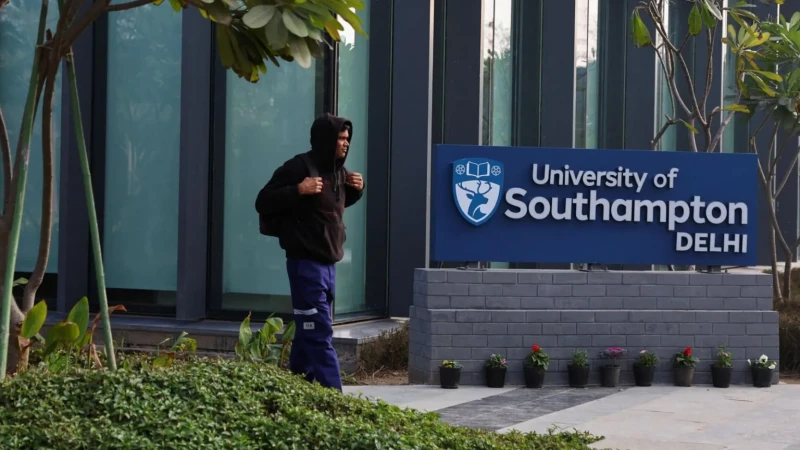
Several leading British universities are currently establishing their branches in India, with the Universities of York and Southampton taking the lead. Specifically, the final stages of the new branch of the University of York are underway near Powai Lake in Mumbai, a city with a population of over 20 million, while the University of Southampton has already opened a branch in Delhi.
The University of York has begun recruiting students for the 2026-27 academic year, aiming to enroll only 270 students in the first year and then increase that number to between 3,000 and 4,000 in the coming years.The doors for foreign universities in India were opened through the Indian National Education Policy introduced in 2020, and the relevant legal framework was published in 2023. Last year, coinciding with British Prime Minister Sir Keir Starmer's visit to India, nine more British universities, including Aberdeen, Bristol, Liverpool, and Queen's, agreed to establish their branches in India. This appears to be an excellent opportunity for British universities facing financial difficulties, as well as for Indian students seeking high-quality education.
According to British government data, there are currently about 40 million university students in India, and this number is expected to grow to 70 million by 2035. Annually, 11 million students complete their school education in India, with 1.5 to 1.7 million demonstrating top educational skills. However, since India's leading higher education institutions can only admit approximately 200,000 students annually, a massive market has been created for British universities in India.
It is expected that the fees at these new university branches will be about 50% of the fees at their parent universities in the UK. However, since the majority of Indian students pursue education abroad with the aim of gaining international work experience, it is questionable whether a British degree obtained in India will fully meet their expectations. Nevertheless, given the strict visa regulations in the UK, this will be an excellent alternative for upper-middle-class students seeking international-level education at a lower cost and without visa risks.
The success of these projects largely depends on overcoming existing regulatory challenges and infrastructure issues in India. Anarock, a real estate consulting firm, points out that meeting the demand for new universities would require approximately 30,000 acres of land and a massive investment of about 100 billion US dollars. For this reason, many foreign universities show a tendency to lease existing buildings rather than construct permanent ones.
Last year, British universities earned 43 billion dollars in export income, with only a small amount of 1.34 billion dollars coming from international branches. While these new expansions in India are expected to add about 67 million dollars to the British economy, this is a very small figure compared to the massive contribution of 5.3 billion dollars that Indian students made to the UK economy by coming to study there in 2024.