![Gossip Lanka News [English]](https://blogger.googleusercontent.com/img/a/AVvXsEhYm2aFFq-bIW1nWX-RrqnPFoIsVos6_VCVz8BpLt0QJi55GNXHXC2fugeRvL0qUStEuCfs7Sfu6ZiSlhrkldxfGuE_wzy5gitY6rMZ2KSi8VBbGvkgXLks37RwZV-4-HKbWiNLRxB8C_r1e4z3mpxFTMPDJPEADoG8E-bZteWFipeD5KNGbjvCfqEfKw=s300 "Gossip Lanka News [English]")
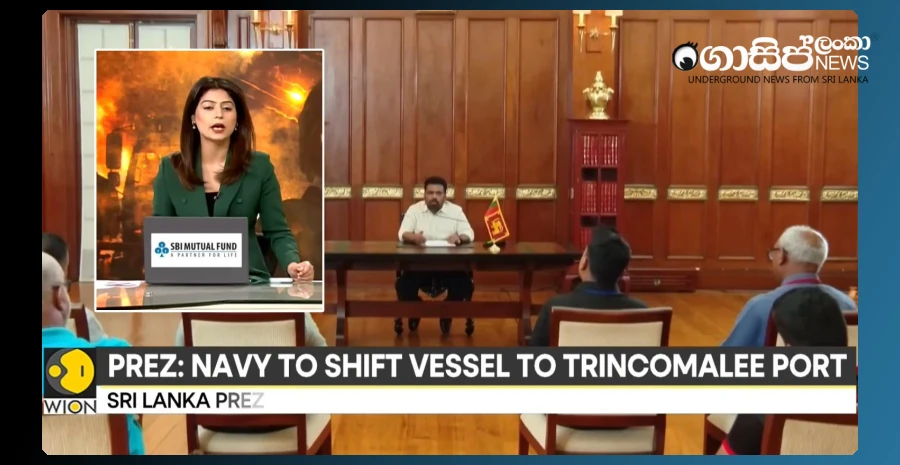
Sri Lanka's act of rescuing the crew of an Iranian ship has now become an event that has garnered international attention. The detailed video made by the international WION channel regarding this and the responses it received are shown below.
The WION channel says this:A day after nearly 90 people died and several others went missing in an attack by an American submarine on another warship, Sri Lanka rescued over 200 crew members from a second Iranian vessel off its coast. The President stated that Sri Lanka decided to assist the Iranian vessel near the Colombo port after detailed discussions with all parties.
This vessel will be taken to the northeastern Trincomalee port. The President says: "Our naval vessels have already reached the ship and are engaged in rescuing the sailors. We have made the necessary preparations to bring 208 people ashore. Among them are 53 officers, 84 cadet officers, 48 senior sailors, and 23 sailors. We have already transferred these sailors to our naval vessels and begun bringing them to Colombo port."
The President stated that Sri Lanka, which places great importance on humanity, handled this situation in accordance with international obligations. Indeed, the Sri Lankan President has stated in a social media post that no civilians should die in wars, and it was further mentioned that Sri Lanka continues to maintain a non-aligned policy regarding the West Asian conflict.
Presenting a timeline of events that occurred over the past few days, the President revealed that on February 26, the Iranian government officially requested permission from the Sri Lankan Ministry of Foreign Affairs for three Iranian naval vessels to enter Sri Lankan ports between March 9 and 13. However, Colombo had not granted approval for that visit. Notably, American-Israeli attacks on Iran began two days after Tehran requested permission.
According to the President, this request was made as a goodwill visit aimed at strengthening relations. However, he stated that such visits require extensive procedural arrangements and added that these vessels were found dangerously close to Sri Lanka's national maritime boundary.
Furthermore, on February 27, Sri Lanka received a report that a sailor on the Iranian vessel, which was currently under its control, had been involved in an accident. Iran requested Sri Lanka's assistance to bring that sailor and another officer ashore for psychological support.
The President further confirmed that the Sri Lanka Navy and Air Force jointly transported the individuals ashore and referred them for medical treatment. The Sri Lankan President stated that on March 4, reports emerged that a vessel located about 90 nautical miles from the port, beyond the national maritime boundary, had been attacked and was issuing distress signals. In response, Sri Lanka immediately launched a massive operation involving both the Navy and the Air Force, during which the forces were able to rescue approximately 32 people alive.
Finally, Australian Prime Minister Anthony Albanese has stated that three Australian military personnel were on board the American submarine that sank the Iranian ship, as part of training activities under a defense agreement with Britain and the United States.
A recent humanitarian relief operation carried out by Sri Lanka has garnered significant international attention. The actions of the Sri Lankan government and Navy in providing refuge to an Iranian vessel and its sailors, reportedly attacked by the US, have been widely praised. An analysis of social media responses and comments reveals that Sri Lanka acted with its humanitarian values at the forefront, even amidst a wartime situation. It is particularly noteworthy that responses appreciating the kindness of Sri Lankans have been received even from countries like Switzerland, with many emphasizing that humanity is more powerful than weapons.
This incident has also sparked a strong discussion about the regional geopolitical situation and the role of neighboring states. Many commentators and the general public point out that the relevant parties failed to provide adequate protection to a vessel that had arrived for a joint military exercise at India's invitation. Despite attempts to act as a regional power in the Indian Ocean, India's silent policy during such a crisis has been severely criticized. Consequently, responses confirm that a perception is emerging among the international community that Sri Lanka has taken on the true humanitarian leadership in the Indian Ocean region.
The leadership and decision-making ability of Sri Lanka's current President, Anura Kumara Dissanayake, have been widely appreciated during this crisis. Despite being a small island, the brave decision taken by the Sri Lankan government to stand up for humanity without fear of powerful nations has been praised by all. Through their comments, the people have confirmed that Sri Lankans, nurtured by Buddhist philosophy, are ready to assist anyone in distress, regardless of their race, religion, or political affiliation. It has been clearly demonstrated that Sri Lankans, with their experience of a brutal war spanning nearly three decades, will never support another war, and their sole aspiration is world peace.
Although some parties warned that Sri Lanka might face international pressure from the US or Israel due to this incident, the majority opinion is that this was merely the provision of humanitarian aid in accordance with international law. The Sri Lanka Navy and Air Force acted solely to save the lives of a group of sailors who were on the verge of death, not for any political or military objective. Social media analysis further reveals that standing impartially for humanity amidst the conflicts of world powers has further enhanced Sri Lanka's reputation in the eyes of the world.