![Gossip Lanka News [English]](https://blogger.googleusercontent.com/img/a/AVvXsEhYm2aFFq-bIW1nWX-RrqnPFoIsVos6_VCVz8BpLt0QJi55GNXHXC2fugeRvL0qUStEuCfs7Sfu6ZiSlhrkldxfGuE_wzy5gitY6rMZ2KSi8VBbGvkgXLks37RwZV-4-HKbWiNLRxB8C_r1e4z3mpxFTMPDJPEADoG8E-bZteWFipeD5KNGbjvCfqEfKw=s300 "Gossip Lanka News [English]")
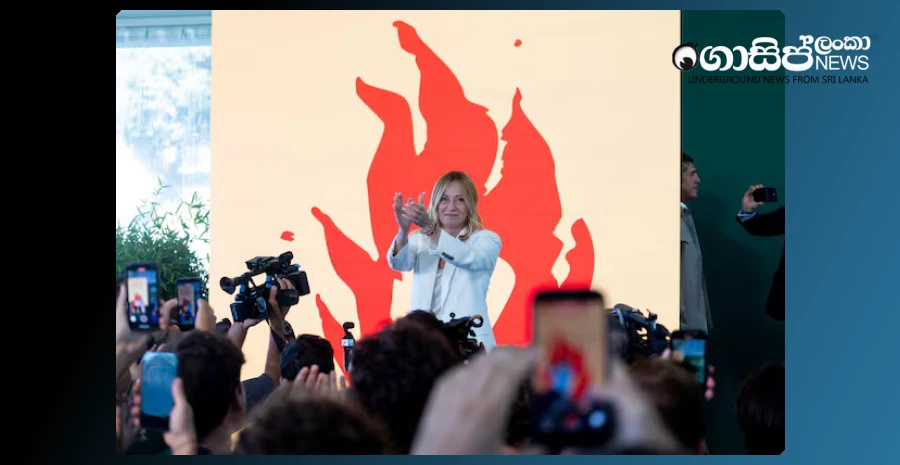
Italian Prime Minister Giorgia Meloni has officially proposed legally limiting the number of foreign students allowed in school classrooms in Italy and completely banning the use of traditional Islamic attire such as the burqa and niqab in schools. Against the backdrop of Italy being unable to prevent the arrival of migrants due to a shortage in the labor force, it appears the government is attempting to resolve potential cultural conflicts within the country through this strict policy of cultural assimilation.
Analysts also identify this move as a political strategy to consolidate right-wing political support and maintain power, targeting the general election scheduled for next year.Speaking at the annual national youth organization festival of the ruling 'Brothers of Italy' party in Rome, the Prime Minister unveiled this new educational and immigration bill. The maximum number of foreign students who can be admitted to a classroom in schools across the country will be legally stipulated, and although the exact upper limit was not specified, she emphasized that an excessive number of foreign students hinders the Italian language-based education system. Meloni stated that Italian children should never feel helpless or like a minority in their classrooms, and added that this bill would soon be presented to the Council of Ministers.
The Prime Minister pointed out that if there is one student in a classroom who does not understand Italian, teachers and classmates can help them, but when such students become the majority, it leads to neglect rather than integration. She stated that those who come to build a future in Italy must respect the country's language, culture, and laws, and that this is the only acceptable and honest path for them. Furthermore, this bill mandates that parents of students facing educational challenges due to a lack of Italian language proficiency must also attend Italian language classes, which experts highlight as a measure to enforce cultural assimilation not just for individual students but for the entire family.
The Italian 'ISMU' foundation, which conducts research on migration, indicates that in the 2025 academic year, there were 930,000 foreign students in Italian educational institutions, accounting for 11.6 percent of the total student population from preschool to high school. According to statistics from the Korean Educational Development Institute, the number of multicultural students in South Korea is 210,838 (4.3 percent), in comparison to which the proportion of foreign students in Italian classrooms is nearly three times higher. Furthermore, according to reports from 'IDOS', an Italian migration research institute, the number of foreign students in Italy has increased by 16 percent over the past 11 years, while the number of Italian national students has decreased by 12.5 percent.
Under this new bill, strict restrictions are also imposed on the use of religious attire in schools. The burqa, which completely covers the body, and the niqab, which covers the entire face except for the eyes, are completely prohibited in Italian educational institutions, but the hijab, which only covers the hair and neck, is not included in this ban. Meloni stated that students must come to school with their faces visible and that no one can be allowed to hide the individuality of young women based on traditional reasons, emphasizing that women's rights and the secular values of Italian society take precedence over religious freedom.
Italy is not the first European country to ban face-covering attire in schools and public places. France and Belgium banned full face covering in public places in 2011, and Denmark did so in 2018. Portugal has implemented similar laws since last month, and Austria has extended this ban to children under 14 years of age. The proposed bill is expected to officially become law after receiving parliamentary approval within 60 days following approval by the government's Council of Ministers.
While this decision aligns with the right-wing political trend spreading across Europe, experts warn that it could have severe negative social consequences. It is particularly pointed out that there is a risk of marginalization for the Muslim community as immigration controls are tightened. Antonello Giannelli, President of the National Association of Italian Principals (ANP), stated that while this is a legitimate issue from an educational perspective, finding practical technical solutions is difficult. Professor Salvatore Curreri, a constitutional law professor at Enna Kore University, points out that the right to education for all children, including foreigners, is guaranteed by Article 34 of the Italian Constitution, and strict enforcement of maximum limits could violate constitutional objectives.