![Gossip Lanka News [English]](https://blogger.googleusercontent.com/img/a/AVvXsEhYm2aFFq-bIW1nWX-RrqnPFoIsVos6_VCVz8BpLt0QJi55GNXHXC2fugeRvL0qUStEuCfs7Sfu6ZiSlhrkldxfGuE_wzy5gitY6rMZ2KSi8VBbGvkgXLks37RwZV-4-HKbWiNLRxB8C_r1e4z3mpxFTMPDJPEADoG8E-bZteWFipeD5KNGbjvCfqEfKw=s300 "Gossip Lanka News [English]")
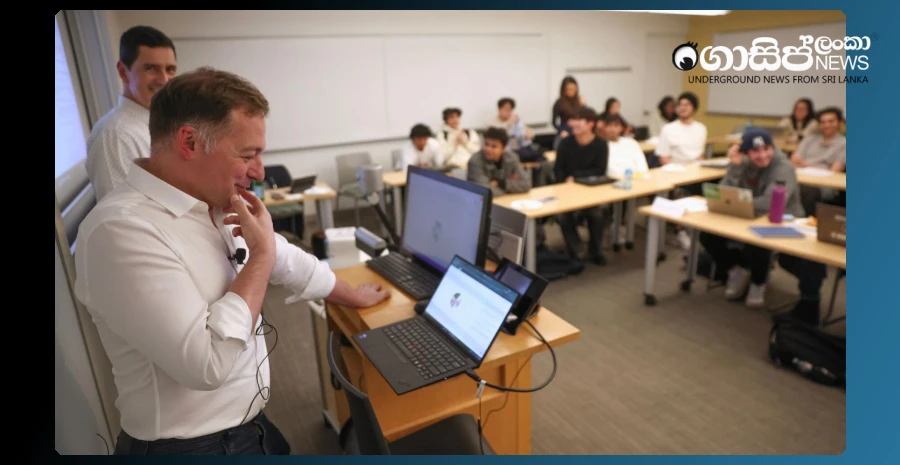
University professors in the United States are turning to oral examinations, an ancient Socratic method, to address a crisis created in the field of higher education due to artificial intelligence (AI). With the widespread use of generative AI tools like 'ChatGPT' among students, even though the essays and assignments they submit are of a very high standard, students have been unable to personally explain those points.
Educators are deeply concerned that students' critical thinking, creativity, and cognitive skills are deteriorating, and that they have outsourced their thinking efforts to artificial intelligence.To control this situation, steps have been taken to reintroduce oral examinations as a method of asking questions live, without laptops and chatbots. Professor Chris Schaffer of Biomedical Engineering at Cornell University introduced 20-minute oral questioning sessions for his students last semester, where grading was based entirely on oral answers. He states that artificial intelligence cannot be used for an oral examination, pointing out that this is a method that encourages true understanding. Commenting on this method, Olivia Pisarchick, a student at Cornell University, says that being asked questions live gives her a greater sense of responsibility towards the subject matter and motivates her to study.
Assistant Professor Emily Hammer of the University of Pennsylvania also uses oral examinations alongside written assignments for her courses. She points out that this is an effort to preserve the cognitive abilities that students are losing, rather than merely preventing cheating. Additionally, Professor Panos Ipeirotis of the Business School at New York University has brought a modern solution to this problem by taking steps to conduct students' oral examinations through AI-powered voice agents. His view is that since students' written work can no longer be trusted as a product of genuine thought, an oral examination should be conducted with every written assignment. Andrea Liu, a student at New York University, stated that while this AI method caused some discomfort, she acknowledged its necessity.
This oral approach not only confirms students' true knowledge but also develops their professional skills. However, implementing this practically for large classes has presented a challenge in time management, and concerns have also arisen that it might cause some anxiety among shy students or those with special needs. Nevertheless, this Socratic method, which was used in ancient European universities during times of book scarcity, is once again adding great value to modern education by confirming that artificial intelligence currently lacks the ability to think and make decisions independently.