![Gossip Lanka News [English]](https://blogger.googleusercontent.com/img/a/AVvXsEhYm2aFFq-bIW1nWX-RrqnPFoIsVos6_VCVz8BpLt0QJi55GNXHXC2fugeRvL0qUStEuCfs7Sfu6ZiSlhrkldxfGuE_wzy5gitY6rMZ2KSi8VBbGvkgXLks37RwZV-4-HKbWiNLRxB8C_r1e4z3mpxFTMPDJPEADoG8E-bZteWFipeD5KNGbjvCfqEfKw=s300 "Gossip Lanka News [English]")
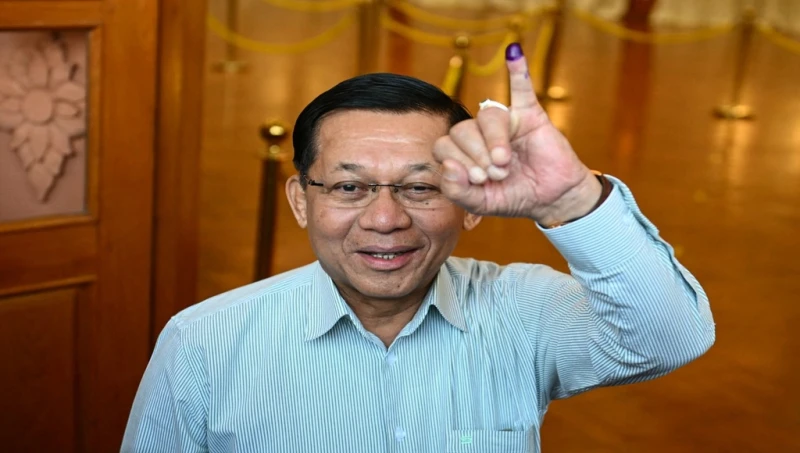
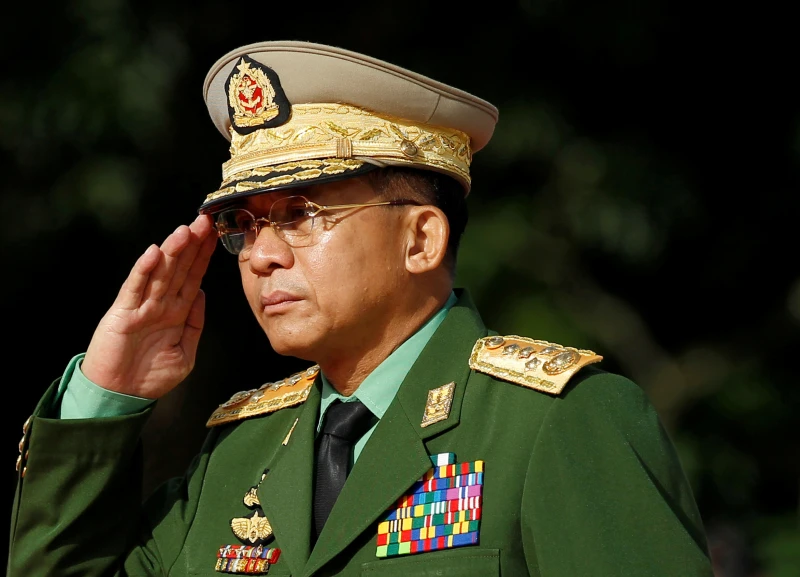
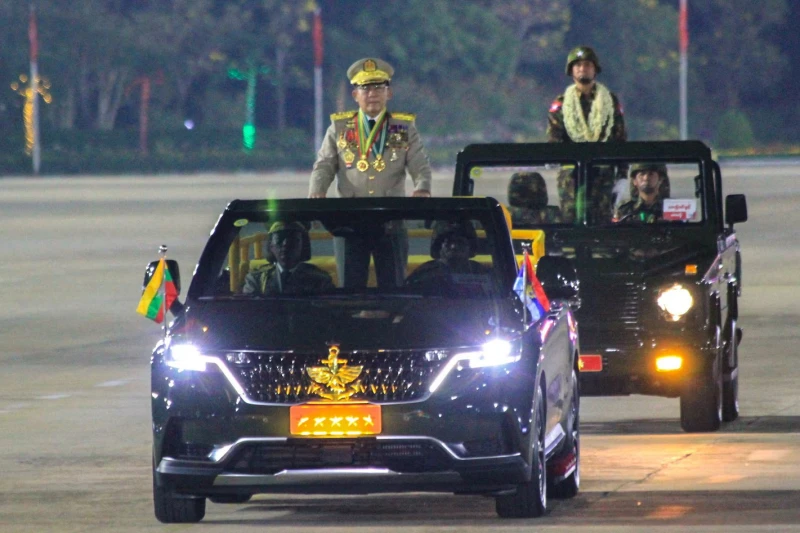
It was reported from Naypyidaw, the capital of Myanmar, on Monday, March 30, 2026, that Senior General Min Aung Hlaing, the head of the country's military junta, has stepped down from his position as Commander-in-Chief of the Armed Forces and has been nominated as a vice-presidential candidate with the aim of becoming president under the guise of civilian rule. This pivotal event was reported a few days after the new parliament convened with a pro-military majority following a controversial election.
During a live televised session of the Pyithu Hluttaw (Lower House of Parliament) on a state-owned television channel, lawmaker Kyaw Kyaw Htay officially proposed his name, stating, "I nominate Senior General Min Aung Hlaing as Vice President."According to Myanmar's 2008 constitution, the military, the Lower House, and the Upper House must each nominate one vice-presidential candidate, from whom one will subsequently be elected as president. Min Aung Hlaing has thus stepped down from his military position to fulfill the constitutional requirement that the president cannot simultaneously hold the highest military office, and he is widely expected to be elected president. Concurrently, at an official military power transfer ceremony in Naypyidaw, 60-year-old Lieutenant General Ye Win Oo, the former intelligence chief, was promoted and sworn in as the new Commander-in-Chief of the Armed Forces. During this official ceremony, Min Aung Hlaing formally handed over the military insignia, the commander's baton, and the military flag to his trusted successor.
Behind this political transition lies the severe crisis that began with the military coup launched by Min Aung Hlaing on February 1, 2021. This coup overthrew the democratically elected government of the National League for Democracy (NLD), led by Nobel laureate Aung San Suu Kyi. Following her landslide election victory, the military arrested Suu Kyi, dissolved her party, and declared a state of emergency that has been continuously extended. This seizure of power led to massive nationwide protests, brutal crackdowns, and a civil war, giving rise to resistance groups such as People's Defense Forces (PDFs), Ethnic Armed Organizations (EAOs), and the exiled National Unity Government (NUG). Despite the implementation of mandatory conscription laws, the junta has suffered severe setbacks on the battlefield against these resistance forces, and thousands have died and millions displaced amidst a collapsing economy.
The backdrop for this new political configuration was set by the heavily criticized "sham" election held in three phases on December 28, 2025, and January 11 and 25, 2026. The main opposition party, the NLD, was banned from contesting the election, and voter turnout in some areas recorded a low percentage of around 50 percent. This election, boycotted by democratic groups and condemned as illegitimate by the international community, saw the military-backed Union Solidarity and Development Party (USDP) gain a majority. Min Aung Hlaing, 69 years old and born in July 1956, had signaled this transition months in advance by strategically appointing his loyalists to various positions in early 2025-2026. While this mirrors the exit strategy adopted by former dictator Than Shwe in 2010, it is notable that this time it is occurring amidst an active civil war.
Min Aung Hlaing, a career infantry officer who rose through the military ranks after the 1988 uprising and was appointed Commander-in-Chief of the Armed Forces by Than Shwe in 2011, is known for his hardline policies and suppression of political rivals. Although he has shed his military uniform to become president, he is expected to continue to wield power and influence through a proposed high-level advisory council and the new military leadership. The new Commander-in-Chief, Ye Win Oo, is a long-time confidant of Min Aung Hlaing and is considered his "eyes and ears," a former military intelligence chief. With an intelligence background rather than a combat one, he is referred to by analysts as a "paper general," and this appointment has allowed Min Aung Hlaing to maintain full control over daily military operations while ensuring his unwavering loyalty.
Critics point out that this process is not a move towards democracy but a strategy to consolidate power, allowing the military to maintain its constitutional dominance (including control over security and the ability to regain power) under a civilian facade. As this clearly indicates that the junta will never relinquish true power, the resistance from opposition groups is likely to intensify rather than end. While pro-government media may praise this as a "return to democracy," exiled groups and the NUG government will strongly condemn it. Public opinion in urban areas remains fiercely hostile to the junta since the coup. Furthermore, the United States, the European Union, and the United Nations are expected to condemn this as an illegitimate process, while ASEAN remains further divided on the matter.