![Gossip Lanka News [English]](https://blogger.googleusercontent.com/img/a/AVvXsEhYm2aFFq-bIW1nWX-RrqnPFoIsVos6_VCVz8BpLt0QJi55GNXHXC2fugeRvL0qUStEuCfs7Sfu6ZiSlhrkldxfGuE_wzy5gitY6rMZ2KSi8VBbGvkgXLks37RwZV-4-HKbWiNLRxB8C_r1e4z3mpxFTMPDJPEADoG8E-bZteWFipeD5KNGbjvCfqEfKw=s300 "Gossip Lanka News [English]")
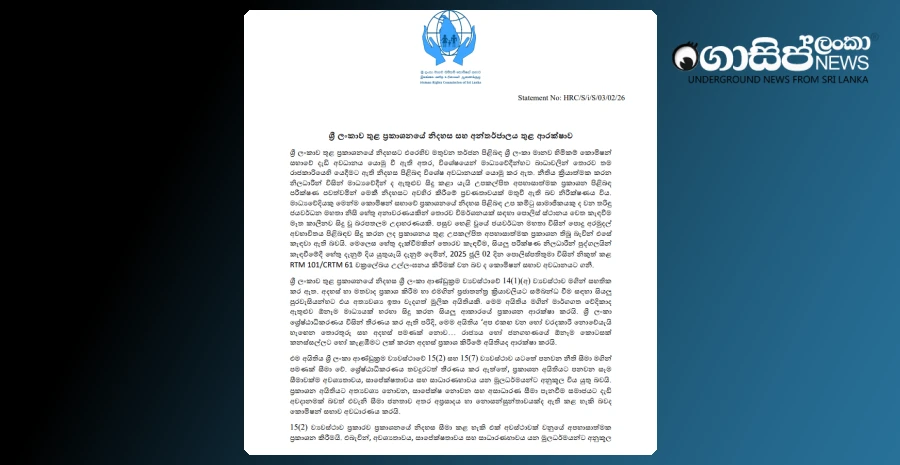
The Human Rights Commission of Sri Lanka has drawn its serious attention to the challenges faced by freedom of speech and expression in Sri Lanka, as well as the obstacles faced by journalists in their professional activities. In particular, the Commission has observed that the freedom of expression has been hindered by law enforcement officials subjecting citizens, including journalists, to investigations, assuming their statements are defamatory.
To clarify this situation, the Commission has cited a recent incident as an example. The most recent example is the incident where Mr. Tharindu Jayawardhana, a member of the Human Rights Commission of Sri Lanka's Sub-Committee on Freedom of Expression and a journalist, was summoned to a police station without a specific reason being disclosed. It was later revealed that this summons was made claiming that a statement he made regarding the misuse of public funds was defamatory. However, the Commission points out that even Circular No. RTM 101/CRTM 61 issued by the Inspector General of Police on July 02, 2025, which states that reasons must be given when summoning individuals, has been violated in this process.
The right to freedom of expression, affirmed by Article 14(1)(a) of the Constitution, is a fundamental right of citizens and is valid for all media platforms, including the internet. The Commission emphasizes that this also protects the right to hold and express critical opinions that do not agree with the government or the majority view. This right can only be restricted within the legal framework prescribed under Articles 15(2) and 15(7) of the Constitution, in accordance with the principles of necessity, fairness, and proportionality.
Although many mistakenly believe that making defamatory statements is a criminal offense, the Commission clarifies that under current Sri Lankan law, it is only a civil offense. Defamation was removed from criminal law by the Penal Code (Amendment) Act No. 12 of 2002. Therefore, the police have no legal authority to investigate defamatory statements, and accepting or investigating such complaints is an action that should not be taken by the police. If someone has been harmed by a defamatory statement, they should seek remedies through civil courts, not through criminal law.
International human rights standards recognize that public figures, especially politicians and government officials, should tolerate criticism more than ordinary citizens. The Commission points out that they should not attempt to silence dissenting voices by using criminal law or police power in the face of criticism, but rather adopt democratic methods such as clarifying facts. They also state that issues such as hateful statements targeting women should be resolved through long-term social interventions, not through the misuse of the law.
While the Commission recognizes the importance of combating genuine cybercrimes occurring online, laws should not be used to restrict freedom of speech. It has also been warned that attempting to prevent defamatory statements using the Online Safety Act No. 9 of 2024 could hinder freedom of expression. The full attention of the government and investigative agencies should be focused on investigating technical crimes such as hacking, data theft (phishing), malware, and child abuse.
Accordingly, the Human Rights Commission of Sri Lanka requests the government and the Inspector General of Police to prioritize the investigation of genuine cybercrimes and to instruct all police stations not to treat complaints related to civil defamation as criminal matters. The statement further emphasizes that politicians or government officials should not misuse police powers to suppress criticism against them.