![Gossip Lanka News [English]](https://blogger.googleusercontent.com/img/a/AVvXsEhYm2aFFq-bIW1nWX-RrqnPFoIsVos6_VCVz8BpLt0QJi55GNXHXC2fugeRvL0qUStEuCfs7Sfu6ZiSlhrkldxfGuE_wzy5gitY6rMZ2KSi8VBbGvkgXLks37RwZV-4-HKbWiNLRxB8C_r1e4z3mpxFTMPDJPEADoG8E-bZteWFipeD5KNGbjvCfqEfKw=s300 "Gossip Lanka News [English]")

The Daily Mail has reported that the US government has unveiled a new set of dietary guidelines, completely overturning nutrition advice given for decades, which urged limiting red meat consumption and fearing fatty foods like butter. According to these new guidelines, Americans are now recommended to consume full-fat dairy and yogurt, beef fat, and a high amount of protein.
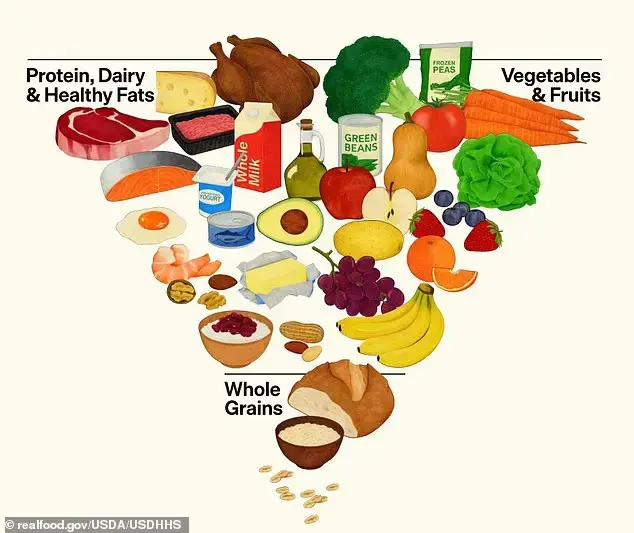
It is particularly noteworthy that red meat, previously considered unhealthy, has been explicitly included in the list of recommended foods. This goes against traditional nutritional advice prevalent worldwide, including in Britain, which recommends limiting saturated fat and red meat. In the food pyramid released with the new guidelines, meats like steak are placed in a prominent position. (The pyramid is shown at the bottom of this article)However, critics point out that while it is generally accepted that the shape of this food pyramid implies consuming more of what is at the bottom and less of what is at the top, the new diagram might sometimes mislead people. Previously, it was stated that 45% to 65% of daily calorie intake should come from carbohydrates, but in the new pyramid, carbohydrates are placed at the lowest level. Americans have been advised to significantly reduce refined carbohydrates such as bread flour, packaged breakfast foods, and crackers, and instead consume only two to four servings per day of fiber-rich grains like oats, brown rice, and quinoa. The main theme of the new guidelines is "Eat real food." For the first time in history, "highly processed foods" have been designated as a category to be completely avoided, and emphasis has been placed on prioritizing home-prepared meals.
US Health Secretary Robert F. Kennedy Jr. (RFK Jr) and Agriculture Secretary Brooke Rollins describe this change as the "most significant reset" in federal nutrition policy in decades. However, strong opposition has emerged in the US against this change. The Center for Science in the Public Interest (CSPI) calls this "clear misinformation" and warns that advice on protein and fats could be confusing and harmful. The American Heart Association also agrees, urging consumers to limit red meat, butter, and animal fats. While the meat and dairy industries celebrate this change as a victory, packaged food manufacturers have maintained a quiet stance, though stock market values of companies like Kraft Heinz have fallen.
Recently, an anti-vegetable oil sentiment has been growing in America, with sunflower and soybean oils being referred to as "toxic industrial fats." The new guidelines have approved the use of animal fats, and only olive oil is listed as a healthy fat. According to Marion Nestle, a nutrition policy expert at New York University, although there is no mention of seed oils due to the economic influence of corn and soy producers, Robert F. Kennedy Jr. is strongly opposed to seed oils. Experts in the United Kingdom have mixed opinions on adopting these new American guidelines. Professor Tom Sanders of King's College London states that these guidelines have taken on a populist nature, deviating from scientific basis. He expresses concern about further increasing protein intake and promoting animal fats, given that Americans already consume sufficient protein.
The core of the new guidelines is a reinterpretation of the causes of heart disease. For decades, the focus was on reducing "bad" cholesterol (LDL) in the blood, but the new view is that the main cause of heart disease is not fat in the blood, but rather how the body responds to sugar and refined carbohydrates. Professor Benjamin Bikman of Brigham Young University points out that about 70% of patients with high cholesterol still face the risk of heart attacks. According to his research, the ability to control blood sugar is a better indicator for predicting heart disease. Refined carbohydrates and highly processed foods raise blood insulin levels, which damages blood vessels and leads to fat deposition. Professor Naveed Sattar of the University of Glasgow agrees with reducing refined carbohydrates but emphasizes that limiting saturated fat is still important.
Another point that has garnered much attention is the recommendation of full-fat dairy products. Although low-fat dairy was previously advised, new evidence suggests that saturated fat is not always harmful. Experts say that while it can be harmful when consumed with sugary and flour-based foods, there is no risk when consumed as part of a balanced diet with vegetables, meat, and grains. A study involving 136,000 individuals from 21 countries revealed that those who consume more dairy products have a lower risk of heart disease. However, the new guidelines still advise keeping saturated fat to less than 10% of total calories, which creates confusion. Professor Sanders points out that maintaining this limit while using animal fats is practically impossible.
Furthermore, a new target has been set for protein intake, recommending 1.2 to 1.6 grams of protein per kilogram of body weight per day, which is nearly double the previous amount. While more protein is important for older adults and athletes, Professor Stuart Phillips of McMaster University in Canada says there is no additional benefit for the general population. Experts fear that the message "eat more protein" will encourage people to skip vegetables and grains and consume only meat. The prominent placement of meat at the top of the pyramid may also contribute to this. Dr. Ty Beal states that protein should be obtained from natural foods, not from factory-processed high-protein foods.
Finally, when asked whether the United Kingdom will follow these new American guidelines, it appears they will not. The UK Department of Health and Social Care has stated that there are no plans to update advice on saturated fat or protein. Instead, they are focusing on measures such as banning energy drinks, controlling fast-food advertisements, and imposing taxes on sugary drinks to combat obesity. Professor Mike Lean emphasizes that when healthy food is expensive and fast food is abundant, it is difficult for people to follow even the best advice.
(Source: Daily Mail)