![Gossip Lanka News [English]](https://blogger.googleusercontent.com/img/a/AVvXsEhYm2aFFq-bIW1nWX-RrqnPFoIsVos6_VCVz8BpLt0QJi55GNXHXC2fugeRvL0qUStEuCfs7Sfu6ZiSlhrkldxfGuE_wzy5gitY6rMZ2KSi8VBbGvkgXLks37RwZV-4-HKbWiNLRxB8C_r1e4z3mpxFTMPDJPEADoG8E-bZteWFipeD5KNGbjvCfqEfKw=s300 "Gossip Lanka News [English]")
The disaster struck and passed. But the devastation it wrought was immense. The damage to the country's road network, in particular, severely impacted the national economy for many years. While natural calamities inflict such blows, our innate resilience in overcoming them is truly remarkable.
These capabilities and efficiency were abundantly evident when we witnessed the rapid reconstruction efforts of the country's devastated highway and railway systems.
Specifically, 256 main highways in the country were destroyed by the recent floods, landslides, and other disasters. Furthermore, the railway network suffered the worst calamity in its history. During the tsunami disaster, only a few sections of the coastal railway line were destroyed. We were able to restore that within 57 days because everyone united.
However, the damage to the railway lines this time was immense. The Upcountry Railway Line was the most severely affected.
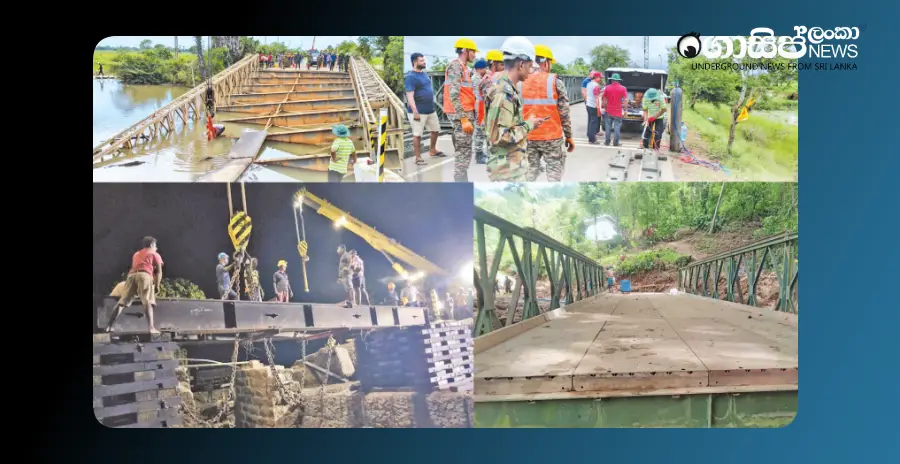
Currently, out of the 256 damaged roads in the highway network, 223 have been reopened for vehicular traffic. Among these, two Bailey bridges received from India have also been installed, said Wimal Kandambi, Director General of the Road Development Authority, to Silumina:
“Out of the 40 major bridges that became impassable for vehicular traffic, 15 have now been opened. These routes have been reopened for traffic via temporary bridges, including Bailey bridges. Work on another 10 bridges is currently underway. Furthermore, as soon as investigations into the remaining 15 severely damaged bridges are complete, necessary construction steps will be taken.
Nevertheless, we have now established the necessary routes to all major cities in the country. In addition to the Road Development Authority, the Army, Air Force, Navy, and other institutions and organizations provided support for this effort.
We received 4 Bailey bridges from India. Of these, we have currently installed two bridges. One bridge was installed on the Paranthan-Mullaitivu road (from Paranthan to Tharavi) and the other on the A35 road from Peradeniya to Chenkalady. As a result, we were able to restore these roads, which would have been impassable for months, within about a week.
The loss incurred by the Road Development Authority due to this disaster is 190 billion rupees; an enormous loss exceeding 19,000 crore rupees.
We were able to restore 15 damaged major bridges for vehicular traffic within 7 to 10 days. Being able to establish the necessary routes to all major cities and suburbs within 14 days is a significant achievement.”
The Indian Army also provided assistance in installing the Bailey bridges received from India. Furthermore, the support of the armed forces, including the Army, was received for the reconstruction of many bridges. Notably, the Iranawila bridge, built across the Lunugala Oya, was also damaged and destroyed in this disaster, but it was reopened for traffic within a week. Similarly, the bridge and highway leading to Rattota town were completely destroyed, but that bridge was also reopened within a few days.
While it typically takes years to construct major bridges, the Road Development Authority's achievement in establishing the necessary road network to reach the country's villages and cities in less than 14 days is commendable.
That is the story of highway development. For highway development, one can reach the vicinity of the site by vehicle, or at least close to it. However, the rapid re-establishment of railway bridges and tracks, which were so severely damaged that they were inaccessible even by vehicle, and the resumption of train services, was a monumental effort undertaken by the Railway Department. The contribution of the Army in this regard is especially noteworthy.
Railway General Manager Ravindra Pathmapriya told Silumina that only about 20% of trains could operate after the natural disaster on the 27th of last month.
“With this disaster, our railway lines suffered extensive damage. After clearing obstacles like fallen trees that blocked train operations after the 28th, we couldn't even run 20% of the usual train services. However, within a few days of the disaster, we were able to fully restore train operations on the Kelani Valley Line to normal. Similarly, on the Coastal Railway Line, train services are running according to the normal schedule, with the exception of two or three trains.
One of our biggest challenges was the destruction of the Bujjomuwa railway bridge. A large pit, about 40 feet deep, had formed at the bridge, causing significant damage. Since the bridge was built on ancient brick foundations, this posed a major problem. Yet, we were able to restore that bridge and resume train services within 10 days. For 10 days, railway employees worked day and night, not just from the track and engineering departments. Employees from many sectors worked there regardless of rank. A large number of Army personnel contributed daily. Providing them with food and especially water was even a challenge. In some instances, neighbors even supplied food and drinks. Working on these tasks late at night in the rain amidst such severe difficulties is truly commendable.
By re-establishing that bridge, we were able to bring back trains that were stranded in Polgahawela, Rambukkana, Kurunegala, Ganewatta, and Mahawa, unable to reach Colombo, and extend train services up to Rambukkana and Mahawa.
Currently, service trains are running from Mahawa to Gal Oya and Trincomalee. Train services on that route are expected to resume before the end of this month. Furthermore, on the Batticaloa line, for a continuous stretch of over 2 kilometers, the railway track is completely missing. We have currently reconstructed a distance of 500 meters. By next month, those works should be completed, and train services can resume.
Train services are currently running up to Nattandiya on the Puttalam line. We expect to extend train services to Mahawewa in the coming week. We are striving to advance daily. Beyond that point, the track has been severely washed away. We hope to overcome that challenge quickly as well.
Initially, 66 trains operated, but currently, the number of daily operational trains has been increased to about 160. Furthermore, discussions have been held with the Indian High Commission regarding obtaining Indian assistance again for the reconstruction of the Northern Railway Line. We hope it will be successful. Our biggest problem is the Upcountry Railway Line, especially the Peradeniya bridge. Currently, Peradeniya University, the Railway Department, and the CECB institution have jointly conducted a preliminary study on this matter. The Navy carried out a significant amount of work on that bridge for 4 days.
Before establishing train services on the Upcountry Line from Rambukkana to Peradeniya and Matale, and from Peradeniya to Badulla, steps have been taken to proceed according to geological advice. Specifically, on that route, from Rambukkana to Peradeniya alone, there are 97 instances of landslides and washouts on the railway line. We estimate that completing these works, including the railway bridge up to Peradeniya, will cost approximately 2,100 crore rupees.
Furthermore, there are 80 such road obstructions from Peradeniya via Kandy to Matale. From Peradeniya to Badulla, there are 126 instances of landslides and washouts. Of these, 21 sections of the railway line are in a state resembling hanging rope bridges. The total reconstruction cost for the railway is estimated to be approximately 10,000 crore rupees, or 100 billion rupees. Nevertheless, we are currently planning to gradually construct the Upcountry Railway Line from Badulla to Ella and Nanu Oya. A team is currently inspecting this. By successfully completing this task, we will be able to make a significant contribution to the tourism industry.”
It took railway employees just 10 days to rebuild the completely destroyed Bujjomuwa bridge with new embankments. Currently, Northern railway services have also commenced. Kelani Valley and Coastal railway services were also started within a few days. The railway signaling system was not allowed to be crippled in any way.
It is clear that we have made a significant leap in road, bridge, and railway reconstruction.
(Tharaka Wicremasekara -Silumina)

Tags:
Trending