![Gossip Lanka News [English]](https://blogger.googleusercontent.com/img/a/AVvXsEhYm2aFFq-bIW1nWX-RrqnPFoIsVos6_VCVz8BpLt0QJi55GNXHXC2fugeRvL0qUStEuCfs7Sfu6ZiSlhrkldxfGuE_wzy5gitY6rMZ2KSi8VBbGvkgXLks37RwZV-4-HKbWiNLRxB8C_r1e4z3mpxFTMPDJPEADoG8E-bZteWFipeD5KNGbjvCfqEfKw=s300 "Gossip Lanka News [English]")
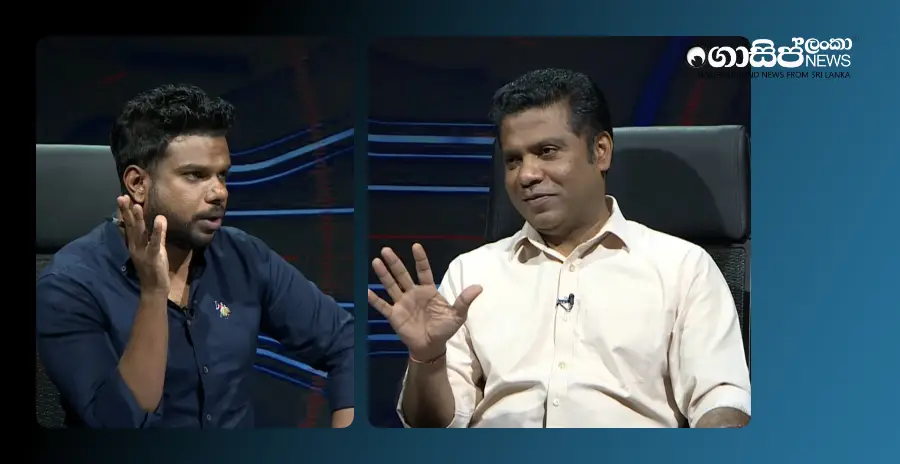
The full written transcript of that discussion is published below.
------------------
Kalindu (Presenter): Ayubowan! Welcome to Derana 360 again today. Today's 360 guest, as we informed you in the promotional clips, is the Minister of Health and Mass Media, Cabinet Spokesperson Dr. Nalinda Jayatissa. We warmly welcome you. There are many things we need to discuss regarding the recent disaster. I would first like to discuss, as an introduction, the current situation the country is facing in the 'Post-disaster' phase. What is the most challenging task at the moment?
Dr. Nalinda Jayatissa (Minister): Kalindu, you know very well that this is an enormous, massive natural disaster that has affected our country. I don't think it can be compared with any other disaster. We have heard of disasters, we have seen disasters. But this damage is severe. In fact, for a country like ours, which was achieving some economic stability, it has had a significant impact.
So now, about eighteen days after the disaster, the initial life-saving efforts (Rescue operations) for the people were largely successful, especially carried out by the security forces, including the tri-forces. International rescue teams also provided assistance. After that, our task was to provide immediate relief to these people. Those activities are still ongoing. Currently, about eighty thousand people are still in or near 670 disaster relief centers.
In recent days, this number increased somewhat. This was influenced by the onset of the Northeast Monsoon, bringing 75-100 mm of rainfall, and the risk of landslides in some areas. We informed the people in areas where the NBRO (National Building Research Organisation) issued red alerts to remain in safe centers. According to data released this evening, approximately seventy-one thousand four hundred and fifty-two (71,452) people are in 739 safe centers.
Next, our biggest challenge now is that the Ministry of Finance has allocated a significant amount of money to provide relief to a large number of people. The President announced in Parliament on December 05 that we expect to spend 72.2 billion rupees within 25 days of December. To kickstart immediate relief efforts and infrastructure rebuilding, an additional five hundred billion rupees will be allocated next year as a supplementary estimate the country expects.
If I briefly answer the most serious challenge we face now, which you asked about; it is the restoration of these collapsed infrastructures and, beyond that, the resettlement of these people in a way that prevents or minimizes loss of life in such disasters in the future. Therefore, it will be a task that takes a considerable amount of time.
For example, the number of fully damaged houses currently stands at about 6,000. We now need to provide houses to those whose homes are completely damaged. We allocated fifty lakhs of rupees for that. With another fifty lakhs for land acquisition, the total amount allocated will be up to one hundred lakhs of rupees. There's another group whose homes, although not completely damaged, are located in high-risk zones. They also need to be resettled in lower-risk areas step by step. It might not be possible to do it all at once. This is because, before this disaster, the NBRO had identified about fifteen thousand (15,000) high-risk houses. We had a plan to construct five thousand new houses last year and in 2025, and three thousand houses in 2026. However, that situation has now changed. Because in addition to these old locations, a number of houses in new high-risk zones have now been added. As these are currently being calculated, we expect to resettle all people from these high-risk areas in safe places within about two years.
Kalindu: Alright, Minister, we especially hope to discuss those sections again. But with the current public discourse, before discussing the issues faced by people expecting disaster relief, I would like to move forward in the program by discussing the "Pre-disaster situation". Because this has become a widely discussed topic. I believe you have stated your position on several occasions regarding the claims that meteorological factors indicating a potential disaster in the country were observed and discussed on Derana's "Big Focus" program on November twelfth (12). You also explained how we responded to this and how we broadcast our views at the Cabinet press conference. Since we need to have a discussion about this here, could you explain the reasons for the government's stance that there was no forecast of a risk requiring caution on November 12th?
Dr. Nalinda Jayatissa: Kalindu, first I must say, last week I participated in four programs: "Siyatha", "ITN", "Rupavahini", and "Swarnavahini". You hadn't booked a time in advance. On December 1st, you connected the tri-force commanders to your program. If I'm to clarify that, we, from the government's side, tried to connect. Accordingly, since the government is prioritizing disaster management at this time, I stated that I would definitely participate on a future date.
Now, in that "Big Focus" program, the Director General of the Department of Meteorology mentions a certain point. The whole country knows that. However, if that point is used later to weave other political narratives, we should avoid that and understand the truth of the matter. Now I will show you, from November 1st to the 12th, there was actually no forecast of such a turbulent situation from either the Department of Meteorology or the Indian Meteorological Department.
For the first time, I am presenting the points made by the Additional Director General of the Department of Meteorology to the Food Policy and Security Committee held at the Presidential Secretariat at 2 PM on October 31st. She states: "Although an increase in rainfall was observed in the last week of October due to a low-pressure depression, it was low relative to the overall expected rainfall, and due to changing atmospheric conditions around the Indian Ocean, a low rainfall situation is observed until December, however, an increase in rain may occur due to the development of Indian Ocean low-pressure conditions."
So, within all the announcements issued by the Department of Meteorology up to the twelfth, there is no serious forecast of that nature whatsoever. We saw advisory notes, but they were about strong lightning warnings, not about this.
Kalindu: You're saying that if there's no solution without it being published, then that chapter is clear, no problem. But what's usually done based on intelligence and experience regarding such predictions, especially concerning the period from the twelfth, is that one could argue whether they had data about such a situation in the days leading up to the twelfth or thirteenth when such a statement was made? Were there any preliminary signs or signals required for that?
Dr. Nalinda Jayatissa: There's nothing like that here. The first report from the Department of Meteorology about a turbulent atmospheric condition came at 2 PM on November 13th. That report states: "A turbulent condition in the lower atmosphere is developing to the east of the island." By November, such turbulent conditions are commonly observed in the Indian Ocean. In November 2024 alone, 21 red alerts were issued.
Next, this turbulent situation is being monitored. It could lead to an increase in rainfall. Then, this turbulent situation is forecast to develop into a 'Low Pressure Area'. It was at 4 PM on the 15th that it was stated this would become a low-pressure area.
Now, if anything was observed on the twelfth or thirteenth, it actually moved away from our region by the 18th. At 2 PM on the 18th, the Department of Meteorology stated: "The low-pressure area near the island is gradually moving away from the island. Due to this, a temporary decrease in rainfall is expected on November 19th and 20th."
Then, when there was an increase in rainfall during these days, it was reported from areas like Galle, Matara, Kalutara, and Bulathsinhala. The reason for this was the first turbulent condition that occurred in the lower atmosphere. That moved away on the 18th. This was the first system (System 1) that occurred in November.
Regarding the second system, the Department of Meteorology predicted at 8 PM on November 18th that there was a possibility of a new low-pressure area forming in the southeastern Bay of Bengal.
Along with this, around the 20th, it was stated that about 50 to 75 mm of rainfall would occur in the Western, Sabaragamuwa, Galle, Matara, and Nuwara Eliya areas. Look at the forecast made by Mr. Galkande, Director of the Department of Meteorology, to the Food Security Committee on the 21st. He says: "The increase in rainfall on November 21st is due to an atmospheric low-pressure condition, and an increase in rain can be expected in the Northern and Eastern areas by the end of November, however, the expected rainfall in December may be relatively low." You can continuously see that the department is talking about a decrease in rainfall in December. The Director General also states that "overall, since the Maha season rainfall is low, it is important to pay more attention to water management."
Kalindu, regarding the turbulent situation observed around the 18th, 19th, and 20th, our Department of Meteorology specifically states after the 22nd that this situation in the southeastern Bay of Bengal is changing. This is what actually moves towards Sumatra and becomes the 'Fengal' cyclone. Around the 22nd, a low-pressure area forms, on the 25th, a depression forms, and by the 26th, it develops into the Fengal cyclone.
The Department of Meteorology issued warnings (Alerts) in this instance specifically for fishermen and those in the naval sector. Why? Because it originated in the southeastern Bay of Bengal and was heading in that direction. So, the people we needed to save from this were not those staying on land, but the fishermen and naval personnel at sea. They were given the message correctly. Because of that, we were able to save the fishermen's boats without any loss of life.
On the 26th, I saw on your own channel's news that the announcer said, "Now it has moved away from our island." That means the impact of Cyclone Fengal is over.
So, the attempt to confuse is not by saying it was mentioned on the twelfth, or the tenth, or the twentieth. These are two systems. The third system is what actually affected us as a 'Double' impact. After observing this, at 5:30 AM on the 25th, a statement was made about the turbulent nature of the lower atmosphere. By the evening of the 25th, it developed into a low-pressure area. From the morning of the 27th, the depression developed into a deep depression and by night, it became a cyclone.
This cyclone had several unique characteristics. One is that this cyclone rapidly intensified within twelve hours. Second, it traveled very slowly across the country at about eight to ten kilometers per hour. The Association of Meteorologists, as well as Sri Lankan experts in Australia and other countries, had expressed similar opinions. Especially the change in its path. Initially, it was forecast to move along the eastern coast towards Tamil Nadu. But at some point, it moved inland. After coming inland, it remained within the country for over forty-eight hours, moving very slowly. This is what truly affected us.
The Director of NBRO stated that nearly 1,300 landslides were identifiable from satellite images alone. We have never heard of such a number of landslides before.
Kalindu: Minister, I think you have explained this factually. However, when discussing this story of the twelfth, especially regarding the Director General of the Department of Meteorology coming to the discussion on the twelfth, let's look at his answer to the specific question about weather trends for the next two weeks in that discussion, and then we'll resume our conversation.
(Video shows: The Director General states that rainfall may decrease due to the monsoon season, but there is a possibility of low-pressure areas developing, and this could change at any time.)
Kalindu: Minister, as you mentioned, even if someone observed a situation on the twelfth and said it left the island on the 18th, that warning he gave isn't nullified by its departure on the 18th, is it? He states that there is a high probability of cyclones occurring during this period. If that's the case, can you maintain the position that the warning given on the twelfth is not valid?
Dr. Nalinda Jayatissa: The Department of Meteorology exists to make predictions, doesn't it? When they present based on that scientific knowledge, the government makes decisions regarding it. But on December 3rd, when I was giving a speech in Parliament, the Association of Meteorologists hadn't said anything about this. However, if those who have studied this scientifically are now saying that this is truly what we can present, and that such forecasts cannot be made so far in advance, then we have to accept that.
The Association of Meteorologists states: "We emphasize that the IMD (Indian Meteorological Department) did not issue any notification about the initial stage of the 'double' cyclone on or around November 13th. This is completely false." Regarding the initial stage of the double cyclone, they say, "No methodology capable of making such precise predictions two weeks in advance has yet been discovered in the world."
The credibility of this Department of Meteorology is important to us. If the public does not trust what this department or scientists say in the future, we will not be able to maintain normal public life.
Kalindu: Minister, my question is, this might have been prevented from reaching its peak. However, by the 23rd, officials had an opportunity to take preparatory steps based on the assumption that it *could* reach its peak. I'm asking, shouldn't the political mechanism have intervened and made decisions?
Dr. Nalinda Jayatissa: Government agencies made those decisions relative to the status of the issued announcements. By the 24th, all officials at disaster management centers had been informed. By the 24th, the tri-force commanders and security forces had been briefed. The Navy, Civil Security Department, Police, and Coast Guard Department had been informed. The first red alert regarding landslides in the Kandy District came at 8 AM on the 26th.
I looked into it, and according to the message received by the police, they carried out their awareness campaigns in many places on the 24th and 25th. People were informed via loudspeakers.
Kalindu: Minister, I have another question. Regarding the "Indian Express" newspaper report you mentioned...
Dr. Nalinda Jayatissa: Yes. I usually check the Indian Meteorological Department (IMD) for our region. Some say IMD predicted it earlier. That's false. Everyone is quoting a report published in the Indian Express.
Let me show you. These are the IMD reports for November 12, 13, 14, 15. For the next seven days, all forecasts for the 'Probability of Cyclogenesis' are listed as 'Nil'. Those claims about predictions until the 18th are false. It was on the 20th that they stated there was a "Moderate probability". This refers to 'Fengal'. Indian agencies continuously reported about Cyclone Fengal. They referred to it as a "Deep Depression over South West Bay of Bengal".
Nothing completely different from our Department of Meteorology is presented here. On the other hand, the data presented by these agencies is received by our Department of Meteorology two and a half to three hours later. Therefore, the claim that India predicted it earlier is also incorrect. We inquired with the Indian government to confirm the report in the Indian Express. Because even in their weather report, it's not there. We inquired about these reports from the Indian High Commission through our Ministry of Foreign Affairs and Ministry of Defense. The Indian Express has distorted something that IMD did not say.
(After a short break)
Kalindu: We are staying with the Minister of Health and Mass Media, Cabinet Spokesperson Dr. Nalinda Jayatissa, on the 360 program today. Minister, you spoke about "Stakeholder Meetings". As I mentioned, internal discussions took place on the 17th, 20th, and 24th. What we don't know is what was communicated in these discussions. If these were conducted via "Zoom" technology, there should be "Recordings". If these come out in the future, we can all get proper answers to our questions.
However, by the twenty-third, according to the announcement of the Association of Meteorologists, they were observing that a low-pressure area could form. From that day until the landfall on the 27th or 28th, there was a five-day period for this to gradually progress.
Minister, on the 23rd, this was not observed under normal circumstances. As you said, by then there were already disasters in the country, floods, and deaths were being reported. So, after the discussion on the twenty-third about such a low-pressure area forming, and a stakeholder meeting held on the 24th to inform all state institutions about this, doesn't the Disaster Management Center (DMC) have a responsibility to inform the President?
If such a situation reached its peak, the President, who is in charge of all these institutions, or the subject minister, should have been informed about the possibility of it turning into a cyclone. Has the Disaster Management Center, through the Secretary of Defense or in some other way, informed the President? Didn't they say, "A previous one occurred and passed without issue. After that, the conditions for Fengal to form were also observed. Now another one has emerged. The risk of a cyclone is commonly arising. Therefore, leaders need to be brought in to discuss this"?
Dr. Nalinda Jayatissa: The Disaster Management Center makes decisions based on the level of the existing forecasts. They act only after an announcement is received.
Kalindu: But if they wait until an announcement comes, what's the purpose of a Disaster Management Center? In a situation where disasters were already occurring, about ten people had lost their lives. Even one life is important, isn't it? So, regarding this low-pressure area, it's its initial stage. If it reaches its end, it could become a cyclone. If a potential situation doesn't materialize, the meeting isn't wasted. But if it does, there are several steps that can be taken. Discussions could be held with the President, who is in charge of all this. Has such an awareness been created or not?
Dr. Nalinda Jayatissa: No. Neither the Disaster Management Center nor the Department of Meteorology has made a specific briefing to the President regarding that. Everyone says they have a valid reason, which is that they were monitoring the existing flood situation and the increase in rainfall.
Now, even at 5:30 AM on the 23rd, as you say, it was stated that "the current rainy conditions across the island are expected to continue for the next few days." However, the identification of a developing low-pressure area was mentioned in the announcement issued at 4 PM on the 23rd for multi-day fishing vessels. It was at 5:30 PM on the 24th that it was stated, "The turbulent conditions in the lower atmosphere around the island have the potential to develop into a low-pressure area on the 25th."
Kalindu: Now, according to the Association of Meteorologists, in their forecast on the 23rd, they indicated the risk of such a low-pressure area forming. By then, one that had already formed was moving towards Indonesia, reaching Sumatra, and by the 25th, it caused significant destruction. My question is based on this: perhaps it could have been prevented from reaching its peak. However, by the 23rd, officials had an opportunity to take preparatory steps based on the assumption that it *could* reach its peak. I'm asking, are you taking the stance that no such briefing was made to obtain the intervention of the political mechanism and proper instructions?
Dr. Nalinda Jayatissa: By then, floods had already occurred in one area. So, by the 24th, while a turbulent situation was being observed, there was also an increase in flood conditions and rainfall. By the 24th, the tri-force commanders and military-related officials had been briefed through the Ministry of Defense to face this situation. The Navy was prepared. The Civil Security Department, Police, and Coast Guard Department had also been informed.
By the 22nd, NBRO's alert was at a yellow level. This means "be vigilant". The announcement issued for 6 districts had not become a red alert by the 24th. The first red alert regarding landslides in the Kandy District came at 8 AM on the 26th. So, a yellow alert means "be vigilant, be prepared if another message comes." A red one means to evacuate.
I looked into it, and according to the message received by the police, they carried out their awareness campaigns in many places on the 24th and 25th. People were informed via loudspeakers. Our army troops were also stationed. Boats were prepared.
Regarding the increase in rainfall, these activities are carried out relative to 75, 100, 150 millimeters. The Department of Irrigation had specifically informed engineers that several reservoirs were overflowing. Recommendations had been provided. Generally, by around the 26th, fifty-one reservoirs were overflowing.
Kalindu: Minister, my question is this. Here, within the official mechanism, within this disaster mechanism, they are working. That's clear. However, we don't see any direct guidance from the political mechanism for this, such as calling them to a meeting and giving instructions, or addressing all district secretaries and others as a political mechanism, until the President held a meeting in Parliament on the morning of the 27th. When the President held the parliamentary meeting on the morning of the 27th, he learned that thirty-one people had lost their lives.
Somewhere, from the point where the police went to the villages and issued announcements, we see that the state mechanism was prepared and intervened. But if guidance from the political mechanism had been received in a pre-disaster situation, and especially if things that legally could have been done (things officials couldn't do, but the President could) had been done, wouldn't that have been better? Are you saying that if that message had gone up and been acted upon in that way, it would not have been possible to give more weight to instructing officials for this?
Dr. Nalinda Jayatissa: Relative to the forecasts issued, those state officials carried out their duties. For example, the Department of Irrigation stated on the 25th that a flash flood situation could occur. It had been raining continuously, and several of our reservoirs had reached very high levels and were overflowing. On the other hand, by that evening, the Department of Meteorology issued red alerts.
What I'm saying is that politics is about a leader appointed by the people of the country providing the necessary guidance to officials. The state mechanism was activated relative to the existing situation. You think the President had no need to sit down with officials before the 27th. Kalindu, it would be good if these lost lives could be brought back.
Considering the understanding of these meteorologists, the change in the cyclone's path, rainfall, and all the things being said now, it would have been better if a more effective mechanism had been activated to evacuate everyone from landslide-prone areas and save every life. That is our wish. However, due to the amount of rainfall and the fact that people in many places did not evacuate despite warnings being issued, this damage occurred. Nobody expected such extensive floods or landslides. In some places, landslides extended up to five kilometers.
All these facts indicate to us that a stronger mechanism is needed. We now need to consider how to strengthen our early warning process within this post-disaster situation.
Kalindu: I need to clarify two more small points. Both you and Minister Ananda Wijepala stated in Parliament that when an official warning was received by 10 AM on the 25th, they began evacuating people from many locations using loudspeakers.
Then, Minister, on the 26th, I went and checked the official report issued by the Disaster Management Center (DMC). If evacuations began on the 25th, according to the report on the 26th, there was only one safe center in the Jaffna District. There were no safe centers in Kalutara District. Gampaha, Galle, Hambantota, Matara, Badulla... none of these places had safe centers by the morning of the 26th. Ratnapura had two. Nuwara Eliya had one.
My question was, if people were told to "Evacuate", were the necessary places for these people to go already established within the mechanism by the 25th? Were safe centers built with temporary toilet facilities, food facilities, and all funds allocated? According to this report, even Badulla didn't have any.
Dr. Nalinda Jayatissa: I'll tell you. Many people sent this message on the 25th. Now, even in Gampola, Matale, and Kandy, this message has been disseminated through the police to the extent possible. In the police divisions of Rattota, Kandenawara, Yatawatta, Mahawela, and Naula in Matale, people have been informed via loudspeakers.
Now, what's happening here is that we need to save people from the risk of landslides. There is a mechanism to evacuate people from places identified as high-risk. Messages can be sent to go to the nearest temple, church, or school. This message is also given to the police as an additional measure. If formal 'safe centers' were not established in some places, they went to safe locations. According to the report I have, a significant number of people were in safe centers by the 25th.
Kalindu: But according to this report, there are very few safe centers across the island. We are not talking about eighty thousand or a hundred thousand as you say. Jaffna has only one. Kalutara, Gampaha, Galle, Hambantota, Matara have none. Kegalle has none. Ratnapura has two. If that's the case, don't you see a shortage in the construction of these safe centers? If this preparation started by the 25th after sending the necessary messages within the state mechanism?
Dr. Nalinda Jayatissa: We have no hesitation in seeing a shortage. There is a shortage in implementation. Again and again, I say, if we could have saved these 650 lives, that would have been the most valuable thing, Kalindu. It didn't happen, did it? We couldn't do it. It's difficult to achieve 100% completion in a natural disaster. But our desire is to minimize it as much as possible and save it with minimal loss of life. We must accept that, relative to the magnitude of the disaster, there was a need for a massive, widespread mechanism to intervene at the very first moment. If we don't accept that, we won't find an answer to this today or tomorrow.
Kalindu: I need to clarify two more small points. Both you and Minister Ananda Wijepala stated in Parliament that when an official warning was received by 10 AM on the 25th, they began evacuating people from many locations using loudspeakers.
Then, Minister, on the 26th, I went and checked the official report issued by the Disaster Management Center (DMC). If evacuations began on the 25th, according to the report on the 26th, there was only one safe center in the Jaffna District. There were no safe centers in Kalutara District. Gampaha, Galle, Hambantota, Matara, Badulla... none of these places had safe centers by the morning of the 26th. Ratnapura had two. Nuwara Eliya had one.
My question was, if people were told to "Evacuate", were the necessary places for these people to go already established within the mechanism by the 25th? Were safe centers built with temporary toilet facilities, food facilities, and all funds allocated? According to this report, even Badulla didn't have any.
Dr. Nalinda Jayatissa: I'll tell you. Many people sent this message on the 25th. Now, even in Gampola, Matale, and Kandy, this message has been disseminated through the police to the extent possible. In the police divisions of Rattota, Kandenawara, Yatawatta, Mahawela, and Naula in Matale, people have been informed via loudspeakers.
Now, what's happening here is that we need to save people from the risk of landslides. There is a mechanism to evacuate people from places identified as high-risk. Messages can be sent to go to the nearest temple, church, or school. This message is also given to the police as an additional measure. If formal 'safe centers' were not established in some places, they went to safe locations. According to the report I have, a significant number of people were in safe centers by the 25th.
Kalindu: But according to this report, there are very few safe centers across the island. We are not talking about eighty thousand or a hundred thousand as you say. Jaffna has only one. Kalutara, Gampaha, Galle, Hambantota, Matara have none. Kegalle has none. Ratnapura has two. If that's the case, don't you see a shortage in the construction of these safe centers? If this preparation started by the 25th after sending the necessary messages within the state mechanism?
Dr. Nalinda Jayatissa: We have no hesitation in seeing a shortage. There is a shortage in implementation. Again and again, I say, if we could have saved these 650 lives, that would have been the most valuable thing, Kalindu. It didn't happen, did it? We couldn't do it. It's difficult to achieve 100% completion in a natural disaster. But our desire is to minimize it as much as possible and save it with minimal loss of life. We must accept that, relative to the magnitude of the disaster, there was a need for a massive, widespread mechanism to intervene at the very first moment. If we don't accept that, we won't find an answer to this today or tomorrow.
Kalindu: As another question, this particularly applies to you as the Minister of Health. Chilaw Hospital was submerged on the 27th. Given the stance that an announcement regarding a flash flood situation was made on the 25th, and necessary notifications were also issued, it takes a little time to reach Chilaw Hospital, doesn't it? So, wasn't there a possibility to move expensive medical equipment, patient records, and medicines in storage on the first floor to an upper floor or transport them elsewhere within two days to prevent damage?
Dr. Nalinda Jayatissa: If that message went out on the 25th... Chilaw was submerged at this time after 1957. I did a program with the Deputy Director of that hospital. He said it was no fault of his, that with the overflowing of the Deduru Oya, a torrent of water came in at an unimaginable speed. This is located on low ground.
I specifically observed several hospitals. The two largest hospitals that were damaged are Mahiyanganaya Base Hospital and Chilaw District General Hospital. The staff did their utmost to save these equipment and medicines. Some equipment, Kalindu, cannot even be easily moved. Some incredibly heavy equipment was moved to upper floors with the help of the tri-forces. Or at least they were slightly elevated.
The problem is that it was not possible to remove all that equipment from there relative to the speed at which the water level of the Deduru Oya rose. The same thing happened at Mahiyanganaya Hospital. The water first came on the 27th. But it's not possible to remove all of it. You can't move something like a CT Scan. But patients, even children about forty-five days old, were kept safe. The staff did their utmost.
Kalindu: Before we go to a break, we need to specifically discuss compensation. To compensate the people of the country in the post-disaster situation, you issued several announcements with dedication. First, there was the twenty-five thousand (25,000) allowance. By today, about eighteen days have passed since the disaster. But it has not yet been fully paid out. What is the problem with that?
Dr. Nalinda Jayatissa: That's true, Kalindu, the situation varies from district to district. For example, in Gampaha District, nearly seventy-five percent (75%) has been paid out by now. Ratnapura is 68.4%. Matale is 64.2%. In this way, some places have completed payments. Some places have practical issues. We are summoning all District Secretaries to the President to inquire about these shortcomings.
Our hope is to complete these payments as quickly as possible. Because the faster this twenty-five thousand is given, the sooner people's lives can restart. The President said that in addition to giving the twenty-five thousand now, the compensation we provide and the money given for purchasing kitchen equipment should also be given at once, without making people wander around District Secretariat offices.
Kalindu: The Grama Niladhari Association makes statements on various occasions. There is also a statement from Minister Lal Kantha. It has been reported that some politicians and local leaders of this government, especially those from the "Praja Shakthi" program, are currently obstructing the duties of Grama Niladharis in the process of providing these relief aids. Some Divisional Secretariats have asked for signatures from the Praja Shakthi political authority. So, if they go to get recommendations from that political authority in the context of giving this twenty-five thousand rupees, it will hinder the independence of the Grama Niladhari.
Dr. Nalinda Jayatissa: The Praja Shakthi program is a newly created structure. It has a chairman, a secretary, and government officials. However, there is no one else required to sign the form for obtaining relief, apart from government officials.
Kalindu: Then why is Minister Lal Kantha saying this?
Dr. Nalinda Jayatissa: Whether it's Praja Shakthi, Public Security, Rural Development, Women's Affairs, or the Dayaka Sabha... anyone can come forward to assist in this. I believe there's nothing wrong with volunteer organizations, villagers coming forward to help Grama Niladharis, Economic Development Officers, and Samurdhi Officers in such a situation. However, nowhere is an outsider's signature required in addition to a government official's.
On December 14th, a circular was issued by the Ministry of Defense. It stated that administrative Grama Niladharis, Social Service Officers, Child Rights Officers, Early Childhood Development Officers, Women's Development Officers, Agricultural Research Officers... and other government field officers can be enlisted to assist the Rural Disaster Management and Relief Services Committee officials and the Divisional Secretary. Nowhere does it state that signatures from our party's organizer or a Praja Shakthi committee are required.
Kalindu: After going to the villages and distributing these, the complaint heard is that those associated with the National People's Power are intervening in this, and that politics has interfered here.
Dr. Nalinda Jayatissa: The Praja Shakthi committee is a structure initiated to eradicate rural poverty and promote rural economic development. In many places, appointments to it have not yet been made. In a situation like this disaster, it's fine even if the temple's Dayaka Sabha (lay committee) gets involved, isn't it? I state with responsibility that no one else's signature is required on the form apart from government officials. We have informed in writing to the best of our ability. The intervention of a Praja Shakthi committee is not a mandatory requirement for this. It is not needed at all.
Kalindu: Minister, as we move forward from there, let's specifically talk about "complete house damage". You said about six thousand cases have been reported so far. The President, in his first speech in Parliament, stated that 50 lakhs of rupees would be provided as compensation for completely damaged houses.
So, how is "complete house damage" compensated? If someone's house, whether in the hills or anywhere in the country, is completely destroyed to the point of being uninhabitable, does that mean all of them will definitely receive fifty lakhs of rupees?
Dr. Nalinda Jayatissa: As of noon today (December 02), 6,193 houses have suffered complete damage. The highest number of complete damages is reported from Kandy District (2,013). Next are Nuwara Eliya (767), Badulla (596), and Puttalam (630). These numbers are still being calculated by government officials, so this amount might increase to about 6,500.
The first thing is, a house that has suffered complete damage means a house that cannot be made suitable for re-habitation through repairs whatsoever. To determine this, government assessment officers conduct an inspection. Someone might feel that an injustice has been done by government officials, that they cannot repair it. In that case, an appeal can be submitted to the Divisional Secretary. Then, it can be re-examined.
We check if the completely damaged land is in a high-risk zone. Because, as I repeatedly say, there is a land issue. We or they don't have land in the best places. Some are submerged by projects or water. So, if the land is not in a high-risk zone, and if it's possible to rebuild houses there, we provide fifty lakhs.
When providing this 50 lakhs, we do not inquire whether the previous house was a tin house, a wooden house, or if its value was 12 lakhs or 25 lakhs. Some people's houses might be worth more than 50 lakhs, or less. But we provide an equal amount of 50 lakhs to everyone.
Next, let's say someone doesn't have land (if the land was lost due to a landslide), we provide government land. If government land cannot be provided, they are given up to another fifty lakhs to purchase land. So, a total amount of up to one crore can be received, with 50 lakhs for the house and 50 lakhs for the land. However, our primary focus is to provide government land and, in addition, provide infrastructure (roads, water, electricity).
Kalindu: Minister, when talking about partial damages, the President said that compensation could be provided in several categories: 10, 15, 20, 25 lakhs. In Parliament, he made a statement like, "Even if a tin sheet is lost, 10 lakhs will be given." This has created a special discussion. Did he say that in a symbolic sense? Or will 10 lakhs actually be received even if a tin sheet is lost?
Dr. Nalinda Jayatissa: The provision of up to 25 lakhs is based on an assessment. The amount is determined by assessing the government's expenditure and the damage. You can't give ten lakhs just for a lost tin sheet, can you? According to that assessment, the first category is ten lakhs. The problem here is that the President did not say "according to the assessment" in Parliament that day. But circulars have been issued to provide compensation in four categories: 10, 15, 20, and 25.
Kalindu: People have expectations regarding this. About starting with ten lakhs even if there is very minor damage to the house. Are you saying that it changes according to the assessment?
Dr. Nalinda Jayatissa: Yes, it will be received according to the assessment. However, I will ask whether that amount will be given if a house has damage less than ten (10 lakhs). I can't say for sure right now. But let's see what is done for much lesser damages.
(After a short break)
Kalindu: Minister, you said that if such a situation arises again, there should be a discussion about a mechanism to immediately evacuate people in preparation for it. A common argument raised in village discussions is that after the tsunami disaster, the 'Disaster Management Act' was passed in 2005. Under that, the National Council for Disaster Management has been decided to be established. There is a 24-hour operational Disaster Management Center. Are you saying this mechanism is not sufficient?
Dr. Nalinda Jayatissa: Kalindu, the Sri Lanka Disaster Management Act No. 13 of 2005 was passed in Parliament after the tsunami. However, until President Anura Kumara Dissanayake convened this council on August 6th last year, this council had not been convened since 2018. It had not met for seven or eight years.
To fully implement this Disaster Management Act, there are several shortcomings that need to be addressed. One is the need to align the mechanisms of other ministries with this. This cannot be done solely by the Disaster Management Center, which operates under the Ministry of Defense. About twenty ministries, and the governors and chief ministers of all provincial councils, need to be involved in this.
Kalindu: The Act states that the National Disaster Council should meet four times a year. But even after you convened it after seven years, it hasn't been convened four times by this November, has it?
Dr. Nalinda Jayatissa: There's no point in just convening and discussing. If the necessary mechanisms to properly implement the Act are not in place, we need to fix them. For that purpose, we appointed a committee of thirteen people to amend the Act. Those activities are ongoing. This morning, we also discussed this at the National Disaster Council.
It is due to the weaknesses in this Act that, in such a disaster, it was not possible to act through a somewhat 'weak' Act, and therefore, emergency law/essential services were declared under the Public Security Ordinance to begin operations. If anyone is afraid that this Public Security Ordinance will suppress media or freedom of speech, we are not doing that. We used it to facilitate immediate interventions during this disaster and to remove legal obstacles.
Kalindu: Many, including the Leader of the Opposition, say that the declaration of emergency law was delayed. It was done on the 29th. They say it was requested in Parliament from the 25th.
Dr. Nalinda Jayatissa: We issued the Gazette notification under the Public Security Ordinance on the 28th. On the 29th, the Commissioner General of Essential Services was appointed. After the impact of the cyclone on the 27th, the security forces and police began rescue operations for the public. Our task was to change the procurement limits for spending money. For example, a Divisional Secretary was allowed to spend up to 50 million rupees, and a District Secretary up to 100 million rupees.
Another problem we had was the obstacle to moving machinery (JCB machines etc.) from districts with fewer disasters (like Galle, Matara) beyond the limits of local government bodies. We granted that permission by November 30th. Therefore, after the declaration of this Act, state officials were able to spend money and exchange resources without fear.
Kalindu: Finally, I need to ask about a political matter. Regarding Mr. Ashoka Ranwala. His involvement in a car accident in the Sapugaskanda area and driving the vehicle at that time has raised a big question mark in society about the police's actions and behavior.
He is accused of being under the influence. However, the necessary breathalyzer test was not conducted on him at that time. It was only after several hours that a test was said to be conducted. The magistrate granted him bail after examining him. But the public has doubts about whether he was truly in a medical condition that prevented him from being taken to the police. Can such things happen under a new administration?
Dr. Nalinda Jayatissa: MP Ashoka Ranwala is currently receiving treatment at the National Hospital. So, the only way to check his condition is not just a breathalyzer. To my knowledge, his urine and blood samples have been taken. They have been sent to the government analyst. Those reports will be presented to the court. The accident occurred on Friday night. By Monday night, the report had still not been received. The police (JMO) will present facts to the court regarding the long delay. Accordingly, if anyone has doubts, they will be able to see what happened.
Kalindu: There's another question related to him. On December 19th last year, you made a statement. You said, "Former Speaker Ashoka Ranwala resigned from his post because he was unable to present his certificate (degree), not because of an issue with the degree itself. He will provide it soon." Now a year has passed. Why has he been unable to present it? If he had fraudulently used that title (Doctor), wouldn't the party have to take further action?
Dr. Nalinda Jayatissa: I made that statement based on what he told us (the party) at that moment. Now a year has passed, and he still hasn't presented it. We are concerned about everyone who voted for us, didn't vote for us, and trusted us. We make decisions taking public opinion into account. I won't say what we are going to do at this moment. But we are paying special attention to it.
Kalindu: So, does that imply that if he has done something fraudulent, disciplinary action will be taken against him?
Dr. Nalinda Jayatissa: I can't say exactly what that action will be. But if something fraudulent has been done, yes, as a party, we will do what needs to be done.
Kalindu: Alright. Thank you very much, Minister, for joining us today. We especially had the opportunity to exchange ideas based on facts. While we appreciate the intervention of public servants and the tri-forces, our aim was to draw public attention to the shortcomings in the mechanism. Bidding farewell from 360. Ayubowan!