![Gossip Lanka News [English]](https://blogger.googleusercontent.com/img/a/AVvXsEhYm2aFFq-bIW1nWX-RrqnPFoIsVos6_VCVz8BpLt0QJi55GNXHXC2fugeRvL0qUStEuCfs7Sfu6ZiSlhrkldxfGuE_wzy5gitY6rMZ2KSi8VBbGvkgXLks37RwZV-4-HKbWiNLRxB8C_r1e4z3mpxFTMPDJPEADoG8E-bZteWFipeD5KNGbjvCfqEfKw=s300 "Gossip Lanka News [English]")
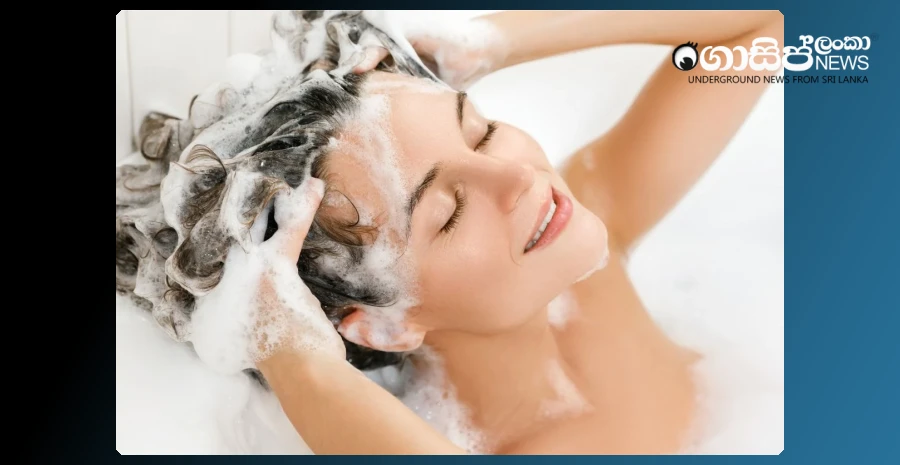
Looking at the daily lifestyle of contemporary society, we are accustomed to using various cosmetics and cleansing agents to maintain body health and cleanliness. Among these, "shampoo" and "conditioner" hold a prominent place.
For many, bathing is not a complete process without the use of shampoo. But have you ever wondered if the shampoo we use is truly essential for our hair, or if it's merely a massive marketing ploy designed to attract consumers? Recently, a discussion among health reporters and medical specialists revealed many important and interesting facts about this. This article is prepared based on the history of shampoo, the function of its chemical ingredients, and the experiences of individuals living without using shampoo.Looking at the history of shampoo, it appears to have a very long past. Surprisingly, the word "shampoo" was introduced to the Western world via India. It is said to have originated from the Sanskrit word "Chapo," meaning to massage or rub. Ancient Indians maintained a practice of massaging their heads using extracts obtained by boiling natural substances like soap berries. Colonial rulers and traders who came to India observed this practice and took it to Europe, where it eventually became known as "shampoo." This clearly indicates that the origin of the product we use today lies within Eastern culture and the use of natural herbal remedies.
However, looking at a shampoo bottle in the current market, its ingredients are entirely different from the natural extracts used in the past. Modern shampoo production is based on complex chemistry. The primary component here is detergent, or cleansing agents. These work by breaking down the surface tension of water, removing oil, dirt, and dead skin cells from the hair. But shampoo manufacturers are not satisfied with mere cleansing. They use various tactics to give consumers the impression that they are using a high-quality product. For example, "foaming agents" are added to create a large amount of lather when shampoo is applied. While this lathering is not actually essential for cleaning the hair, consumers are reluctant to use a shampoo that doesn't foam.
Furthermore, various chemicals are added to increase the thickness of the shampoo liquid and give it a shiny, pearl-like appearance. This is purely done with the aim of enhancing the product's external appearance and "luxury" feel. In addition, preservatives like parabens are added to prevent the growth of fungi and bacteria, and artificial fragrances are included for scent. The problem that arises here is whether such a large number of chemicals frequently coming into contact with the scalp is beneficial for health. Some individuals fear the absorption of these chemicals into the body, while others believe that this can harm the natural microbial environment (Microbiome) of the scalp.
After using shampoo, many people are also accustomed to using conditioner. This is also an interesting chemical process. Since shampoo removes the natural oils from the hair, the hair tends to become dry. Conditioner is used to control this. Scientifically, hair has a negative electrical charge. Conditioner is formulated to contain positively charged particles. Due to this positive and negative attraction, the conditioner adheres to the hair, covering damaged areas and giving the hair a smooth feel. Simply put, we are forced to use another chemical, conditioner, to solve the problem created by shampoo.
Due to the use of these chemicals and the harm caused to the environment (such as the release of plastic particles into water), a global trend of "No Poo," or going without shampoo, is developing. Individuals following this method completely abstain from commercial shampoos or soaps, cleaning their hair using only water or very natural substances. According to them, during the first few weeks after stopping shampoo use, the hair becomes very oily. This is because the glands in the scalp are accustomed to producing more "sebum" (oil) to compensate for the oil constantly removed by shampoo. However, their experience shows that when shampoo use is stopped, over time, the activity of these glands balances out, natural oil production is regulated, and the hair then takes on a healthy and clean appearance.
From a medical perspective, doctors like Dr. Norman Swan point out that if you do not have a specific dermatological condition like dandruff or psoriasis, daily or frequent shampoo use is not mandatory. In fact, our ancestors lived for centuries without any of these commercial products. There is no scientific evidence that limiting or stopping shampoo use causes health damage to a person with a healthy scalp. Perhaps washing hair less often than we think might help maintain the natural oil balance of the scalp.
Finally, it can be said that shampoo has become more of a social habit and a psychological necessity than an essential part of our lives. Many are addicted to the clean and light feeling obtained from using a small amount of foamy, fragrant shampoo. However, rather than seeking "miraculous" results as shown in advertisements, it is wiser to understand the nature of your scalp and, if necessary, choose an appropriate cleansing method under the advice of a dermatologist. If you wish, you can continue using shampoo, and if you are concerned about the environment and chemicals, there is no obstacle to minimizing shampoo use or trying alternative methods. The most important thing is to wisely choose your health habits without being deceived by advertisements.
(Based on ABC Science)