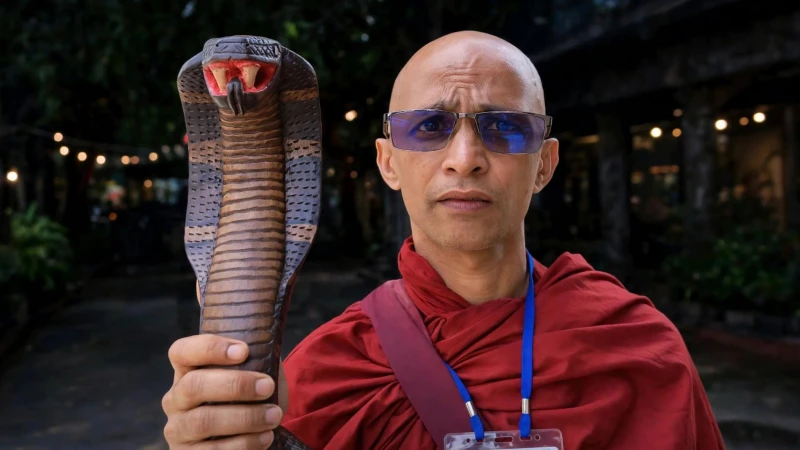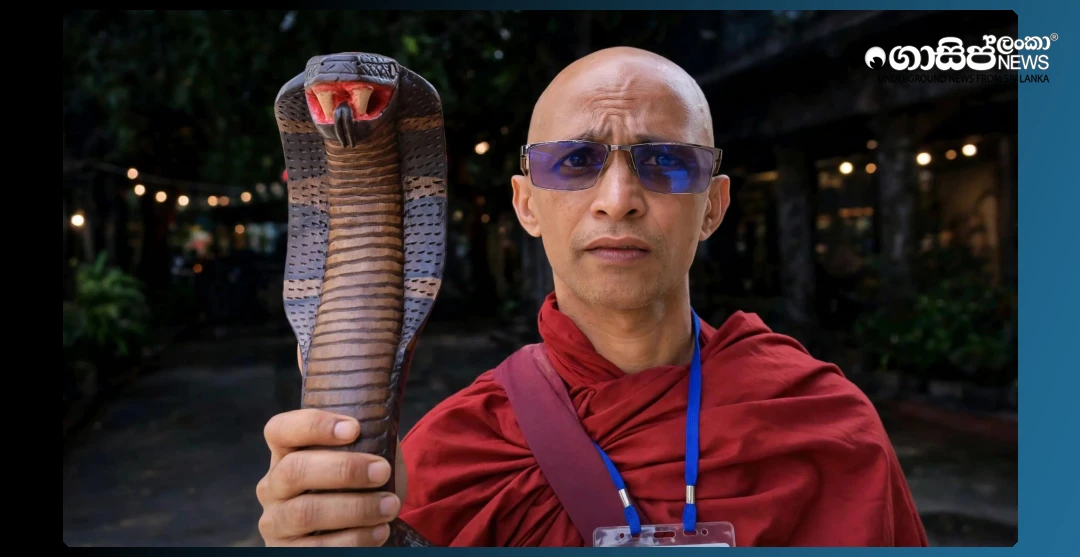
The character known as "Nai Cheevaradhariya" (the monk with the snake) has recently become a figure of intense controversy on social media in Sri Lanka. His real name is Raigamage Mahinda.
His background, reportedly residing at the Digalana Aranya Senasanaya in Elpitiya, Galle, takes on a completely different dimension from the traditional life of a Buddhist monk. According to reports, he is a married man from the Deraniyagala area and a father of two children. He is also currently facing severe public criticism for reportedly paying maintenance to his family.His recent walk from Kandy to Colombo further intensified this controversy. Although he claimed that over a hundred people were with him, by the time he reached Kadugannawa, before arriving in Colombo, only his "Naga Basthama" (snake staff) remained with him. According to reports, this walk concluded incompletely yesterday.
Mahinda claims that this Naga Basthama, reportedly created by someone named 'Sura' from the Kothmale area as an aid for the walk, is the first instance in Sri Lankan history where a monk has used such an item. He states that he adopted this practice after observing monks in countries like Tibet, Laos, and Myanmar using bamboo staffs, and that it symbolizes Mucalinda, the Naga King who sheltered the Buddha, and the ancient Naga tribal history of Sri Lanka. He further adds that he had previously undertaken a 125 km walk from Kurunegala to Anuradhapura.
However, his behavior and snake-related activities, reportedly ordained as Bodhidhamma in Ratnapura, have caused intense public anger. He himself admits that even photos of him with snakes around his neck are circulating on social media. He states that the threats and insults directed at him are not from other ethnicities or religions, but from Sinhala Buddhists themselves, and he also alleges that some threats came through accounts with the 'Malimawa' (compass) symbol. He has declared that if people reject his activities, he will abandon everything and return to his wife and children.
This incident has also sparked severe public criticism regarding the behavior of certain individuals within the Buddhist monastic community. Commentators on social media platforms like YouTube, particularly citing channels like 'Lal Talk', point out that this is not merely an issue concerning one individual. They raise serious allegations that individuals like 'Thiththagalla', who was reportedly assaulted at a mansion in Galle previously, have reached a point where they even propose marriage to the daughters of Mahanayaka Theros, and that there are monks who publicly state that associating with around three hundred women is acceptable. Furthermore, critics claim there are rumors that such individuals in areas like Kelaniya and Bellanwila even use lorries to transport and support children.
Against such a backdrop, critics issue a strong warning that if the Mahanayaka Theros do not immediately take action against individuals who are destroying the Sasana (Buddhist dispensation), the general public will take the law into their own hands in the future. It is evident from the current public discourse that if official steps are not taken to control individuals who support children under the guise of robes and engage in anti-Sasana activities, even more severe reactions could emerge within society.