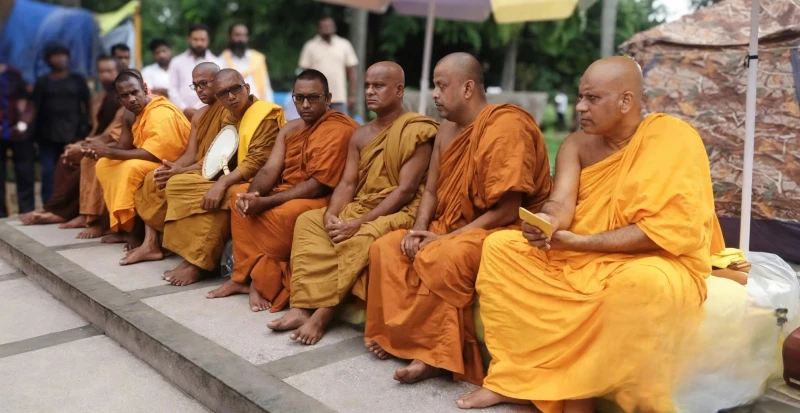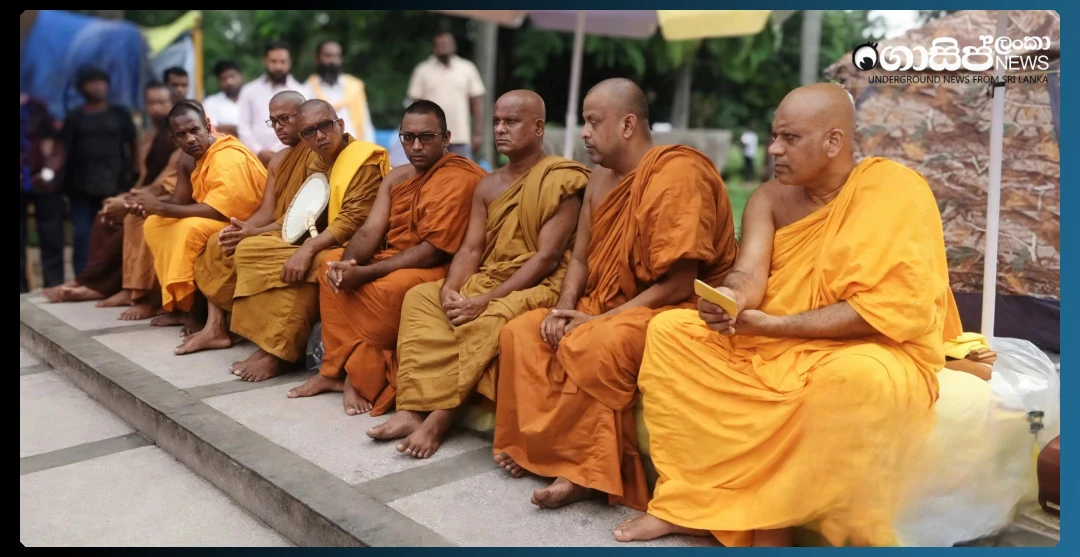
The Satyagraha, which has been ongoing for several days in Viharamahadevi Park, Colombo, has now generated both legal and social controversy. Although the court has twice firmly ordered the removal of the Satyagraha from that location, the protesters are still remaining there, interpreting the court order differently as an affirmation of their rights.
The beginning of this protest was marked by a peaceful protest march that arose against the illegal and anti-Buddhist removal of Venerable Galagodaaththe Gnanasara Thero's robes when he was brought out of court after his imprisonment. The lawyer representing the Satyagrahis points out that the protesters, who initially gathered near the President's House in Colombo, respected the police's notification that the main road would be blocked and moved away from that spot.
The police, presenting facts to the court, have issued an order under the provisions of Section 106 (1) of the Criminal Procedure Code No. 15 of 1979 to the chief incumbents including Venerable Ulapane Sumangala and Venerable Balangoda Kashyapa, other monks continuously present, civil activists, and representatives of various political parties. Accordingly, the relevant parties have been ordered not to obstruct F. R. Senanayake Mawatha, Lipton Roundabout, Soysa Roundabout, Dharmapala Mawatha, Kannangara Mawatha, Greenpath Road, and Malpara, including the premises near the Buddha statue in front of Viharamahadevi Park and the walking paths. Furthermore, it has been emphasized that they should refrain from continuously staying in front of the Prime Minister's Office on Malpara and near the Buddha statue in Viharamahadevi Park, and not damage any public or private property.
A motion was filed in the Colombo Fort Magistrate's Court requesting the removal of the prohibitory order issued against this Satyagraha, but it was rejected. However, the judge did not issue warrants for the arrest of these individuals. According to the interpretation of the lawyer representing the Satyagraha, it was stated in court that the Magistrate has no intention of restricting the right to freedom of expression and peaceful assembly, which is affirmed by the Constitution, and that it is permitted to continue as long as it does not obstruct the public or public property. The protesters' stance is that since they have remained peacefully for seven days without damaging any public property (transformers or buses), there is no further impediment to continuing their religious activities.
Commenting on this legal situation, Venerable Ulapane Sumangala Thero states that although the police reported to the court that the sidewalk and lane were obstructed, the Satyagraha is being held approximately three hundred meters away from the walking path. He also emphasizes that although the police requested a warrant from the court to arrest Venerable Kassapa Thero and others involved in the Satyagraha, the judge rejected it.
Venerable Sumangala Thero states that they have not had any clashes with the police during the past seven days, and even when 'Malima' supporters passing by insulted them and booed, they responded with metta (loving-kindness). He also points out that although a large exhibition by the Prime Minister, held three hundred meters away with extensive coverings, caused significant inconvenience to the public, they have not caused any such obstruction to anyone.
His Holiness's view is that this Satyagraha is not merely a political slogan, but a struggle to save the Sasana (Buddhist dispensation) from 'traitors to the nation'. He states that this is the first time since independence that a struggle is being waged to save the Sasana from a sitting government, and he strongly criticizes the current subject minister for referring to Ruwanwelisaya as a 'monument'. He also accuses the current administration of attempting to oppress Sinhala Buddhists by exploiting their innocence and non-violence.
The protesters state that they are conducting 'Seela Bhavana' (meditation and observance of precepts) programs at this location on Poya days to protect the foremost place given to Buddhism, as affirmed by the Ninth Article of the Constitution. Following the statement made by Venerable Ulapane Sumangala Thero, "Even if we give our lives, or if our lives are taken, we will not abandon our struggle except by achieving victory," the Satyagrahis continue their protest by chanting 'Pirith' (Buddhist blessings).