![Gossip Lanka News [English]](https://blogger.googleusercontent.com/img/a/AVvXsEhYm2aFFq-bIW1nWX-RrqnPFoIsVos6_VCVz8BpLt0QJi55GNXHXC2fugeRvL0qUStEuCfs7Sfu6ZiSlhrkldxfGuE_wzy5gitY6rMZ2KSi8VBbGvkgXLks37RwZV-4-HKbWiNLRxB8C_r1e4z3mpxFTMPDJPEADoG8E-bZteWFipeD5KNGbjvCfqEfKw=s300 "Gossip Lanka News [English]")
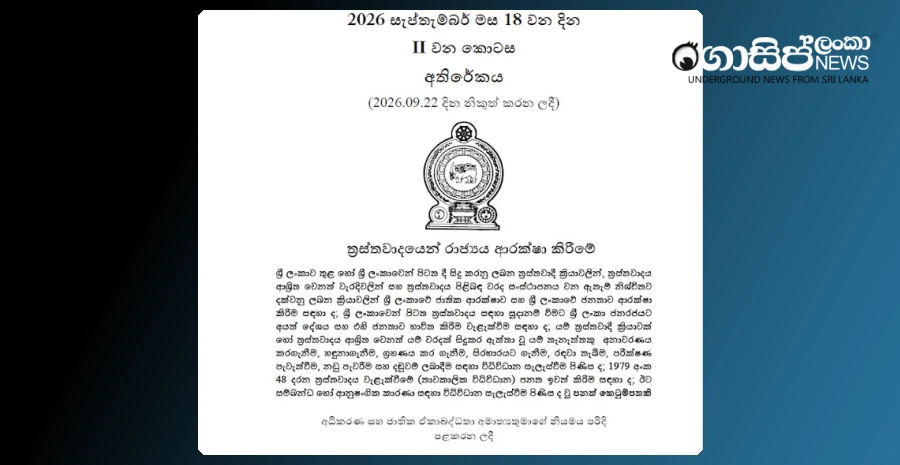
The government has published the 'Bill to Protect the State from Terrorism,' prepared by completely repealing the Prevention of Terrorism (Temporary Provisions) Act No. 48 of 1979, which was in force in this country for over 45 years, through an extraordinary gazette. This new bill, issued under the instructions of the Minister of Justice and National Integration, is expected to be passed in Parliament and come into effect from the appointed date.
The main objective of this Act is to ensure the security of Sri Lankans, diplomatic properties located both domestically and abroad, as well as national security. It provides a new legal framework for terrorist offenses, investigations, detentions, and prosecutions, in accordance with fundamental rights enshrined in the Constitution and international human rights standards.
Murders, serious injuries, hostage-taking, damage to infrastructure and the environment, as well as cyber attacks carried out with the intention of instilling fear in the public or influencing a government for political or ideological purposes, are defined as terrorist offenses herein.
Nevertheless, special provisions have been included in the bill to protect the right to peaceful expression. Accordingly, Section 4(4) confirms that peaceful protests, trade union actions including strikes, provision of humanitarian aid, as well as fair reporting by journalists, political criticism, expression of opinions, and academic or research activities shall in no way be considered terrorist offenses or promotion of terrorism.
New procedures have been introduced to ensure transparency during the arrest and investigation of suspects. Any suspect arrested must be produced before the nearest Magistrate within 48 hours, and written notification of the arrest must be given to the next of kin and the Human Rights Commission of Sri Lanka within 24 hours. Furthermore, interrogations must be recorded using audio-visual technology, and Magistrates and the Human Rights Commission have been granted the power to inspect detention centers without prior notice.
Strict limitations have also been imposed regarding detention periods. A detention order issued by the Secretary to the Ministry of Defence shall not exceed two months at a time, and the total detention period is limited to a maximum of one year. Prior approval from the High Court must be obtained for detention exceeding two months. Furthermore, an 'Independent Review Committee' headed by a retired Supreme Court or Court of Appeal judge is proposed to examine the legality of detention orders, and aggrieved detainees can seek relief from this committee.
For a statement made by a suspect before a Magistrate to be accepted as evidence, forensic medical examinations before and after the said statement are mandatory. If it appears that a suspect has been subjected to torture, the Magistrate has the power to immediately provide medical treatment, transfer the suspect, and order an investigation by the Inspector General of Police.
In sentencing, those convicted of causing death in a terrorist attack will receive life imprisonment. For other serious offenses, aiding and abetting proscribed organizations, or providing funds, rigorous imprisonment up to 20 years and fines up to 20 million rupees can be imposed. However, in cases where no deaths or serious harm occurred, the new bill also provides for the postponement or suspension of prosecution on conditions such as public apology, rehabilitation, or compensation to victims, with the consent of the Attorney General and approval of the High Court.