![Gossip Lanka News [English]](https://blogger.googleusercontent.com/img/a/AVvXsEhYm2aFFq-bIW1nWX-RrqnPFoIsVos6_VCVz8BpLt0QJi55GNXHXC2fugeRvL0qUStEuCfs7Sfu6ZiSlhrkldxfGuE_wzy5gitY6rMZ2KSi8VBbGvkgXLks37RwZV-4-HKbWiNLRxB8C_r1e4z3mpxFTMPDJPEADoG8E-bZteWFipeD5KNGbjvCfqEfKw=s300 "Gossip Lanka News [English]")
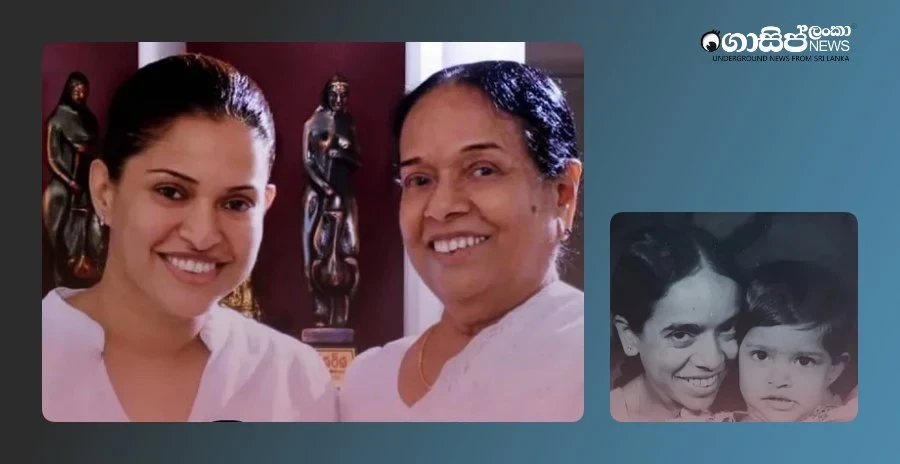
Her name is Ama Sarada. She is the youngest daughter of the veteran singer Nanda Malini, who passed away from among us. This is a summary of the wonderful conversation she had about Nanda Malini when she appeared on a program on the Lak Handa channel 2 years ago in 2024...
Although there were many questions we wanted to ask Sarada, the first question that came to mind was why she didn't enter the art field despite having so many opportunities through her mother, who is known by the entire country. Even as we asked that question, Sarada, dressed in a very simple attire just like Malini, had no shortage of smiles on her face. After a short while, Sarada, awakening her voice, answered the question in detail. She first stated that being born to such a mother was a great fortune. Also, according to her memory, her mother never exerted any kind of influence on their lives at any point. Simply put, Malini did not provide the traditional parental guidance on what subjects they should choose or who they should become. So, from a young age, they had the opportunity at home to explore fields they liked. Especially, Malini's friends from the art world, scholars, and connoisseurs used to visit their home, and Sarada had the opportunity to meet and converse with them from a young age. They even had the opportunity to address these respected figures who visited as 'uncle' and 'aunt' because of their mother's value.
Perhaps for that reason, Sarada said she didn't feel a great specialty in music. However, she studied music as a subject up to G.C.E. Advanced Level. Not stopping there, she was even selected for the University of Visual and Performing Arts but did not pursue it further. She has also completed a diploma in the Indian Bhatkhande system, and amidst all this, she states that music and appreciation are two different things.
Next, we inquired about love, which everyone desires. Sarada's answer to this was also quite remarkable. She said that love is our timeless need. Especially, as one matures, it is felt even more strongly than in youth. Changing Sarada's focus again, we asked about her feelings regarding tears. There, Sarada, recalling her mother, remembered the bitter, dark paths Nanda Malini had to traverse, despite gaining so much public admiration. She mentioned, to her knowledge, that her mother had economic difficulties in her childhood but did not lack love. However, she stated that there is a question as to whether her mother experienced love in her youth. Accordingly, she said that there is a very close relationship between tears and love. “My mother is someone who deserves love. But she suffered because of love. I only saw her tears once. That was on the day Amaradeva passed away. My mother was someone who sang songs for the country even with a pistol to her head. It is a great fortune for me to be her daughter,” said Ama Sarada, Nanda Malini’s daughter.
As the conversation flowed, the song 'When the whole world is fed up, disillusioned, and burning...' came to our minds.
We heard that song in Nanda Malini's voice many years ago. We wanted to ask Sarada about this because almost everyone, young and old, still has a fondness for this song. Sarada, with her usual smile, stated that because the apparent meaning of the song was love, her mother was skilled enough to sing such a phenomenon very smoothly, immersing thousands of listeners in bliss, perhaps because she herself might have faced such a situation. Further interpreting the song, she said that even though various other definitions are provided for love, just one word from the lover is enough to comfort the other party. She states that in love, the mental bond is much stronger than the physical bond. She also said that especially in Asian countries like ours, relationships are viewed from different angles, but there might be deep events within some relationships that we don't see. Furthermore, she stated that human lives cannot be built without love.
Next, we turned to her school days. While it is normal for other children's parents to attend parent-teacher meetings, we asked if the presence of Sarada's mother, Dr. Nanda Malini, was special to her as a child..
Sarada gave a very remarkable answer to that as well.
Sarada went to Anula Vidyalaya, Nugegoda, with her elder sister. She recalled that even then, there were many arguments with her mother and father.
She stated that her mother alone was both her mother and father. After that, she mentioned that as a child, being Nanda Malini's daughter began to feel like a nuisance when her mother would stop at various places every time she came to school and engage in conversations with teachers and parents. However, she mentioned that as they grew older, it felt like a great honor.
Again, we steered the conversation in a new direction and asked Sarada about her mother's reverence for her teachers. Sarada stated that no matter how harsh a time her mother went through, she never saw her fallen, and that itself was a question for her. Recalling her memory, she said that if there was one day her mother cried, it was the day of Amaradeva's demise. She very humbly stated that Amaradeva was truly a teacher who built the woman named Nanda Malini. She also stated that even today, if Amaradeva is seen on television or a song of his is heard, that respect emanates from her mother's face.
Next, we spoke with Sarada about Nanda Malini, the revolutionary. Starting the discussion about the many songs in her songbook that raised a voice against injustice and unfairness, we began by asking if she talked about music at home. Sarada stated that most of the time, music was not discussed at home. She mentioned that her mother always kept her professional life and family separate.
Recalling 'Pawana', Dr. Nanda Malini is a remarkable artist who did not stop her art of singing even when a gun was pointed at her head. We wanted to ask her daughter Sarada about this because no one knew more about her mother than she did.
Regarding that, she stated that she and her elder sister, just like their mother, fell victim to these problems. Although she didn't have much knowledge about it at the time, she recalls that her mother's inability to stay in Sri Lanka and the fact that Sarada and her sister, as young children, were subjected to various threats created an extremely stressful environment. However, she mentions with her usual smile that today she feels great joy about the sacrifices made for her mother. Sarada also did not forget to remember all the relatives, friends, and teachers who helped in various ways during those difficult times.