![Gossip Lanka News [English]](https://blogger.googleusercontent.com/img/a/AVvXsEhYm2aFFq-bIW1nWX-RrqnPFoIsVos6_VCVz8BpLt0QJi55GNXHXC2fugeRvL0qUStEuCfs7Sfu6ZiSlhrkldxfGuE_wzy5gitY6rMZ2KSi8VBbGvkgXLks37RwZV-4-HKbWiNLRxB8C_r1e4z3mpxFTMPDJPEADoG8E-bZteWFipeD5KNGbjvCfqEfKw=s300 "Gossip Lanka News [English]")
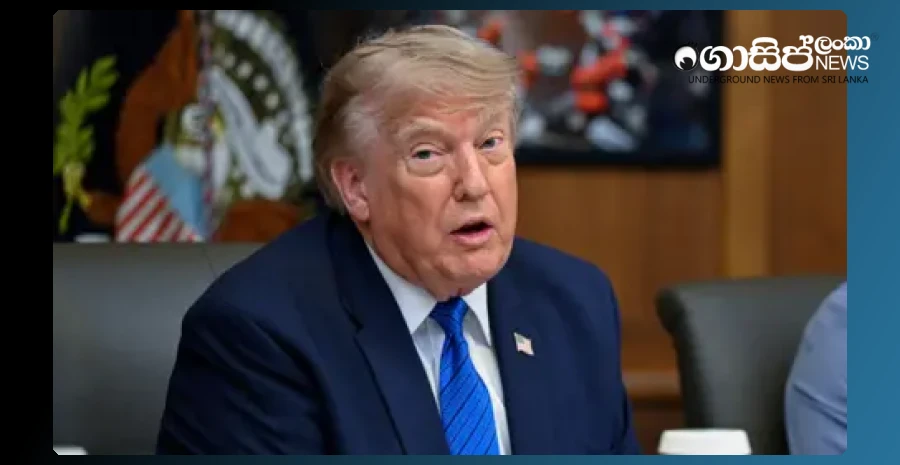
US President Donald Trump has stated that he decided to suspend military attacks planned against Iran if an agreement could be reached with the country very soon. Mr. Trump, in a post on his 'Truth Social' account, mentioned that several Middle Eastern countries, including Iran, had requested him to temporarily delay the military attack, as an agreement had been reached on the basic framework of a deal.
This statement was issued against the backdrop of reports that the United States and Israel were preparing to launch a massive and powerful series of attacks against Iran. It is a prominent feature of Trump's foreign policy to issue destructive threats and then allow room for diplomatic solutions.However, Iran's semi-official 'Mehr' news agency has completely rejected claims that Tehran requested the US to delay military action, stating that Trump's statement is "just another new lie." Meanwhile, Iran's acting Defense Minister, Majid Ibn Al-Reza, stated that although every threat from their enemies is part of a psychological war, Iran considers them real and credible threats. He further emphasized that Iran will never be caught off guard by anticipated attacks and will not remain inactive at all.
American media had reported that the United States and Israel were planning the most powerful series of bombing attacks ever launched, targeting Iran's energy infrastructure. According to America's CBS news service, these attack plans were discussed at a cabinet meeting held at Camp David. The US government has advised all American citizens residing in the Middle East to be prepared to evacuate immediately if the situation in the region escalates. Trump stated in his post that the US was prepared against Iran with a level of military power and offensive strength not seen since World War II. However, he said that suspending this attack would contribute to the future good of the entire world and the existence of a successful and prosperous Iran.
Previously, on April 7, Trump had also threatened that if Iran did not agree to peace talks, "an entire culture would be destroyed," and warned of destroying Iran's civilian infrastructure and power plants. Although widely criticized as a war crime, this threat led to bilateral talks in Pakistan, spearheaded by Vice President J.D. Vance. While his supporters opined that such strong threats from Trump, known as the 'Madman Theory,' were able to bring Iran to the negotiating table, the talks ended without an agreement due to numerous unacceptable conditions.
Speaking to reporters at the Camp David meeting, Trump had stated that the US would launch very powerful attacks until the Iranian people could no longer bear it. Subsequently, the Saudi state news agency reported that a phone conversation took place between Saudi Arabia's Crown Prince Mohammed bin Salman and Trump, with the aim of reducing regional tensions. The Saudi Crown Prince emphasized the importance of reaching a milestone centered on discussions between the parties to de-escalate conflicts and pave the way for diplomatic solutions.
Although Iranian missiles do not pose a threat to the American mainland, Gulf region US allies such as Bahrain, Jordan, and the United Arab Emirates are deeply concerned that their infrastructure, including water treatment plants, could be subjected to Iranian attacks. After a prepared truce agreed upon in April broke down in June, Washington and Tehran continuously exchanged attacks and counter-attacks. The US blockaded Iranian ports and bombed Iranian targets, while Iran launched missile and drone attacks against American targets in the Middle East, disrupting shipping in the Strait of Hormuz, which is vital for global oil transportation.
Due to this, significant fluctuations occurred in global oil prices, and Trump has had to face considerable pressure not only internationally but also domestically. According to the 'Pew' Research Center, approximately 60% of Americans do not approve of this war with Iran, which has also led to a rapid decline in Trump's popularity. The American President is well aware that such foreign policy decisions can have severe domestic repercussions for his administration in the face of the upcoming critical American midterm elections.