![Gossip Lanka News [English]](https://blogger.googleusercontent.com/img/a/AVvXsEhYm2aFFq-bIW1nWX-RrqnPFoIsVos6_VCVz8BpLt0QJi55GNXHXC2fugeRvL0qUStEuCfs7Sfu6ZiSlhrkldxfGuE_wzy5gitY6rMZ2KSi8VBbGvkgXLks37RwZV-4-HKbWiNLRxB8C_r1e4z3mpxFTMPDJPEADoG8E-bZteWFipeD5KNGbjvCfqEfKw=s300 "Gossip Lanka News [English]")
The 'Martian Moons eXploration (MMX)' mission, led by the Japan Aerospace Exploration Agency (JAXA), is set to make history as the world's first mission designed to bring samples from Mars' moons back to Earth. The main objective of this mission is to collect at least 10 grams of surface soil from Phobos, Mars' largest moon, and return it to Earth in 2031.
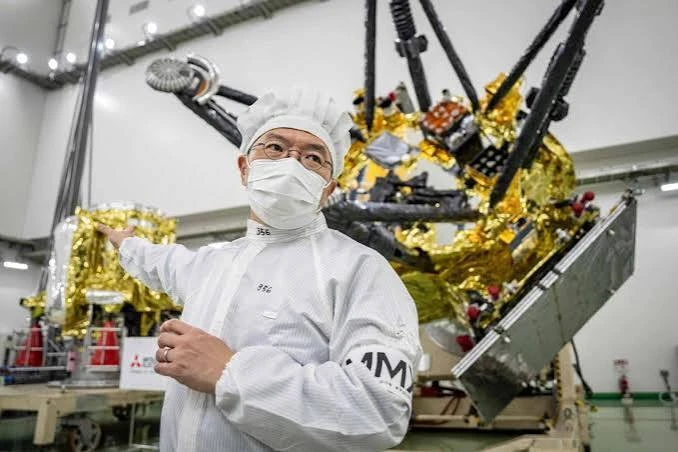
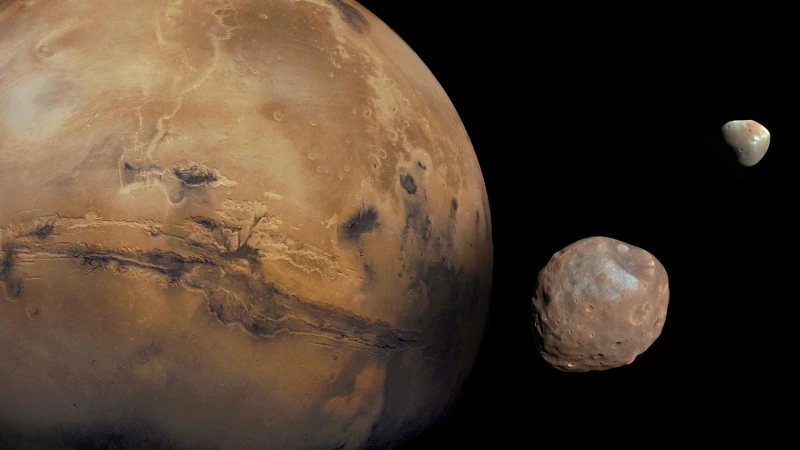
On August 13, 2026, JAXA officially unveiled the flight model of this spacecraft to the media at the Tanegashima Space Center in Kagoshima Prefecture, southern Japan. It is scheduled to be launched into space by an H3 rocket in the autumn of 2026, and Project Manager Yasuhiro Kawakatsu stated that after years of development, his team is now at the starting line of the mission. Weighing between 4 and 4.5 tons, this spacecraft is one of the largest planetary exploration vehicles designed by Japan, standing approximately 5.3 meters tall and featuring a solar panel system that extends to about 9 meters when deployed.Mars' two moons, Phobos, with a diameter of about 22 kilometers, and Deimos, with a diameter of about 13 kilometers, have irregular shapes and dark surfaces, and their origin remains a major unsolved problem in solar system science. One theory is that these moons are primitive asteroids containing water and organic matter that were captured by Mars' gravity, while the other main theory is that they were formed from debris ejected after a massive impact on Mars. Since these controversial ideas cannot be resolved solely through remote sensing data, scientists hope to confirm their true origin through mineralogical and isotopic laboratory analyses of the samples brought back to Earth. Additionally, since debris ejected from the Martian surface is expected to be mixed with Phobos' surface, information about Mars' chemical history and the existence of past life can be revealed without the risk of directly going to Mars to collect samples. Other objectives of this mission include mapping the composition and topography of the two moons, observing Mars' atmosphere and climate, and developing new technologies for deep space communication and landing under low-gravity conditions.
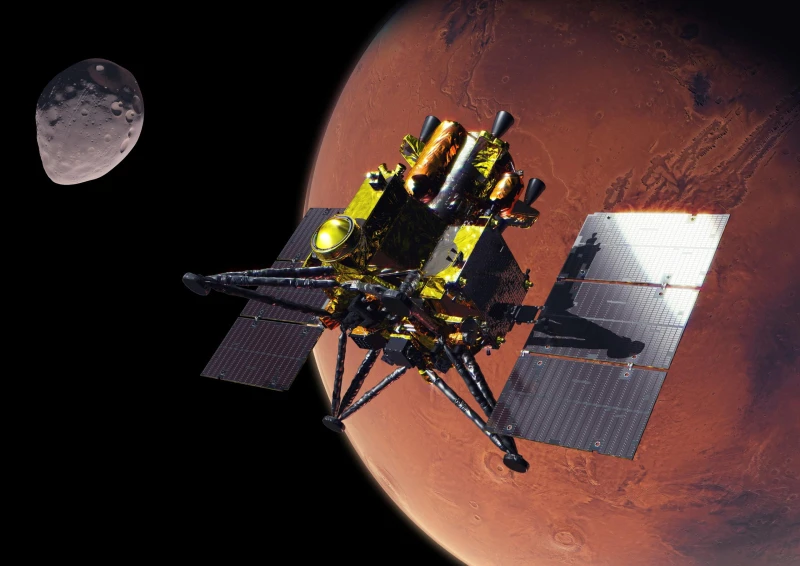
This spacecraft consists of three main parts: the propulsion module, the exploration module, and the sample return module. Launched from Tanegashima in late 2026, the spacecraft is expected to reach Mars' orbit in 2027. Since Phobos' gravity is extremely weak, 1,700 to 1,800 times less than Earth's, the spacecraft will not travel in a normal orbit but will use a quasi-satellite orbit to conduct exploration activities and select landing sites between 2027 and 2029. Subsequently, in 2029, the spacecraft will land on the moon's surface once or twice for only a few hours during daylight, collecting samples. The sample-containing capsule, separating from the spacecraft departing the Martian system in 2030, is scheduled to land in Australia's Woomera Desert region in 2031.
To collect samples, the spacecraft is equipped with two distinct but complementary instruments known as C-SMP and P-SMP. The C-SMP system, mounted on a robotic arm, drills into the surface soil to a depth of at least 2 centimeters or more to collect samples, while the P-SMP system uses compressed gas to draw surface soil debris into a collection container. The goal is to obtain a 10-gram sample, more than double the 5 grams collected by the Hayabusa2 mission, and to minimize risk, the spacecraft's stay on the moon's surface is limited to about 2.5 hours. Before the main spacecraft lands, the Idefix rover, a Franco-German joint product weighing between 23 and 25 kilograms, is scheduled to be deployed from a height of several tens of meters to observe the moon's surface mechanical properties. Operating for 100 days, it will provide preliminary information necessary for sample collection using instruments such as 3D navigation cameras and Raman spectrometers.
Built upon the experience of Japan's highly successful Hayabusa and Hayabusa2 asteroid sample return missions, the MMX project operates with the active participation of international organizations including NASA, France's CNES, Germany's DLR, and the European Space Agency (ESA). By mid-August 2026, its flight model had already been delivered to Tanegashima, where system-level tests were conducted in its cleanroom and it was showcased to the media. Launch site operations and final electrical tests are currently ongoing, and it is reported that the development of this massive project has cost between 350 and 400 million US dollars (approximately 55 billion Japanese Yen).