![Gossip Lanka News [English]](https://blogger.googleusercontent.com/img/a/AVvXsEhYm2aFFq-bIW1nWX-RrqnPFoIsVos6_VCVz8BpLt0QJi55GNXHXC2fugeRvL0qUStEuCfs7Sfu6ZiSlhrkldxfGuE_wzy5gitY6rMZ2KSi8VBbGvkgXLks37RwZV-4-HKbWiNLRxB8C_r1e4z3mpxFTMPDJPEADoG8E-bZteWFipeD5KNGbjvCfqEfKw=s300 "Gossip Lanka News [English]")

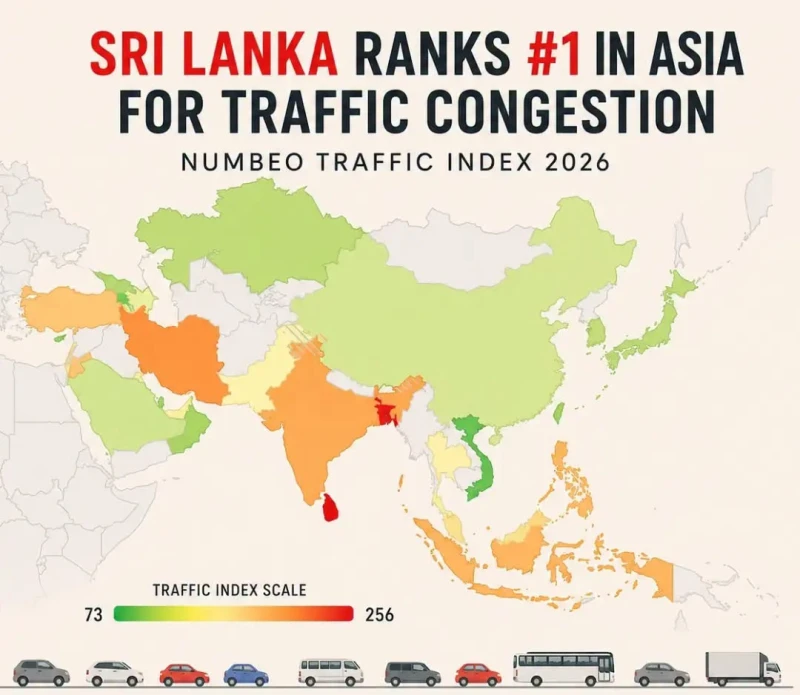
According to the latest Numbeo traffic index released for the year 2026, Sri Lanka has become the country with the most severe traffic congestion in the entire Asian region. According to these latest data reports, Sri Lanka leads this unfortunate ranking by scoring 254.5 points on the traffic index.
Compared to other Asian countries, Bangladesh secured the second position with 246.2 points, Iran the third with 215.3 points, and India the fourth with 205.1 points. Indonesia, the largest and most populous country in Southeast Asia, ranked fifth with 191.1 points, clearly illustrating the serious challenge of increasing road congestion across Asia. Additionally, Jordan, Turkey, Lebanon, the Philippines, and Pakistan are among the top 10 countries with the highest regional traffic congestion, while countries like Malaysia, Thailand, Singapore, and Vietnam have managed to report relatively low levels of traffic congestion.
Globally, Sri Lanka has been named the country with the third-highest traffic congestion in the world, with Nigeria (320.3 points) and Costa Rica securing the first two positions respectively. Bangladesh and Kenya complete the list of the top five countries globally. Numbeo calculated this index based on several key factors such as time spent commuting, time wasted due to congestion, breakdown in fuel efficiency, and carbon dioxide emissions caused by traffic congestion.
The publication of these rankings has sparked intense discussion and critical public analysis within society. According to public opinion, the majority question the reliability of this index, stating that the situation in Sri Lanka is much better compared to the severe traffic congestion in major Asian cities like Bangkok, Jakarta, Dhaka, Mumbai, and Delhi. Many point out that the Numbeo index is based on a survey methodology where anyone can express preferences and provide data online, rather than solely on objective data from the ground, thus suggesting potential bias or inaccuracies. Nevertheless, the public acknowledges an increase in traffic congestion in Colombo and its suburbs, identifying places like Borella Junction, Orugodawatta, and the Nugegoda-Nawala road as key areas experiencing daily severe congestion.
Regarding solutions to the country's transport crisis, various opinions are clashing among the public. Some parties criticize the abandonment of large-scale projects like the Japanese Light Rail Transit project due to political reasons, while others point out that spending an enormous sum of USD 2.2 to 2.5 billion for a short distance of 16 km is impractical, and it would take generations to repay such a cost. In contrast, implementing the Colombo suburban railway efficiency enhancement project, estimated at a relatively lower cost of around USD 192 million, along with railway electrification and strengthening metro bus services, are proposed as more suitable alternatives. Additionally, ideas are expressed that practical strategies such as limiting the number of private vehicles entering the city, charging a fee for vehicles carrying fewer passengers than their seating capacity when entering the city, and strictly enforcing road discipline could alleviate existing congestion.