![Gossip Lanka News [English]](https://blogger.googleusercontent.com/img/a/AVvXsEhYm2aFFq-bIW1nWX-RrqnPFoIsVos6_VCVz8BpLt0QJi55GNXHXC2fugeRvL0qUStEuCfs7Sfu6ZiSlhrkldxfGuE_wzy5gitY6rMZ2KSi8VBbGvkgXLks37RwZV-4-HKbWiNLRxB8C_r1e4z3mpxFTMPDJPEADoG8E-bZteWFipeD5KNGbjvCfqEfKw=s300 "Gossip Lanka News [English]")
The conflict between the United States and Iran has severely escalated over the past twenty-four hours due to Iran's attacks on commercial vessels transiting the Strait of Hormuz. In this critical maritime region, where more than twenty percent of the world's energy trade occurs, Iranian-backed forces have attacked three commercial vessels, including Qatar's 'Al Rekayat' and Saudi Arabia's 'Wedyan'.
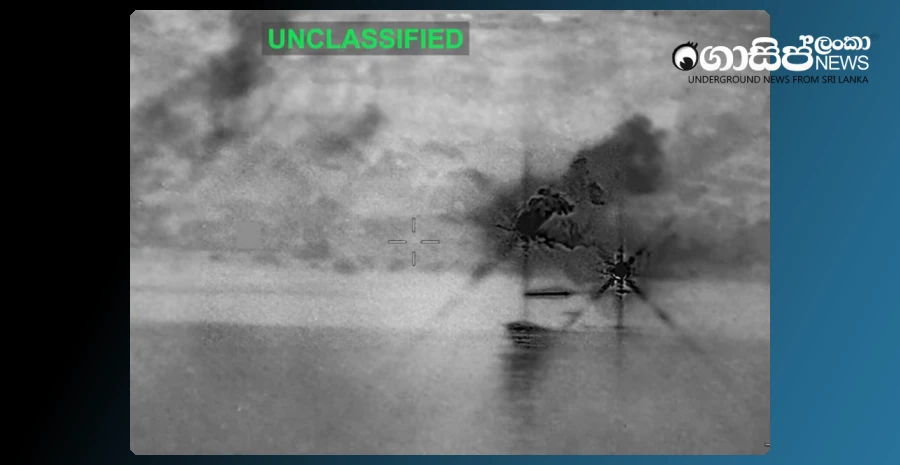
These attacks caused severe damage to the vessels, with fires and crew evacuations reported, effectively ending the fragile ceasefire that had been in place. Although Iran did not take full responsibility for these attacks, it has used this as an opportunity to assert control and transit fees in the Strait. In response, the United States has taken steps to revoke the waivers previously granted for Iranian oil exports.In response to Iranian naval attacks and to counter threats to maritime navigation, the U.S. Central Command (CENTCOM) has launched a massive series of airstrikes against Iran. The U.S. attacked over 80 targets, including air defense systems, coastal radar stations, anti-ship missiles, and command centers, targeting areas such as Bushehr, Chabahar, Bandar Abbas, and Jask. Large explosions and plumes of smoke were reported from southern Iran, and one civilian was reportedly killed in the Iranshahr region. Although U.S. authorities stated that these attacks were directed at very precise targets, an investigation is currently underway regarding an alleged incident near a school and a naval base. U.S. President Donald Trump has stated that further action will be taken if necessary, but he hopes to resolve the conflict quickly.
In response to the American attacks and to protect its sovereignty, the Iranian Revolutionary Guard Corps (IRGC) and the Iranian military have jointly launched a series of missile and drone attacks on American and Gulf military bases in Bahrain and Kuwait. Targets included Sheikh Isa Air Base, the Fifth Naval Fleet Headquarters and fuel depots in Juffair, Bahrain, as well as Patriot missile defense systems at Camp Arifjan and Ali Al Salem Air Base in Kuwait. Early warning communication systems in Qatar are also suspected to have been targeted, and American defense systems have managed to thwart some of the attacks. Iran has issued warnings to all American bases in the region, vowing to expand attacks further if aggressive actions continue.
This military escalation comes amidst a nationwide period of mourning declared for the recently deceased Iranian Supreme Leader Ayatollah Ali Khamenei. Before his burial in Mashhad, his body is being carried through cities like Najaf and Karbala in Iraq for religious ceremonies and public tributes. Khamenei's son, Mojtaba Khamenei, has been appointed as Iran's new Supreme Leader. This appointment consolidates the power of hardliners, and Trump had previously declared it unacceptable. Addressing the NATO summit, Trump stated that previous agreements are now over, but opportunities for negotiations remain. Meanwhile, Israeli attacks targeting Beirut and central Iran have further complicated this political instability.
Due to this wartime atmosphere, global crude oil prices have instantly risen by more than five percent, and insurance premiums have increased, with vessels also beginning to be rerouted. If the Strait of Hormuz is completely closed, there is a risk of a severe crisis in global energy costs, inflation, and food supply chains, and infrastructure such as Eurasian rail links could also be threatened. Meanwhile, the previously established 'Islamabad Memorandum' and ceasefire agreement have completely collapsed, and talks scheduled to be held in Doha have been temporarily halted due to the funeral ceremonies. Although the United Nations and NATO have attempted to intervene and de-escalate the situation, the risk of a large-scale regional war, the emergence of nuclear issues, and a global economic downturn is currently rapidly increasing.