![Gossip Lanka News [English]](https://blogger.googleusercontent.com/img/a/AVvXsEhYm2aFFq-bIW1nWX-RrqnPFoIsVos6_VCVz8BpLt0QJi55GNXHXC2fugeRvL0qUStEuCfs7Sfu6ZiSlhrkldxfGuE_wzy5gitY6rMZ2KSi8VBbGvkgXLks37RwZV-4-HKbWiNLRxB8C_r1e4z3mpxFTMPDJPEADoG8E-bZteWFipeD5KNGbjvCfqEfKw=s300 "Gossip Lanka News [English]")
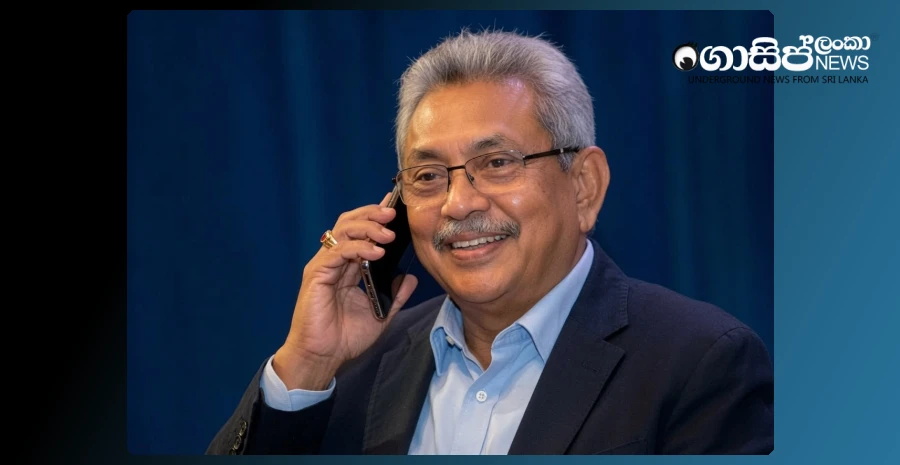
A telephone conversation between former President Gotabaya Rajapaksa and an individual identified as a civil activist has now spread across social media, with reports suggesting that this conversation could generate sympathy for the former President.
However, it has now been revealed that the background of that conversation and the true details of Gotabaya Rajapaksa's military life are different.
In the new telephone conversation, Gotabaya Rajapaksa stated that he legally retired from the military after 20 years of service. However, in an interview Gotabaya Rajapaksa gave to journalist Shamindra Fernando of 'The Island' newspaper on June 30, 2013, he himself revealed a completely different story about himself. In March 1990, after the Indian Peacekeeping Force withdrew, the Second Eelam War began in June, leading to the loss of even the A9 highway, forcing supplies to northern camps to be sent only by sea and air. Faced with this severe military setback during the tenure of then Army Commander Hamilton Wanasinghe, Lieutenant Colonel Gotabaya Rajapaksa was heavily pressured by his wife, Ioma Rajapaksa, to leave the army and go to his parents residing in America.
Initially, Gotabaya did not agree, but later Ioma Rajapaksa tried to get Gotabaya out of the army through Brigadier Wijaya Wimalaratne, a neighbor in their housing complex in Thimbirigasyaya. Wijaya Wimalaratne, who worked at the Joint Operations Headquarters, was an officer who could influence the rulers at the time. Meanwhile, a news report in the 'Sunday Island' stating that Gotabaya was preparing to retire greatly angered then State Minister of Defence Ranjan Wijeratne, who attributed responsibility to Mahinda Rajapaksa, but Mahinda denied it. Under Ioma Rajapaksa's influence, Brigadier Wimalaratne had given this news to the newspaper with the aim of getting Gotabaya transferred from the Gajaba Regiment in Palaly to Colombo. Later, Ranjan Wijeratne, Denzil Kobbekaduwa, and Janaka Perera met Gotabaya, and in late 1990, he was appointed Deputy Commandant of the Kotelawala Defence Academy. Having joined as a Lieutenant on April 26, 1971, and served in the Signal Corps, Sinha Regiment, Rajarata Rifles, and Gajaba Regiment, he completely left the army and went to America on November 1, 1991, amidst an escalating war, after Ranjan Wijeratne was assassinated in a bomb attack on March 2, 1991.
A completely different incident occurred 18 years prior, in 2012. At that time, Ms. Frederica Jansz, editor of 'The Sunday Leader' newspaper, called Gotabaya Rajapaksa, who served as the powerful ministerial-level Secretary of Defence under the American system. She sought to confirm facts for an investigative article regarding an accusation that public resources had been misused by changing SriLankan Airlines flights, sending a favored pilot, and offloading 59 passengers to bring his wife's pet puppy from Switzerland. During the call, the Secretary of Defence severely threatened her, cursing her with vulgar language, stating he would imprison her, and calling her a disgusting journalist, threatened to have her killed by the public. Despite receiving threatening letters after Lasantha Wickrematunge's assassination, Frederica Jansz did not record the conversation and release it to social media; instead, she published it in the newspaper under the title 'Gota Goes Berserk,' engaging in true journalistic practice by directly questioning those in power.
In contrast, what happened in the new phone conversation was calling a person who lost power after the 2022 'Aragalaya' (struggle), living quietly on social and state sympathy, provoking him, secretly recording it, and posting it on Facebook. As activists like Dulan Senadheera point out, this attempt by those who hid under beds when the Rajapaksas were in power in 2010, 2015, or 2020 to gain cheap publicity today is 'Punching Down,' or attacking a weaker person. Recording and publishing phone conversations without consent is an act contrary to the Code of Ethics of the Sri Lanka Editors' Guild as well as the law of this country.
The best example of the challenge of standing firm against rulers in power is senior journalist Poddala Jayantha. When Gotabaya Rajapaksa summoned Poddala Jayantha and Sanath Balasuriya to his office, threatening them to stop journalists' protests or face death, cursing them with vulgar language and questioning their lineage, Poddala Jayantha bravely confronted him, stating directly to his face that although he came from a poor farming family, he had never washed pots for a living. As a result, a few months later, he was abducted in a white van, brutally assaulted, and had both his ankles broken. Even today, living in New York, the pain in his legs, which have iron plates implanted, reminds him of Gotabaya Rajapaksa.
However, Gotabaya Rajapaksa has gone down in history as one of the most terrifying rulers in this country during his time in power. He has been accused of killing LTTE members who came to surrender with white flags during the final war, the assassination of Lasantha Wickrematunge, the torture of Keith Noyahr, the disappearance of Prageeth Eknaligoda, and the abduction and disappearance of 11 youths by the Navy. Additionally, he is accused of selecting and killing 27 prisoners at Welikada Prison in 2012, shooting at people who demanded clean water in Rathupaswala in 2013, the MiG 27 aircraft deal, and misusing 33.9 million rupees of public funds for the D.A. Rajapaksa Museum.
After becoming President, he also used the Political Victimization Commission to suppress criminal investigations against him, retaliated against Shani Abeysekara, seized full power through the 20th Amendment to the Constitution, and militarized civil administration. Furthermore, the Supreme Court has directly held him responsible for granting baseless presidential pardons to Sunil Ratnayake and Duminda Silva in the Mirisuvil massacre, forcibly cremating Muslim individuals during the COVID-19 pandemic in violation of their religious rights, and working to bankrupt the country's economy through the 2019 tax cuts. Although he filed petitions to prevent his arrest in connection with the Easter attacks investigation, the government has informed the court that it cannot promise he will not be arrested in the future.
Gotabaya Rajapaksa is not a person who can be exempted from public criticism, and for individuals like Sandya Eknaligoda or Ahimsa Wickremesinghe, he is an eternal accused.