![Gossip Lanka News [English]](https://blogger.googleusercontent.com/img/a/AVvXsEhYm2aFFq-bIW1nWX-RrqnPFoIsVos6_VCVz8BpLt0QJi55GNXHXC2fugeRvL0qUStEuCfs7Sfu6ZiSlhrkldxfGuE_wzy5gitY6rMZ2KSi8VBbGvkgXLks37RwZV-4-HKbWiNLRxB8C_r1e4z3mpxFTMPDJPEADoG8E-bZteWFipeD5KNGbjvCfqEfKw=s300 "Gossip Lanka News [English]")
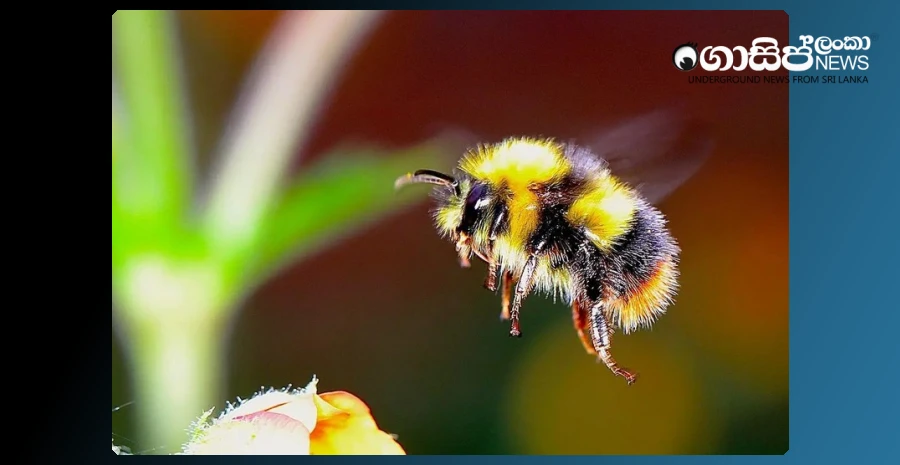
Challenging the long-held belief that insects are merely machine-like creatures acting solely on instinct, a group of scientists has confirmed that bumblebees possess an astonishing ability to use tools for problem-solving. According to a recent research report published in the renowned science journal 'Science', this discovery clearly demonstrates the high-level cognitive abilities of insects.
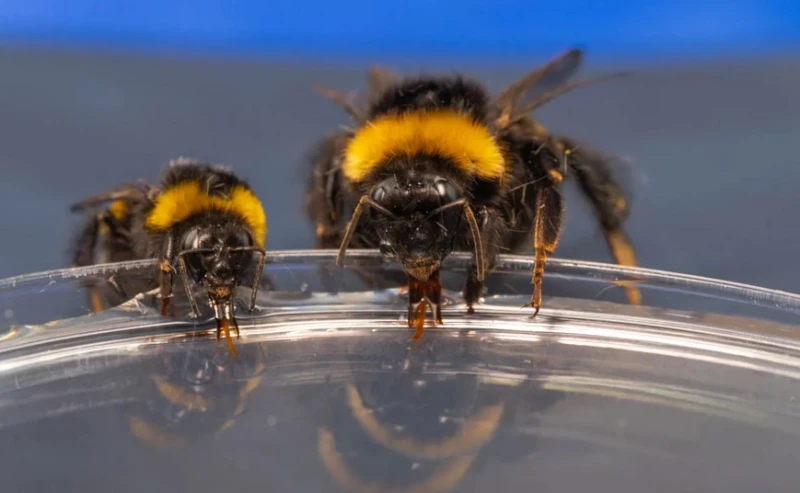
This experiment was designed using a classic research model for insects, similar to how chimpanzees stacked several boxes on top of each other to reach a banana about a hundred years ago. Following primates, elephants, and crows, bumblebees have now been added to the exclusive list of animals with such spontaneous problem-solving abilities.A team of researchers led by Dr. Olli Loukola, a behavioral ecologist at the University of Oulu in Finland, conducted this experiment using bumblebees several weeks old. First, the bees were trained to identify a blue artificial flower containing a sugary reward. Subsequently, the flower was attached to the ceiling of a transparent chamber, placed at a height too great for the bumblebees to fly and reach. To overcome this challenge, the researchers introduced a small polystyrene ball into the chamber. For a bumblebee to reach the flower, it had to roll the ball to a specific spot and climb onto it. This was an entirely new process that the animals had never experienced or been trained for before.
In the initial experiment, 75% of the bumblebees successfully overcame the challenge and reached the flower. According to Dr. Loukola, this confirms that the animal must have an understanding that an external object can be used as a tool to achieve a certain goal. However, scientists still had doubts as to whether the bumblebees truly understood the problem and acted accordingly, or if they merely succeeded by chance through engaging in a game of rolling the ball. To confirm this, they implemented another complex stage of the experiment.
In this stage, bumblebees were allowed to explore two chambers, left and right, with the artificial flower placed in only one of them. Before introducing the ball, the chamber was illuminated with red light, making the location of the blue flower invisible. When the ball was then introduced, even with the flower out of sight, the bumblebees were able to correctly roll the ball to the flower's location from memory. In this complex experiment, 23 out of 30 bumblebees showed successful results. According to Professor Lars Chittka of Queen Mary University of London, who was not involved in this research, this very clearly proves that insects with small brains can generate successful solutions to novel problems, and in their lab, bumblebees have also been observed performing unique actions such as counting and manipulating objects.