![Gossip Lanka News [English]](https://blogger.googleusercontent.com/img/a/AVvXsEhYm2aFFq-bIW1nWX-RrqnPFoIsVos6_VCVz8BpLt0QJi55GNXHXC2fugeRvL0qUStEuCfs7Sfu6ZiSlhrkldxfGuE_wzy5gitY6rMZ2KSi8VBbGvkgXLks37RwZV-4-HKbWiNLRxB8C_r1e4z3mpxFTMPDJPEADoG8E-bZteWFipeD5KNGbjvCfqEfKw=s300 "Gossip Lanka News [English]")
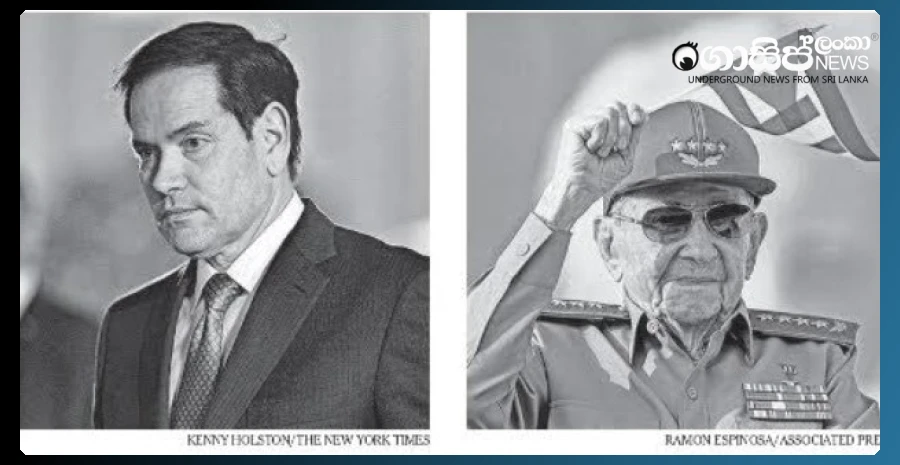
United States Secretary of State Marco Rubio is currently passionately pursuing his goal of overthrowing Cuba's communist government. Born into a family that immigrated from Cuba to America in search of economic opportunities three years before Fidel Castro's communist revolution in 1959, he grew up in the strongly anti-communist Cuban-American political environment of South Florida.
His father, Mario, worked as a bartender, and his mother, Oriales, worked as a hotel maid, cashier, and Kmart store clerk.As the latest step in America's ongoing efforts to weaken the Cuban government, the accusation made last Wednesday against 94-year-old Raúl Castro, the head of the Castro family, is considered a significant milestone in Rubio's mission. Addressing the Cuban people in a short video message regarding this, he stated that President Trump is paving a new path between Cuba and the United States. He also strongly emphasized that Cubans are forced to live without electricity for 22 hours a day not because of American oil sanctions, but because the rulers are plundering billions of dollars without helping the people. Benjamin J. Rhodes, former Deputy National Security Advisor under the Obama administration, points out that Rubio's identity and actions have always been based on the policy of changing the Havana regime.
Rubio's Cuban strategy is also closely linked to the military campaign launched by the Trump administration against Venezuela. As a result of these operations, America succeeded in arresting Nicolás Maduro and bringing him to New York on drug trafficking charges, and in filing an indictment against him in 2020. By weakening the Venezuelan government, which primarily supplies oil to Cuba, and by pressing Maduro's friend Delcy Rodríguez to stop oil supplies, Cuba's economy was plunged into a severe crisis after decades. Rubio told NPR that he welcomes the impact on Cuba of overthrowing the Maduro government and that he supports anything detrimental to a communist dictatorship.
A few months ago, Rubio had initiated economic discussions with Raúl Guillermo Rodríguez Castro, Raúl Castro's grandson, with the aim of obtaining political concessions. American authorities attempted to remove President Miguel Díaz-Canel and bring about a political change favorable to the Trump administration. However, due to the slow nature of the discussions and the Castro family's rigid policies, American authorities' patience appears to have worn thin. As a result, America took steps to send the Nimitz aircraft carrier and accompanying warships to the Southern Caribbean Sea on Wednesday, more as a show of force than a major military operation. It is clear that the arrival of these ships on the same day the Department of Justice filed charges against the Castro family is no coincidence.