![Gossip Lanka News [English]](https://blogger.googleusercontent.com/img/a/AVvXsEhYm2aFFq-bIW1nWX-RrqnPFoIsVos6_VCVz8BpLt0QJi55GNXHXC2fugeRvL0qUStEuCfs7Sfu6ZiSlhrkldxfGuE_wzy5gitY6rMZ2KSi8VBbGvkgXLks37RwZV-4-HKbWiNLRxB8C_r1e4z3mpxFTMPDJPEADoG8E-bZteWFipeD5KNGbjvCfqEfKw=s300 "Gossip Lanka News [English]")
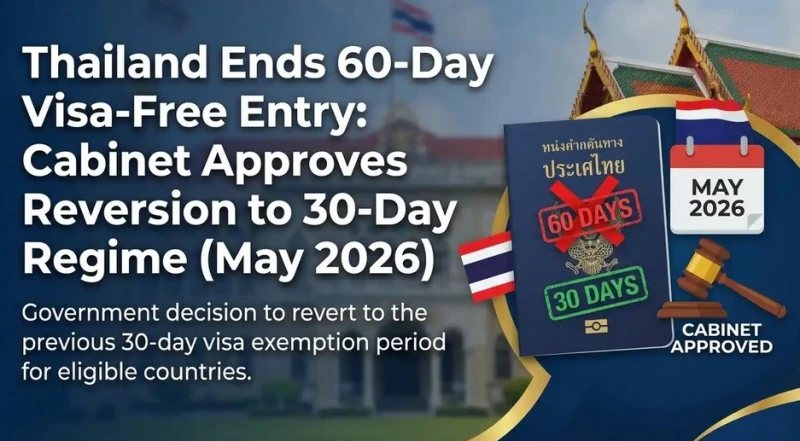
The Thai government has taken steps to swiftly tighten its visa regulations with the aim of controlling various illegal activities and the crime wave perpetrated by foreigners. Accordingly, on May 19, 2026, the Thai Cabinet approved the complete cancellation of the 60-day visa-free stay facility that was in effect in the country.
These new laws are scheduled to be implemented 15 days after being published in the Government Gazette, meaning they will come into effect from early June 2026. Until then, the existing 60-day limit will remain valid for arriving tourists. The 60-day facility previously available to Sri Lankans will also be abolished accordingly.(Recently, a group of monks carrying drugs also arrived in the country from Thailand)
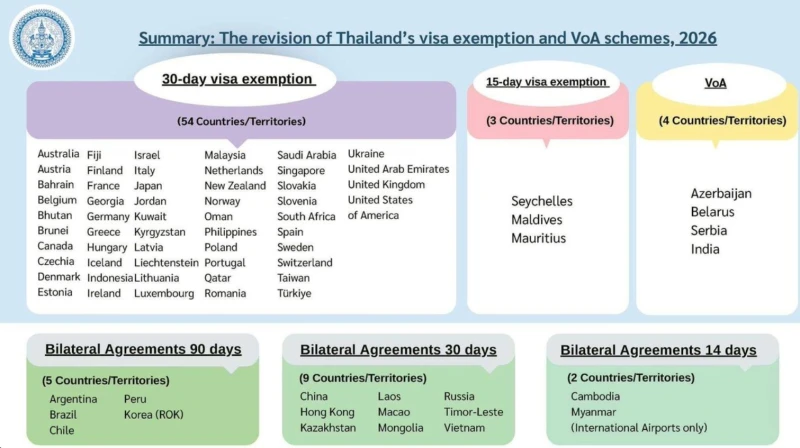
This 60-day visa-free system was introduced in July 2024 for tourists from 93 countries with the aim of reviving the tourism industry, which had severely declined after the COVID pandemic. However, under the new amendments, this relaxed policy is being changed, and the old 30-day limit will be re-enforced for the majority of countries. Tourists from 54 countries, including the USA, Britain, Australia, and Canada, will be granted a 30-day visa-free period, with the possibility of extending it by another 30 days upon payment of a 1,900 Thai Baht fee, at the discretion of an immigration officer.
Under the new set of laws, several countries like the Maldives and Seychelles will receive a 15-day visa-free facility. For Indian tourists, who previously enjoyed a 60-day exemption, the government has decided to grant only a 15-day period under the Visa on Arrival system, subject to a fee of 2,000 Thai Baht. However, due to existing bilateral agreements, tourists from China, as well as countries like South Korea, Argentina, Brazil, Chile, and Peru, which are entitled to a 90-day stay, will not be affected by these new amendments. Additionally, restrictions have been imposed for tourists arriving via land borders, allowing only two 30-day visa-free entries per year.
The primary reasons for this strict decision are to prevent foreigners from obtaining illegal employment under the guise of tourism, overstaying their visas, operating fake business networks, engaging in drug trafficking, and joining international criminal gangs. Commenting on this, Thailand's Minister of Tourism and Sports, Surasak Phanjaroonworakul, stated that the government's main objective is not short-term economic gains, but rather to attract quality tourists to the country and prevent criminals who arrive under the guise of tourism. He also emphasized that changing this visa-free system would not severely impact the country's main tourism market.
As more than 10 percent of Thailand's GDP is generated by the tourism industry, local tourism businesses have expressed some concern about this decision in the face of competition from other rival countries like Vietnam. These new restrictions will be a significant problem, especially for digital nomads who intend to stay for several months and those who use short-term border runs to renew their visas. However, government authorities point out that since the average stay of the majority of tourists visiting Thailand is less than nine days, these regulations will not pose a major obstacle to regular tourists. Authorities also remind that alternative methods, such as special tourist visas or the 'Destination Thailand Visa' (DTV), which allows stays of up to 180 days, remain open for those who wish to stay long-term.