![Gossip Lanka News [English]](https://blogger.googleusercontent.com/img/a/AVvXsEhYm2aFFq-bIW1nWX-RrqnPFoIsVos6_VCVz8BpLt0QJi55GNXHXC2fugeRvL0qUStEuCfs7Sfu6ZiSlhrkldxfGuE_wzy5gitY6rMZ2KSi8VBbGvkgXLks37RwZV-4-HKbWiNLRxB8C_r1e4z3mpxFTMPDJPEADoG8E-bZteWFipeD5KNGbjvCfqEfKw=s300 "Gossip Lanka News [English]")
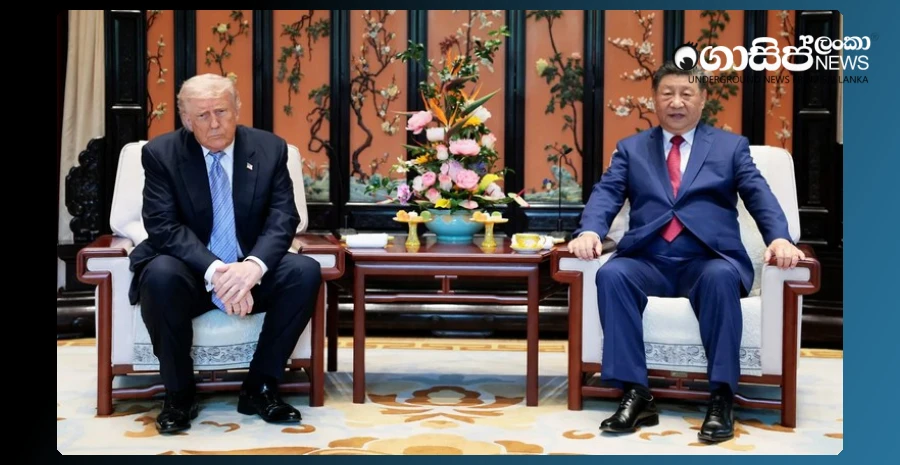
US President Donald Trump has warned Taiwan against officially separating from China and declaring independence. Speaking to Fox News at the end of a two-day summit with Chinese President Xi Jinping in Beijing, the American president stated that he does not wish to see anyone achieve independence.
However, Taiwanese President Lai Ching-te had previously stated that Taiwan already considers itself a sovereign nation, and therefore they have no need to officially declare independence. The United States has long supported Taiwan and is legally bound to facilitate its self-defense. Yet, the US has consistently had to balance this alliance with maintaining diplomatic relations with China.
Trump previously said that he has not made any promises to any party regarding this self-governing island, which China claims as part of its territory and has not ruled out acquiring by force. Washington's official stance is also that they do not support Taiwan's independence. Furthermore, maintaining continuous relations with the Beijing government depends on their recognition that there is only one Chinese government.
The Beijing government has expressed strong disapproval of the Taiwanese president, previously calling him a "troublemaker" and a "destroyer of cross-strait peace." Although many Taiwanese consider themselves part of a separate nation, the majority prefer to maintain the current status quo, where Taiwan neither declares independence from China nor unifies with it.
In an interview with Fox News, Trump emphasized that American policy on this matter has not changed. He stated that he does not expect to travel 9,500 miles (15,289 kilometers) for a war, and his goal is to see both Taiwan and China calm down.
Speaking to reporters on his flight back to Washington, the American president said that he and the Chinese president discussed many issues regarding Taiwan. But he refused to discuss whether America would defend Taiwan. Trump further stated that Xi Jinping holds a strong stance on Taiwan and does not want to see a movement for independence.
According to Chinese state media, Xi Jinping warned during the discussions that the Taiwan issue is the most important problem in China-US relations, and if not properly managed, it could even lead to a conflict between the two nations. When asked if he expected a conflict with China over Taiwan, Trump stated that he did not think so, and that everything would be fine because Xi Jinping does not want a war.
In recent years, China has intensified military exercises around Taiwan, raising tensions in the region and testing Washington's diplomatic balance. Late last year, the Trump administration announced an $11 billion arms package for sale to Taiwan, which included advanced rocket launchers and various missiles. The Beijing government strongly condemned this.
Trump said he would soon decide whether to proceed with the arms sale, adding that he and Xi Jinping discussed it in great detail. He also stated that he would have to speak with the person currently governing Taiwan.
Although the United States does not have official relations with Taiwan, it maintains a significant level of unofficial ties. US presidents traditionally do not speak directly with the Taiwanese leader, as doing so could lead to significant tensions with the Beijing government, which considers the Taiwanese president a separatist.
Meanwhile, Taiwan's Deputy Foreign Minister Chen Ming-chi stated on Saturday that Taiwan needs to clarify the exact meaning of Trump's statements. He further added that the sale of US arms to Taiwan is affirmed under US law, and Taiwan-US arms sales are a cornerstone of regional peace and stability.
As quoted by Reuters, a spokesperson for President Lai mentioned that US arms sales are part of America's defense commitment to Taiwan and act as a shared deterrent against regional threats.