![Gossip Lanka News [English]](https://blogger.googleusercontent.com/img/a/AVvXsEhYm2aFFq-bIW1nWX-RrqnPFoIsVos6_VCVz8BpLt0QJi55GNXHXC2fugeRvL0qUStEuCfs7Sfu6ZiSlhrkldxfGuE_wzy5gitY6rMZ2KSi8VBbGvkgXLks37RwZV-4-HKbWiNLRxB8C_r1e4z3mpxFTMPDJPEADoG8E-bZteWFipeD5KNGbjvCfqEfKw=s300 "Gossip Lanka News [English]")
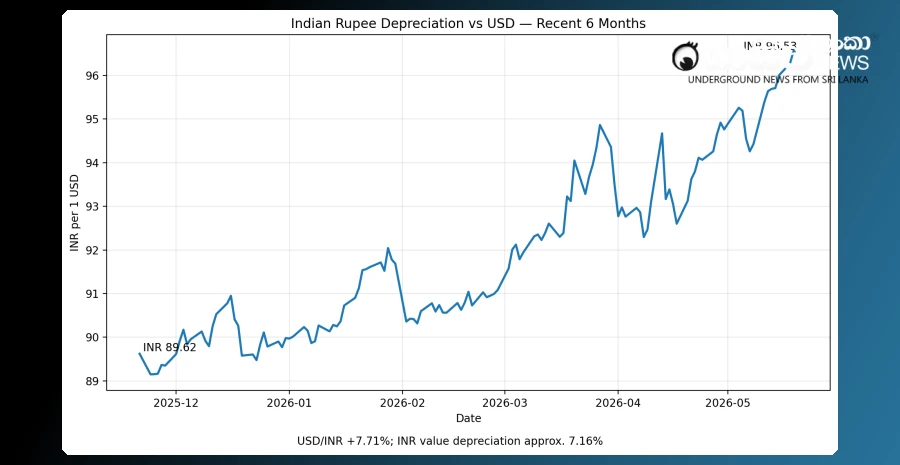
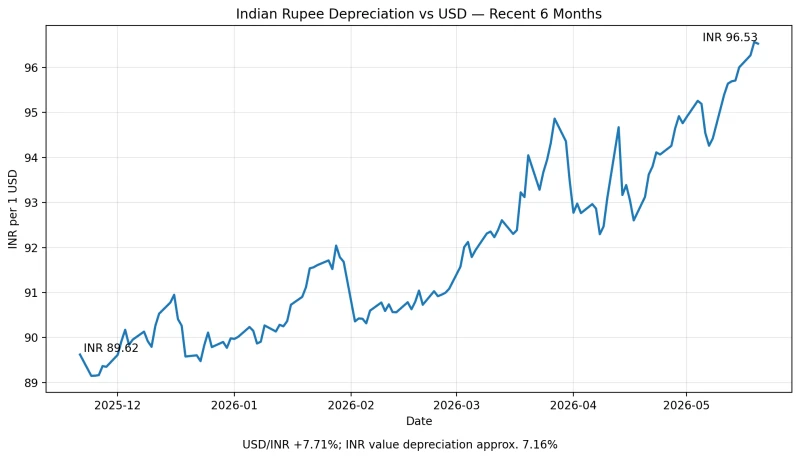
The value of the Indian Rupee against the US Dollar has fallen to an unprecedented historic low, and financial analysts say there is a risk of it falling further in the coming period. As of last Wednesday morning, the Indian Rupee was recorded at 96.9 against the US Dollar, with rising crude oil prices in the global market and the rapid outflow of foreign investment from the Indian stock market being the main reasons for this severe decline.
Abhishek Datta, Vice President of The Continental Group, points out that the Indian Rupee has been under continuous structural pressure due to the inflation disparity between India and the United States. Currently, inflation in India is around 5 percent, while in the US it is 2 percent. Given this situation, he states that the Indian Rupee needs to depreciate by about 3 percent annually to maintain competitiveness in the global market. However, it is expected that the Rupee will get some relief if gold imports are restricted due to increased gold import duties in India, or if oil prices fall through a peaceful US-Iran agreement.
India imports 80 to 85 percent of its crude oil requirements, with half of it transported through the Strait of Hormuz. Due to the US-Israel-Iran conflicts on February 28, the price of a barrel of crude oil in the world market exceeded $100, which directly impacted the currencies of oil-importing countries like India. According to data from the Observer Research Foundation (ORF), every time crude oil prices rise by $10, India's current account deficit widens by 40-50 basis points, which is an additional loss of approximately $9 billion.
Vijay Valecha, Chief Investment Officer at Century Financial, states that the Indian Rupee has depreciated by about 7 percent in 2026 alone due to US President Donald Trump's tariff threats and the Middle East crisis. In the future, the trajectory of the Indian Rupee will be determined by crude oil prices, US bond yields, foreign capital flows, and interventions by the Reserve Bank of India (RBI). Meanwhile, the US Dollar continues to strengthen due to the robust performance of other emerging markets like South Korea and Taiwan.
Although the Rupee has weakened in nominal terms, according to the 'Real Effective Exchange Rate' (REER) calculated by the Reserve Bank of India based on the currencies of 40 countries, the Indian Rupee is currently below its equilibrium value. Last March, this REER index fell below the normal level of 100 to 92.72, which was the lowest value recorded in ten years. This is a significant change compared to the overvalued figure of 105.41 in late 2024. However, Vijay Valecha also points out that for India, as an export-oriented country, a certain level of Rupee weakness is beneficial to keep its export sector globally competitive.
Due to the record depreciation of the Indian Rupee, Indian expatriates residing in the United Arab Emirates are largely inclined to remit money to India. Ali Al Najjar, CEO of Al Ansari Exchange, states that expatriate workers have increased their remittances to their home country to take maximum advantage of this favorable exchange rate before the upcoming Eid al-Adha festival. The efficient and low-cost digital remittance system between the UAE and India has further accelerated this money transfer process.