![Gossip Lanka News [English]](https://blogger.googleusercontent.com/img/a/AVvXsEhYm2aFFq-bIW1nWX-RrqnPFoIsVos6_VCVz8BpLt0QJi55GNXHXC2fugeRvL0qUStEuCfs7Sfu6ZiSlhrkldxfGuE_wzy5gitY6rMZ2KSi8VBbGvkgXLks37RwZV-4-HKbWiNLRxB8C_r1e4z3mpxFTMPDJPEADoG8E-bZteWFipeD5KNGbjvCfqEfKw=s300 "Gossip Lanka News [English]")
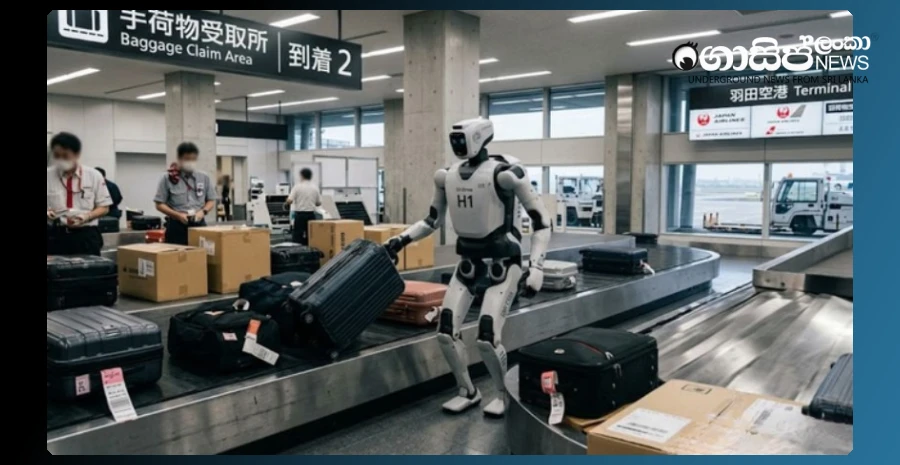
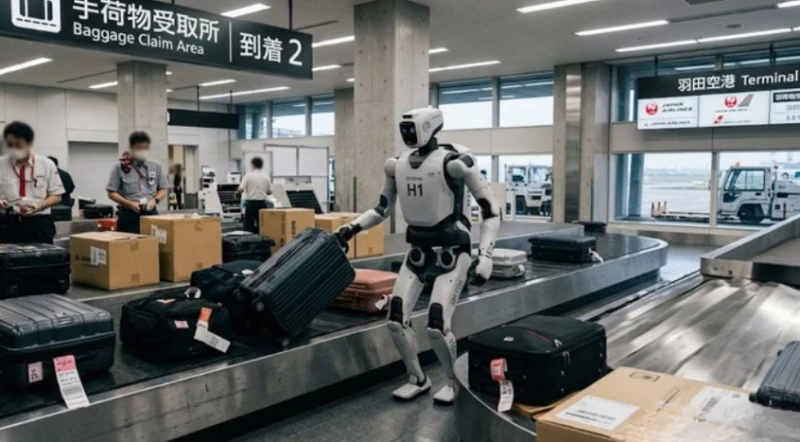
If at an airport, your heavy luggage is carried not by a human but by a machine, it is no longer just a part of science fiction, but a reality unfolding live before us.
Japan Airlines (JAL) has commenced a unique experiment at Haneda International Airport in Tokyo, one of the world's busiest airports, by deploying humanoid robots into service starting this May. Although Japan has always been a nation built on the indomitable courage and hard work of its employees, with this leap in new technology, a massive burden previously placed on airport staff will now be transferred to machines.
Within this massive complex, where over 60 million passengers move annually, it is expected that the physical strain on employees who sweat and lift heavy loads will be significantly reduced by these robots. This experimental project, jointly implemented by JAL and ‘GMO Internet Group’, is scheduled to run until 2028, and it is not merely a technological demonstration but also a sensitive step towards alleviating the hardships of human laborers.
The functionality of these approximately 130 cm tall robots, developed by the Hangzhou, China-based 'Unitree' technology company, was recently demonstrated to the media. Their ability to push luggage onto conveyor belts near aircraft and wave to signal their colleagues captivated everyone. Capable of continuous work for two to three hours after a single charge, these robots are also planned to be used for tasks such as cleaning aircraft cabins in the future.
Behind this technological revolution lies a serious social crisis that Japan is currently facing: the immense challenge of managing the massive influx of tourists into the country amidst a rapidly aging population and labor shortage. Despite various diplomatic issues, 42.7 million tourists visited Japan last year alone, and in just the first two months of 2026, that number has already exceeded 7 million.
Although it has been estimated that Japan will need 6.5 million foreign workers by 2040 to achieve its economic goals, the political pressure on the government regarding the admission of immigrants into the country is not insignificant. Therefore, while robotics appears to be an excellent alternative, airport authorities firmly state that human intervention remains essential for highly sensitive and critical tasks such as security management. As Tomohiro Uchida, President of GMO AI & Robotics, points out, no matter how modern an airport may appear externally, its backend operations still largely depend on human labor today.
No matter how advanced machinery becomes, the value of human intelligence and responsibility, which technology can never fully replace, is becoming even more intensely felt by society with the advent of these 'iron men'.