![Gossip Lanka News [English]](https://blogger.googleusercontent.com/img/a/AVvXsEhYm2aFFq-bIW1nWX-RrqnPFoIsVos6_VCVz8BpLt0QJi55GNXHXC2fugeRvL0qUStEuCfs7Sfu6ZiSlhrkldxfGuE_wzy5gitY6rMZ2KSi8VBbGvkgXLks37RwZV-4-HKbWiNLRxB8C_r1e4z3mpxFTMPDJPEADoG8E-bZteWFipeD5KNGbjvCfqEfKw=s300 "Gossip Lanka News [English]")
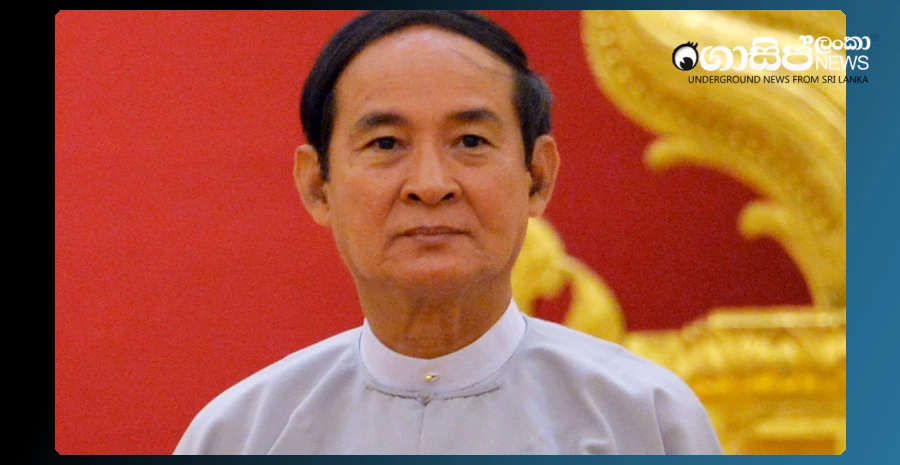
U Win Myint, Myanmar's last democratically elected president, was released from prison on April 17, 2026, under a mass prisoner amnesty declared by the military government for the traditional Thingyan, or New Year, festival. This pardon was granted on the orders of military leader Min Aung Hlaing, who was sworn in as Myanmar's new president around April 10, 2026, following a recently held controversial election.
Although this is considered a significant milestone in Myanmar's political crisis since the 2021 military coup, political analysts believe it is merely a symbolic step rather than a broad democratic reform.Under this amnesty, nearly 4,500 people, including 4,335 domestic prisoners and about 180 foreigners slated for deportation, have been released. Steps have also been taken to commute death sentences to life imprisonment, life sentences to 40 years, and reduce lesser sentences by one-sixth. When 74-year-old Win Myint, who was detained in Toungoo Prison in the Bago Region, was released, he refused to sign the conditional release form under Section 401(1) of the Penal Code, stating that he had committed no wrongdoing or broken any law and had consistently upheld the Buddhist Five Precepts. However, after authorities read him the relevant legal provisions, he was released and is now with his family members at his daughter's home in Naypyidaw. Dr. Myo Nyunt, spokesperson for the National League for Democracy (NLD), confirmed after meeting him that the former president firmly maintained he had not broken any laws and that he is in good health.
Born on November 8, 1951, Win Myint earned a Bachelor of Science degree in Geology and later worked as a lawyer in the High Court and Supreme Court. He is a close confidant of Aung San Suu Kyi and a senior member of the NLD party. Imprisoned after the 1988 uprising and again after the 1990 election, he was elected as a Member of Parliament in 2012, 2015, and 2020. He served as Speaker of the Lower House from 2016 to 2018 and became the 10th President of Myanmar on March 29, 2018. When he was arrested during the military coup on February 1, 2021, he vehemently rejected the military generals' pressure to resign for health reasons, stating that it was better to die than to submit and resign to a military that had no constitutional right to seize power. Subsequently, he was sentenced to 12 years in prison on several politically motivated charges, including corruption, which was later reduced to nine and a half years. He goes down in history as one of only two nationally elected leaders detained by the military in modern Myanmar history.
While resistance groups and the NLD party expressed satisfaction on social media with this release, they emphasize that it does not indicate systemic change. UN Secretary-General António Guterres welcomed the move, calling for the immediate release of all arbitrarily detained individuals, including Aung San Suu Kyi, and for a political solution to end the violence. Under this amnesty, one-sixth of Suu Kyi's 27-year sentence, or about 4.5 years, has been reduced, but she remains in custody and may be transferred to house arrest. Groups like the Burma Campaign UK have criticized this as merely a performance for publicity, pointing out that it does not lead to the repeal of repressive laws. This is further supported by the fact that less than 14 percent of recent pardons have been for political prisoners, and since the 2021 coup, nearly 8,000 civilians have been killed, with over 22,000 political prisoners still incarcerated. Some analysts speculate that Chinese influence on the recent election may have contributed to these releases, while others describe it as a show to demonstrate social reconciliation while the military rule continues.