![Gossip Lanka News [English]](https://blogger.googleusercontent.com/img/a/AVvXsEhYm2aFFq-bIW1nWX-RrqnPFoIsVos6_VCVz8BpLt0QJi55GNXHXC2fugeRvL0qUStEuCfs7Sfu6ZiSlhrkldxfGuE_wzy5gitY6rMZ2KSi8VBbGvkgXLks37RwZV-4-HKbWiNLRxB8C_r1e4z3mpxFTMPDJPEADoG8E-bZteWFipeD5KNGbjvCfqEfKw=s300 "Gossip Lanka News [English]")

The Republican Party strongly asserts that the attack against Iran was carried out under the powers vested in US President Donald Trump as Commander-in-Chief, while Democrats point out that the government has not provided proper justification for it, and therefore, a vote on war powers is planned to be held this week.
Two days after Israeli and US forces began bombing Iran, Secretary of State Marco Rubio, Secretary of Defense Pete Hegseth, CIA Director John Ratcliffe, and Chairman of the Joint Chiefs of Staff General Dan Kane briefed congressional leaders on the situation.
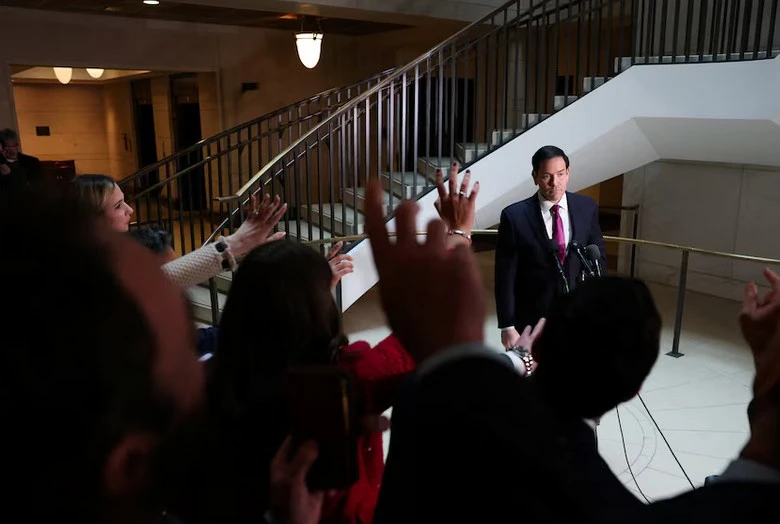
The Secretary of State told reporters that the US faced an imminent threat because it knew Israel planned to attack Iran, and in response, Iran was expected to attack US forces. Republican lawmakers further stated that the US had to respond to this "imminent threat" created by Israel's decision.
House Speaker Mike Johnson told the media after a classified briefing that the Commander-in-Chief and the government had to make a very difficult decision because Israel was determined to act whether America intervened or not. He further stated that this operation was limited in scope and purpose, absolutely necessary for their defense, and he believes it will end quickly.
However, Democrats argue that the US Constitution grants the sole right to declare war to Congress, not the President. Therefore, they point out that President Trump should not have initiated an operation that could drag on for weeks without the approval of lawmakers. They also accuse the government of failing to provide a consistent justification for attacking Iran.
Commenting on this, Democratic Senator Mark Warner of Virginia stated that the government has presented various reasons for attacking Iran within a short period of a week. Although various reasons were put forward, such as destroying Iran's nuclear program, stopping ballistic missile development, changing the regime, and sinking their naval fleet, he further emphasized that Trump's top aides have failed to show credible evidence of an immediate threat to American interests.
By Monday evening, six US service members had died in the conflict, and Trump administration officials are scheduled to brief the full Senate and House of Representatives on Tuesday.
Lawmakers are expected to vote later this week on war powers resolutions that could prevent the President from continuing to strike Iran without a congressional declaration of war. The Constitution grants Congress the power to send US troops to war, except for limited attacks carried out for national security reasons. However, with Republicans holding a slim majority in both the House and Senate, all attempts to force the President to seek lawmakers' approval for military action have so far failed.