![Gossip Lanka News [English]](https://blogger.googleusercontent.com/img/a/AVvXsEhYm2aFFq-bIW1nWX-RrqnPFoIsVos6_VCVz8BpLt0QJi55GNXHXC2fugeRvL0qUStEuCfs7Sfu6ZiSlhrkldxfGuE_wzy5gitY6rMZ2KSi8VBbGvkgXLks37RwZV-4-HKbWiNLRxB8C_r1e4z3mpxFTMPDJPEADoG8E-bZteWFipeD5KNGbjvCfqEfKw=s300 "Gossip Lanka News [English]")
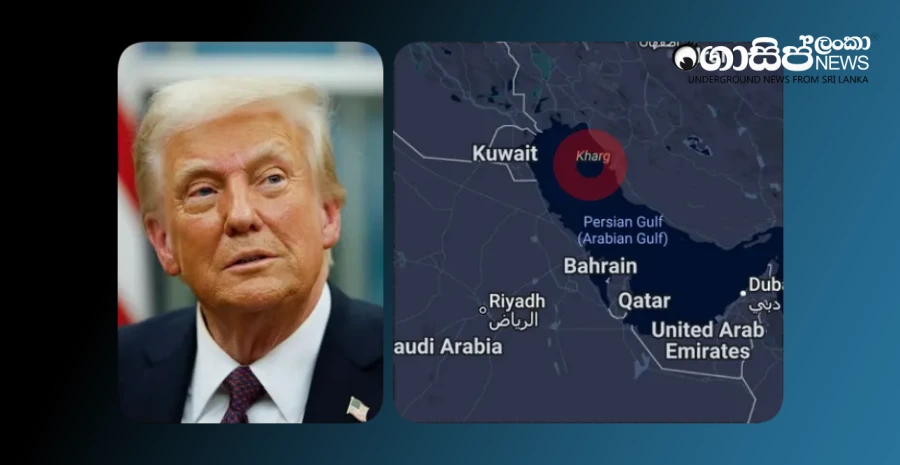
Amidst the war situation between the United States, Israel, and Iran, the importance of Kharg Island, located near the Strait of Hormuz, has suddenly increased. According to some media reports, the Trump administration is considering military options to seize this island, which is considered Iran's main oil revenue center.Between 80% and 90% of Iran's crude oil exports are carried out through this island, where massive oil terminals, pipelines, storage tanks, and ship bunkering facilities have been established. Experts warn that an attack on this center, which has the capacity to ship approximately 7 million barrels per day, could escalate the situation into a third world war.
Developed as a massive oil export center through foreign investment in the 1960s, this island has since become the backbone of Iran's oil supply. Michael Doran, a senior fellow at the Hudson Institute, points out that even after a war, the Trump administration has no desire to completely destroy the Iranian economy. He states that America's old 'red line' or limit has been not to attack such unique and critical locations, but if such places are targeted, Iran will launch a massive counterattack, which could create a situation akin to a third world war.
Although the United States and Israel have launched attacks targeting several Iranian military bases and nuclear facilities, Kharg Island, located 25 to 30 kilometers off the Iranian coast in the Persian Gulf, has not yet been attacked. According to satellite data and companies monitoring maritime traffic, Iran continues to export oil from here even amidst the war. Since February 28, over 12 million barrels (1.2 crore) of oil have been sent abroad via tankers, and Iran uses the 'Dark Fleet' method by disabling its ships' tracking systems, so the actual export value may be higher. A recent example of this is a massive oil tanker bound for Asia disappearing from the tracking system while crossing the Strait of Hormuz and reappearing later.
Due to Kharg Island's close proximity to the Strait of Hormuz, through which approximately 20% of the world's oil supply passes, an attack on this region or a disruption of maritime traffic would severely impact the global oil supply. The American administration believes that destroying or seizing the oil terminal on Kharg Island could block Iran's primary source of income. Money from oil sales is the main economic strength of the Iranian government and military, and without this income, it would be extremely difficult for Iran to sustain a prolonged war. It is predicted that if this island is attacked, Iran's oil revenue would instantly collapse, and the price of a barrel of oil in the world market could rise by about $10.
Currently, Iran produces approximately 3.3 million barrels of crude oil per day, along with about 1.3 million barrels of condensate and other liquid fuels. Accordingly, Iran supplies 4.5% of the total global energy supply. Oil is brought directly to Kharg Island via pipelines from major oil fields such as Ahvaz, Marun, and Gachsaran, and it has a storage capacity of 30 million barrels (3 crore). It is currently estimated that about 18 million barrels of oil are stored there, which is sufficient for 10 to 12 days of export under normal conditions. Media reports indicate that before the war began, specifically between February 15 and 20, Iran increased its oil exports to over 3 million barrels per day, which is three times the normal level.
Kharg Island has been a subject of strategic military discussions before. During the 1979 Iranian hostage crisis, American President Jimmy Carter was advised to seize this island, and during Ronald Reagan's administration in the 1980s, although America attacked other Iranian oil facilities, this island was not targeted. However, during the Iran-Iraq War, the oil terminal here suffered severe damage from Iraqi attacks. To prevent crises and price hikes in the global oil market, the United States and its allies are first engaged in a strategy to weaken Iran's military and nuclear capabilities, which is why this island has not yet become a direct battlefield. Meanwhile, on the 11th day of the American-Israeli and Iranian war, the Iranian Islamic Revolutionary Guard Corps (IRGC) has imposed a new condition for ships of certain countries sailing through the Strait of Hormuz. Accordingly, Iran has stated that for them to pass through that region, those countries must first expel Israeli and American ambassadors, and taxes will be levied on the respective ships.