![Gossip Lanka News [English]](https://blogger.googleusercontent.com/img/a/AVvXsEhYm2aFFq-bIW1nWX-RrqnPFoIsVos6_VCVz8BpLt0QJi55GNXHXC2fugeRvL0qUStEuCfs7Sfu6ZiSlhrkldxfGuE_wzy5gitY6rMZ2KSi8VBbGvkgXLks37RwZV-4-HKbWiNLRxB8C_r1e4z3mpxFTMPDJPEADoG8E-bZteWFipeD5KNGbjvCfqEfKw=s300 "Gossip Lanka News [English]")
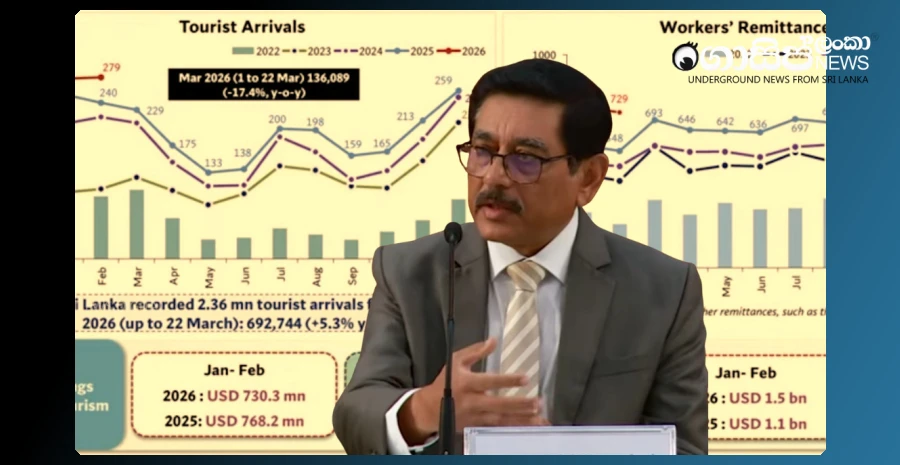
Governor of the Central Bank, Dr. Nandalal Weerasinghe, explained the stability of the country's current financial situation at a special press conference held today. His statement and the answers given to questions asked by journalists are below.
Indeed, when our Monetary Policy Board decided on this monetary policy yesterday, we specifically considered how far we, as a country, could manage this existing external shock.
As a Central Bank, we have two main responsibilities. The first is to control inflation. The second is to maintain the stability of the financial system.
From an inflation perspective, the inflation target we have agreed upon with the government is to maintain it at a 5% level. We previously stated that we expect inflation to reach the 5% level in the third quarter of this year.
However, due to the current increase in energy prices, we expect it to reach that level as an average by the second quarter. This indicates that because we maintained inflation significantly below 5% throughout the past period, we had created a good policy space to maintain inflation at or around the 5% level even if such an external shock occurred.
Moving forward, I see this as a positive factor. Otherwise, if inflation was already at 5%, it would have increased further under these circumstances. However, according to our forecasts, we expect inflation to remain around 2% by the end of this month. After that, it will gradually increase and reach the 5% level. Therefore, from an inflation perspective, we have some space, a policy buffer.
Furthermore, regarding foreign reserves, USD 7.3 billion is the highest reserve amount we have had recently. accordingly, depending on how long this shock persists, we have the ability to manage the shock to the country by utilizing this reserve amount for a certain period. The reason for this is the high level of reserves.
On the other hand, we do not see any problems within the banking system at present. It remains stable. No issues are observed in banks. Specifically, the increase in energy prices is impacting these price increases and inflation. Along with this, the increase in commodity prices may also somewhat increase import costs. However, with the demand being somewhat controlled due to price increases, there is also a possibility of a balancing change occurring on the other side.
These two factors balance each other out. Additionally, looking at the previously mentioned foreign remittances and tourism, according to the current situation, tourist arrivals in March have decreased by about 17%. However, I do not think it is too big a problem to manage.
Regarding foreign remittances, we do not currently see any such decrease. In fact, looking at the data for the first 15 days or so, it appears that remittances increased in the initial period.
How much further will this go? Our migrant workers abroad, especially those in the Middle East, have not been asked to return yet. They are staying there and sending money to their families. This is what we observe at this moment. This is primarily an external shock. The extent of its impact is beyond our control. However, what we can do is to ensure how much space we have built up to absorb the impact of such a shock on the economy.
Comparatively, during previous economic crises, we had no reserve space. But now we are in a better position. Reserves are at a high level. Inflation is at a low level. Compared to the government's fiscal policies, we are at a higher reserve level. The budget deficit has decreased. There is a primary account surplus. Therefore, the ability and strength to face such an external shock are now at a high level. The uncertainty here is that many find it difficult to determine how long this will last. It is an external factor beyond our control. Therefore, what we can do is adapt accordingly. If this persists long-term, we will have to make more changes in the future. But according to the current situation, we see the next two to three months in this way.
Journalist: Yes. Governor, since you spoke about the tourism industry, I am asking this question. In January, 277,000 tourists arrived. In February, 279,000 arrived. But by March 22nd, it had decreased to 136,000. As you said, it's about a 17% decrease. With this situation, will we be unable to reach the economic growth we expect by the end of the year? Or will we be able to restore this situation in the future? What are the Central Bank's forecasts regarding this? Will we be unable to achieve that expected economic growth by the end of this year?
Central Bank Governor: I think it's a bit too early to make a definitive statement about that at this point. Because it depends on the duration of this situation. If this lasts only for a month or a month and a half, it might only be a short-term impact. Once that situation ends, it could return to normal.
Journalist: And Governor, as you mentioned earlier, we will be able to achieve the 5% inflation target by the second quarter. But could a decrease in inflation to 1.5% have any adverse effects or impacts on the economy?
Central Bank Governor: No, there's nothing like that. If deflation persists long-term, it's a problem. We had deflation for 11 months. It would only be a problem if it continued and the country's economic activity decreased. But we saw that even with deflation at 11%, the economy grew by 5%. Therefore, it appears that this deflation has not had an adverse effect on our economy. In some countries, when deflation persists long-term, a decrease in economic activity is observed. But we did not see such a thing here. Now that the situation is returning to normal, it appears that maintaining low inflation, even from an inflation perspective, has created a somewhat advantageous situation for us at present.
Journalist: Governor, representatives from the International Monetary Fund (IMF) are visiting the country this week. Considering changes such as setting energy prices to cover costs and balance of payments (BOP) challenges, do you think Sri Lanka has the possibility of getting two loan tranches approved simultaneously? Also, do you foresee any challenges in reaching the international net reserve targets due to this situation? Thank you.
Central Bank Governor: Yes, the first question is about the IMF delegation, isn't it? They are coming here to discuss this new situation. Both they and the Managing Director who visited here have already stated that reaching a staff-level agreement and completing both reviews simultaneously is the next objective. The delegation is coming here to discuss that. As I have mentioned several times before, even looking at the four reviews already completed, the conditions and circumstances have changed after each review. This will continue to happen. Since the shock this time is a strong one, the changes occurring this time could be significant compared to the last few reviews. Therefore, we expect to hold those discussions in the coming weeks.