![Gossip Lanka News [English]](https://blogger.googleusercontent.com/img/a/AVvXsEhYm2aFFq-bIW1nWX-RrqnPFoIsVos6_VCVz8BpLt0QJi55GNXHXC2fugeRvL0qUStEuCfs7Sfu6ZiSlhrkldxfGuE_wzy5gitY6rMZ2KSi8VBbGvkgXLks37RwZV-4-HKbWiNLRxB8C_r1e4z3mpxFTMPDJPEADoG8E-bZteWFipeD5KNGbjvCfqEfKw=s300 "Gossip Lanka News [English]")
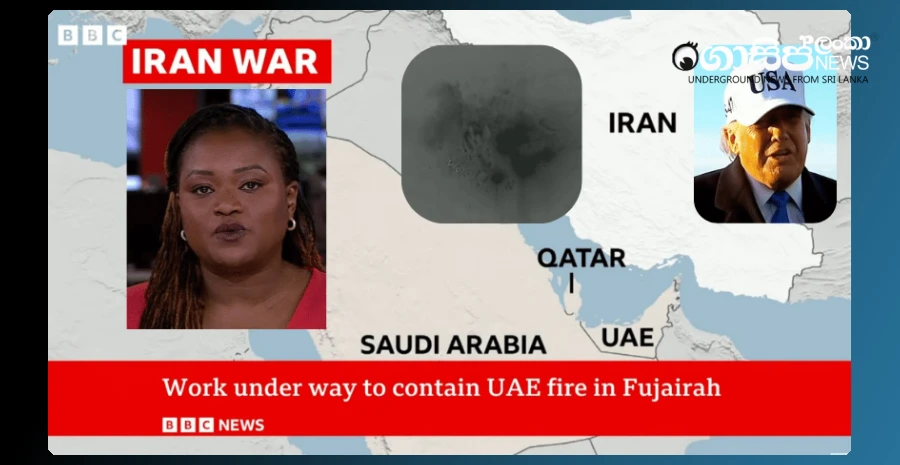
Below is the report brought by BBC World Service on the 15th day (March 14) of the Iran-Israel-America war.
With the war situation in the Middle East region entering its third week, President Donald Trump has officially announced that all military targets on Kharg Island, Iran's main oil export center in the Gulf region, have been completely destroyed by US forces.
According to the US Central Command, over ninety military targets on the island were successfully attacked during this operation, which the President has described as one of the most powerful aerial bombardment campaigns in Middle Eastern history.Iranian media has also confirmed that about fifteen massive explosions were reported around Kharg Island following this attack.
Responding strongly to this military intervention, the Tehran government has warned that if its energy facilities are further attacked, all oil and energy infrastructure belonging to companies supporting the United States will be completely destroyed and turned into ashes. As one consequence, debris from an Iranian drone destroyed mid-air by US forces crashed into the region's largest oil storage complex at Fujairah port in the United Arab Emirates, temporarily halting its operations and spreading massive smoke clouds across the area.
As the situation continues to escalate, evacuation orders have been issued to residents in several areas of Qatar, and a highly precarious atmosphere has been created throughout the entire Middle East region.
As the crisis intensifies, the United States is taking steps to send thousands of additional Marines to the Middle East, including a task force led by the powerful amphibious assault ship USS Tripoli, which has already departed from Japan. Although President Trump has stated that Iran has been completely defeated militarily and their country is collapsing, Iran and its allied armed groups have not ceased their attacks on neighboring states.
Under this context, a missile attack has been launched on the US Embassy in Baghdad, Iraq, and the Islamic Revolutionary Guard Corps has also launched a series of attacks on northern Israel. Concurrently, Israeli forces have carried out airstrikes on Hezbollah targets in Beirut and southern regions of Lebanon, damaging one health center and killing about twelve health workers, including doctors.
Significantly impacting the global economy, Iran continues to disrupt commercial shipping traffic through the Strait of Hormuz, the primary sea lane for oil supplies in the region. Since this is more about targeting tanker ships through drone and missile attacks rather than a physical blockade, a serious crisis of rising prices has been created in the international oil market. Kharg Island is the main center from which ninety percent of Iran's total crude oil exports are sent abroad (especially to China), and due to its deep-sea access, it is the most important location for large tanker ships. International security analysts point out that US forces have currently not directly damaged these oil facilities but have only destroyed military bases and strategic targets that provide security for them.
In the face of this joint military operation led by US President Donald Trump and Israeli Prime Minister Benjamin Netanyahu, it is clear that Iran is employing asymmetric warfare tactics rather than direct military confrontation. Specifically, Iran has succeeded in daily attacking economic vital points of its Gulf Arab neighbors, including Bahrain, using low-cost Shahid drones, which can be produced at a rate of about five hundred per month.
Although some progress was made regarding the nuclear program in recent talks in Geneva, Tehran has firmly refused to even discuss halting its ballistic missile program and its support for proxy armed groups like Hezbollah and the Houthis across the region. For this reason, political commentators express concerns that no matter how massive this military intervention and bombing campaign may be, if the Islamic Republic's rule continues and its influence further extends into neighboring regions, serious questions arise about the ultimate success and achievement of the objectives of this military operation.