![Gossip Lanka News [English]](https://blogger.googleusercontent.com/img/a/AVvXsEhYm2aFFq-bIW1nWX-RrqnPFoIsVos6_VCVz8BpLt0QJi55GNXHXC2fugeRvL0qUStEuCfs7Sfu6ZiSlhrkldxfGuE_wzy5gitY6rMZ2KSi8VBbGvkgXLks37RwZV-4-HKbWiNLRxB8C_r1e4z3mpxFTMPDJPEADoG8E-bZteWFipeD5KNGbjvCfqEfKw=s300 "Gossip Lanka News [English]")
It had been 826 days since India last lost a limited-overs tournament of the International Cricket Council (ICC). During that period, they had won 17 consecutive matches and secured two championships.
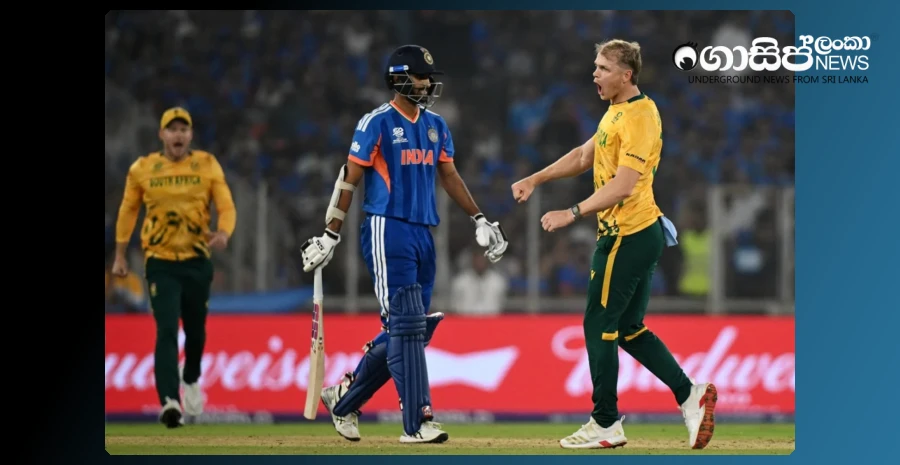
However, in the first Super Eight match against South Africa at the Narendra Modi Stadium in Ahmedabad, India had to face the pain of that past defeat once again. Their batting lineup, which had been the main engine of their victories throughout the past 826 days, completely collapsed this time. Facing a run chase for the first time in this T20 World Cup, the Indian team was helpless against the South African bowlers, getting bowled out for 111 while chasing a target of 187, suffering a massive 76-run defeat.The collapse of the Indian innings appeared to be very systematic. In the very first over of the match, left-handed batsman Ishan Kishan was dismissed for a duck off a spin delivery from Aiden Markram. Abhishek Sharma, at the other end, scored his first runs of the tournament but failed to find a proper rhythm and eventually got out caught. Meanwhile, another left-handed batsman, Tilak Varma, was also dismissed while attempting to step out and hit a shot, and a review opportunity for him was also wasted.
Marco Jansen, who had been a significant threat to Indian batsmen in the previous Test series in India, showcased his skills here as well. He dismissed Tilak Varma and then, with a brilliantly delivered 'knuckle' ball, also got rid of Abhishek Sharma, who was at the top of the T20 rankings before this tournament.
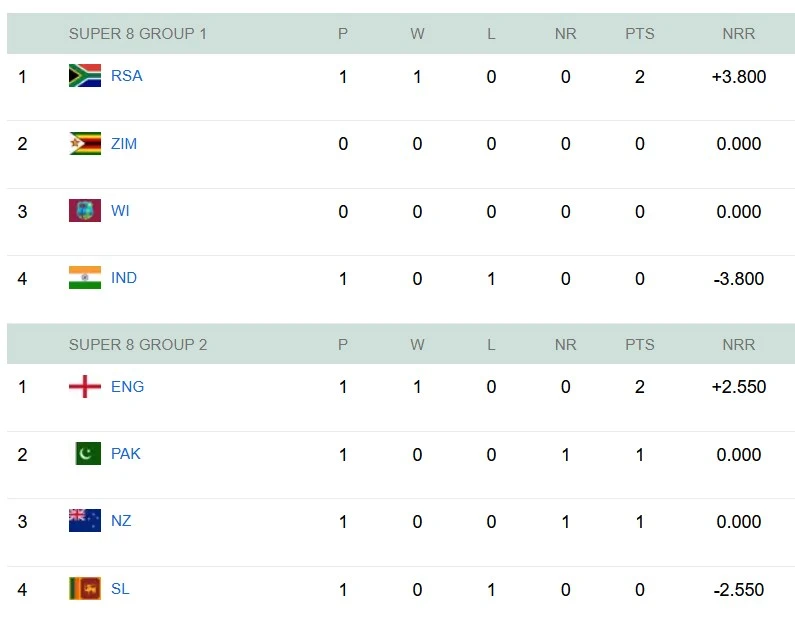
With 3 wickets down for 26 runs, a counter-attacking partnership of 97 runs, similar to what David Miller and Dewald Brevis built in the South African innings, was expected from the Indian batsmen. However, Corbin Bosch quickly dismissed Washington Sundar and Suryakumar Yadav, plunging the Indian scoreboard into a deep crisis at 44 for 4 and 51 for 5. Subsequently, Keshav Maharaj, who took 3 wickets in the 16th over, confirmed India's defeat. This loss also severely impacted their Net Run Rate (NRR), creating a risk that even a small mistake in Chennai or Kolkata could shatter their hopes of defending the championship.
This defeat highlighted several weaknesses in the Indian team, while also reminding us how well they had controlled this format of the game over the past two years. Just two months ago, India had scored 231 runs on this very pitch. However, today's black soil pitch, with grass and cracks, was completely different from the pitch on that December evening. Aiden Markram, correctly identifying its nature, decided to bat first. It was a very brave decision, as a touring team winning the toss and batting first against India in a T20 match in India had only happened on two previous occasions.
Challenging the South African captain's decision, Indian bowlers managed to take their first 3 wickets within 20 runs. Jasprit Bumrah dismissed Quinton de Kock and Riyan Rickelton, while Arshdeep Singh got Markram out.
Nevertheless, David Miller, who came to the crease next, batted exceptionally well, hitting two fours each off Varun Chakravarthy and Arshdeep, scoring 18 runs off 8 balls. By the end of the Powerplay, South Africa had boosted their score to 41 runs.
The nature of the match changed with the introduction of spin bowlers. Miller and Brevis successfully attacked Chakravarthy's deliveries from the back foot. Hardik Pandya, bowling from the other end, delivered 11 good balls, but his 12th ball was a no-ball, and Miller hit a six off the resulting free-hit.
Due to the failure of the spin bowlers, Suryakumar called upon Shivam Dube to bowl. Although his first over cost 15 runs, in his second over, he broke the 97-run partnership by dismissing Brevis. However, Miller, who continued his relentless attack at the other end, completed his half-century in 26 balls.
By the 15th over, South Africa was at 144 for 4, nearing a score of 200. At that point, Suryakumar once again gave Chakravarthy his fourth over, in which he managed to dismiss Miller. Although he conceded 47 runs in the match, he set a new Indian record by taking at least one wicket in 18 consecutive T20 innings (previously, Arshdeep had achieved this feat in 17 matches).
Bumrah, who came to bowl in the latter part of the innings, took another wicket (Bosch), finishing his spell with 3 wickets for 15 runs. Although Arshdeep dismissed Jansen, Tristan Stubbs scored 20 runs in the final over, including two sixes against Hardik, boosting South Africa's scoreboard to 187, which ultimately became an unchasable target for India.
Brief Scores: South Africa 187 for 7 in 20 overs (David Miller 63, Tristan Stubbs 44 not out; Jasprit Bumrah 3-15). India all out for 111 in 18.5 overs (Marco Jansen 4-22, Keshav Maharaj 3-24). South Africa won by 76 runs.