![Gossip Lanka News [English]](https://blogger.googleusercontent.com/img/a/AVvXsEhYm2aFFq-bIW1nWX-RrqnPFoIsVos6_VCVz8BpLt0QJi55GNXHXC2fugeRvL0qUStEuCfs7Sfu6ZiSlhrkldxfGuE_wzy5gitY6rMZ2KSi8VBbGvkgXLks37RwZV-4-HKbWiNLRxB8C_r1e4z3mpxFTMPDJPEADoG8E-bZteWFipeD5KNGbjvCfqEfKw=s300 "Gossip Lanka News [English]")
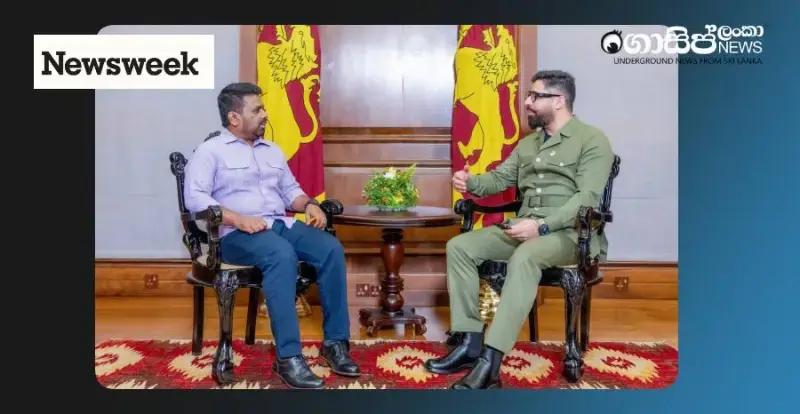
President Anura Kumara Dissanayake has conducted an interview with the international Newsweek magazine regarding the recent natural crisis and the issues that have arisen. The full interview was published on their website, and the complete English translation is provided below.
-----
In an open discussion with 'Newsweek' magazine held at the elegant bilateral meeting hall of the Presidential Secretariat in Colombo, President Anura Kumara Dissanayake explained the realities his nation faces after a devastating cyclone left death and destruction in an already unstable economy.
He also detailed how international partners, from regional neighbors to global powers, came forward during this crisis, and why he believes Colombo now has an opportunity to reset relations with India, manage complex ties with China, and build a deeper relationship with the United States under President Donald Trump.
Below is the transcript containing the questions asked and answers given during the interview.
Newsweek: Sri Lanka has undergone several major political upheavals in recent years, from protest movements to a dramatic shift in the 2024 election. How do you explain the public sentiment that brought your government to power?
President Anura Kumara Dissanayake: The 2022 protests arose not only from power cuts and long queues for fuel and medicine but also from deep frustration over corruption, unequal opportunities, and decisions made without transparency or accountability. By 2024, that public frustration transformed into a democratic demand for a different kind of leadership. Our victory is a call for clean governance, economic justice, and a departure from traditional politics.
People wanted leaders who were like ordinary people, who would tell them the truth and take responsibility. I see the mandate we received as a covenant of trust; an agreement to stabilize the economy without abandoning the vulnerable, to reform institutions instead of capturing them, and to prove that Sri Lanka's democracy can be renewed. We must show them that their trust was not misplaced.
Newsweek: Sri Lanka is situated at the intersection of Chinese-built infrastructure, Indian regional influence, and U.S. economic power. To what extent does Sri Lanka truly retain strategic independence, and how do you balance these relationships?
Dissanayake: India is Sri Lanka's closest neighbor, separated by a mere 24-kilometer stretch of ocean. We share a civilizational connection with India. There is hardly any aspect of life in Sri Lanka that is not connected to India in some way. Every time Sri Lanka has faced a difficulty, India has been the first to respond.
India is also our largest trading partner, the largest source of tourism, and a significant investor in Sri Lanka. China is also a close and strategic partner. We have a long historical relationship at both state and political party levels. Our trade, investment, and infrastructure partnerships are very strong. There are also deep and multifaceted relations between the United States and Sri Lanka. The United States is our largest market.
We also share a commitment to common democratic values and a rules-based world order. We do not see our relationships with these important countries merely as a balancing act. Every one of our relationships is important to us. We will work with everyone, but always with the same objective – to create a better world for Sri Lankans within a better world for all.
Newsweek: How do you foresee Sri Lanka's position changing within a shifting global landscape during President Donald Trump's presidency?
Dissanayake: For Sri Lanka, success means market access and renewed investment flows. We will engage with President Trump's administration to establish Sri Lanka as a stable and trusted partner and a hub in the Indian Ocean.
Newsweek: What exactly does Sri Lanka need from Washington, and what is it willing to offer in return?
Dissanayake: We need market access for our exports, especially textiles and value-added products. We also need climate finance – we lost billions of dollars due to Cyclone Ditwah. It will take us several weeks to assess the true damage. We need assistance for climate change adaptation: this includes early warning systems, resilient infrastructure, and coastal protection. We need technology and investment – we would like to see U.S. companies invest in Sri Lanka in every possible sector, including digital infrastructure, manufacturing, and renewable energy.
We need technology transfer. What we offer in return is a strategically located, stable, democratic partner in the Indo-Pacific region. We are committed to freedom of navigation. We are interested in port and logistics cooperation. We also hope to deepen cooperation on common concerns such as maritime security cooperation, counter-terrorism, and drug trafficking.
Newsweek: With public debt exceeding 100% of GDP, how do you plan to address this, avoiding another default while ensuring the poorest are not burdened?
Dissanayake: We have just completed a historic debt restructuring process, but at the same time, we faced another disaster – Cyclone Ditwah. Initial estimates indicate that the damage could be greater than any natural disaster our island has endured to date. Therefore, we will have to service our debt while rebuilding from climate disasters. This is why debt sustainability frameworks for climate-vulnerable countries must change.
To overcome decades of weaknesses in our economy, we will pursue export-oriented growth. We are increasing government revenue, expanding our tax base through digitalization, and protecting social spending. Over 20,000 people lost their homes due to Cyclone Ditwah. We cannot impose austerity on people who have lost everything. We will expand targeted cash transfers, subsidize essential medicines, invest in agricultural revival, and rebuild homes, schools, hospitals, and public infrastructure. We will have to do this while operating within the parameters of the IMF program. We need the support of our partners and international organizations.
Newsweek: Sri Lanka recorded 5% growth in 2024 and targets a primary surplus of 2.3% in 2025. Within the IMF framework, what policy measures can provide visible relief to low-income families in the next 12-18 months?
Dissanayake: Cyclone Ditwah severely affected approximately two million people, damaging nearly 55,000 homes, some completely destroyed. These families need immediate, visible relief. One – we will have to help build flood-resilient housing. This will protect families while generating construction jobs. Two – we lost about 273,000 acres of paddy fields. We must provide seeds, equipment, and technical assistance to farmers so they can replant. We will need significant funds just for agricultural recovery. This is not merely disaster recovery but also food security. Thirdly – we will maintain subsidies where they matter most to poor families: medicines, fuel, basic foodstuffs. Fourthly – infrastructure repair will generate jobs.
Newsweek: Your government has recently subjected large-scale foreign investment proposals to new scrutiny. How do you convince foreign investors that Sri Lanka is a predictable place to deploy capital?
Dissanayake: We are establishing a transparent, rules-based evaluation system with clear criteria: environmental and climate resilience standards, economic viability, technology transfer and local capacity building, labor and social protection, and alignment with national development goals. Foreign investors need three things: clarity, stability, and trust. We are creating a clean, predictable investment environment that protects the interests of both the investor and the Sri Lankan people. Firstly, to minimize delays, eliminate hidden influences, and provide a clear decision-making path, we have introduced a 'single-window investment approval system'.
Investors will be able to view the entire process online, including timelines, required documents, and responsible officials. Additionally, we are drafting a new investment protection act to ensure fairness, legal certainty, and enforceable rights for investors. Secondly, every large project will undergo a transparent, rules-based evaluation, meaning standard tender procedures and predefined sustainability criteria. No special treatment will be given to insiders or politically connected groups, which is exactly what investors have long demanded. Thirdly, we are strengthening the legal and regulatory framework. Digital procurement systems, enforcement of mandatory asset declarations, and establishment of independent oversight mechanisms are just a few of the steps we are taking.
This ensures that approvals are based on merit, viability, and national benefit, not on private networks. Finally, we will maintain political stability and the rule of law—these are the two strongest signals for investor confidence. A stable government aligned with long-term economic plans is more attractive than a system with sudden policy changes or opaque decision-making. In short: Sri Lanka welcomes investment, but we want transparent, predictable, and productive investment. When investors know the rules and trust that the rules won't suddenly change, they commit more capital, bring technology, and create jobs. That is the environment we are building.
Tags:
Trending