![Gossip Lanka News [English]](https://blogger.googleusercontent.com/img/a/AVvXsEhYm2aFFq-bIW1nWX-RrqnPFoIsVos6_VCVz8BpLt0QJi55GNXHXC2fugeRvL0qUStEuCfs7Sfu6ZiSlhrkldxfGuE_wzy5gitY6rMZ2KSi8VBbGvkgXLks37RwZV-4-HKbWiNLRxB8C_r1e4z3mpxFTMPDJPEADoG8E-bZteWFipeD5KNGbjvCfqEfKw=s300 "Gossip Lanka News [English]")
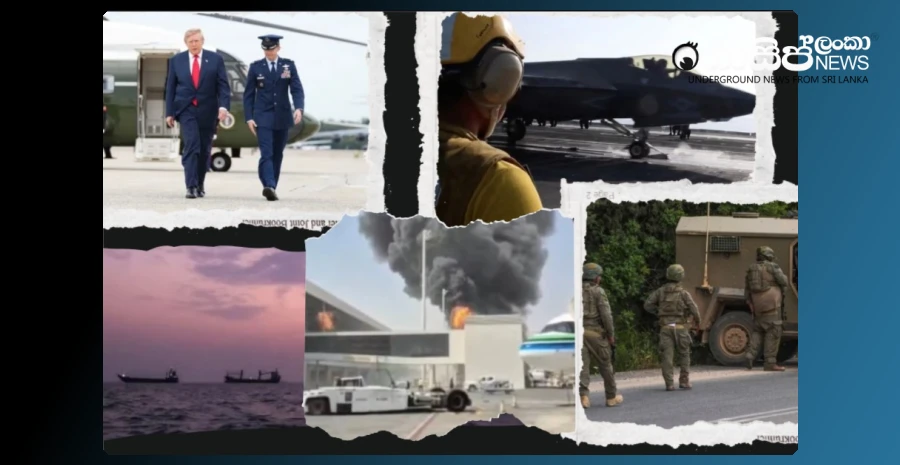
Approximately 226 days have passed since the start of military operations against Iran, and tensions in the region have further escalated due to claims by the Iranian Revolutionary Guard Corps (IRGC) in the Strait of Hormuz and a deadly Houthi attack on Saudi Arabia. At least 12 people were killed and 309 others were injured in an attack on King Khalid International Airport in Riyadh, Saudi Arabia, on Saturday, October 10.
The condition of some of the injured is reported to be serious. Among the deceased were four Saudi nationals, two Bangladeshi nationals, and one each from America, Jordan, Palestine, Syria, Sudan, and Egypt. Airport operations were suspended after the attack, and flights were diverted to other airports. Hospitals were under severe pressure due to the large number of injured.Saudi authorities and the Saudi-led coalition attributed the attack to Iranian-backed Houthi rebels in Yemen, and a senior Houthi official later claimed responsibility for it. He described it as retaliation for Saudi actions in Yemen. This is the third attack on the same airport this week and is considered the deadliest attack in Saudi Arabia in over a decade. Another projectile was reported near Dammam Airport, and the Saudi coalition continues to conduct large-scale operations against Houthi targets in Yemen.
Commenting on the attack, President Trump said that Saudi Arabia has the ability to defend itself, but called the airport attack "horrific." He also said that America could join Saudi attacks against the Houthis, and a decision on that would be made "very soon." He reiterated that the war with Iran would end soon anyway. US Secretary of State Marco Rubio strongly condemned the attacks on Saudi Arabia and expressed concern over the death of an American citizen and the disregard for civilian lives. Although Trump stated on October 8 that he would not attack Iran before the election, subsequent statements kept options open after the election, and he also demanded that Iran "surrender everything." Meanwhile, indirect diplomatic talks continue, with Iranian positions being communicated to the US through intermediaries, including Russian President Vladimir Putin.
Meanwhile, on October 10, the US Central Command (CENTCOM) disabled the commercial cargo ship "Ocean Molica" (also known as Arika Sun), sailing under the Panamanian flag in the Gulf of Oman. The ship attempted to circumvent the existing naval blockade against vessels arriving at and departing from Iranian ports, and the crew ignored repeated warnings. An American fighter jet then used a precision weapon to strike the stern of the ship, completely disabling its propulsion system. No crew injuries were reported. CENTCOM stated that the ship was attempting to leave an Iranian port and transit through regional waters. Since the naval blockade resumed on July 14, CENTCOM has disabled four commercial vessels, diverted 135 ships, and destroyed 10 IRGC-linked oil tankers. This is the first publicly acknowledged US action against a commercial vessel in approximately a month.
Meanwhile, Iranian state media and the IRGC Navy stated that a crude oil supertanker, departing through an "unauthorized" route from the Strait of Hormuz, struck a naval mine, exploded, and caught fire. They also claimed that the ship's navigation and GPS systems were disabled. Warning that any oil tanker disregarding Iranian regulations would suffer the same fate, the IRGC attempted to assert its control over the strait by declaring certain routes illegal. However, the identity, flag, or specific details of the incident have not been independently confirmed. The UK Maritime Trade Operations (UKMTO) separately reported an incident where an oil tanker outbound through Hormuz was hit by an unidentified projectile and caught fire.
Ship traffic through the Strait of Hormuz remains severely restricted, recently at only about 10 percent of pre-crisis levels. Vessels traverse the strait under American coordination, while Iran continues to assert its dominance, using bombs and gunfire against non-compliant ships. During this period, Iranian actions focused on maritime targets rather than land attacks on Gulf countries or Israel. The world oil market accounted for this temporary pause, with Brent crude oil prices around $103 per barrel after previous fluctuations.
The Pentagon announced that the number of US military personnel killed in connection with operations against Iran has been updated to 21. Previously, 18 deaths were reported. The new count includes two non-combat deaths, one a National Guard Major who died in Kuwait in March, and the other a Navy service member who died in September. At least 865 US military personnel have been wounded so far.
Events over the past 24 hours indicate that despite a fragile pause in direct attacks on Iranian territory, proxy battles and the maritime front have further intensified. The risk in the Gulf region and the area around the Red Sea and the Bab-el-Mandeb Strait remains at its highest level, with oil tanker attacks, naval mines, and Houthi attacks potentially having an immediate impact on global energy supplies. Oil prices could rise further if the destruction of a large oil tanker or an attack on Gulf energy infrastructure is confirmed.