
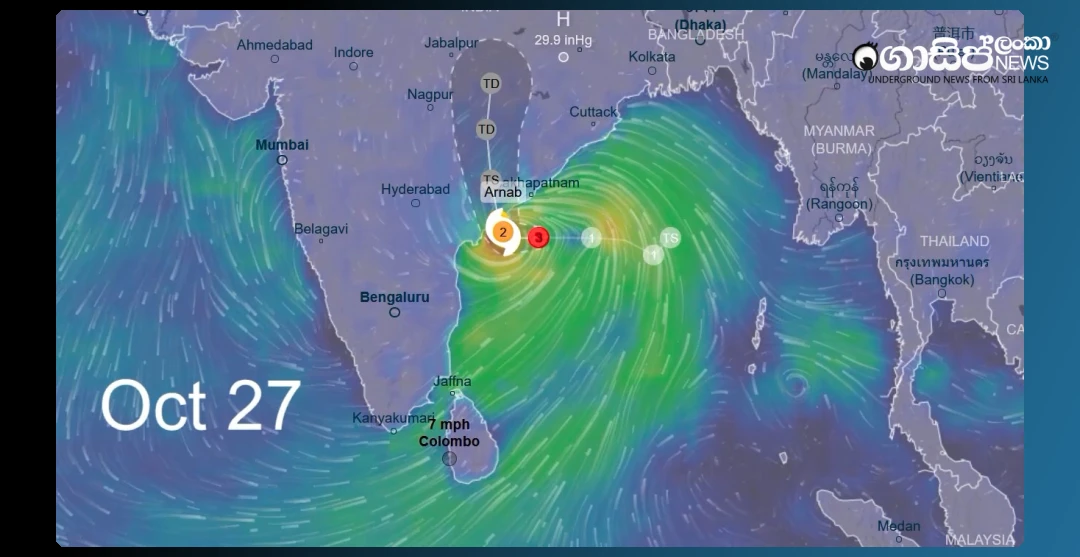
Although Cyclone 'Arnab', which is gradually intensifying in the Bay of Bengal sea area, is not directly entering Sri Lankan territory, the strong clouds and wind currents created simultaneously have led to heavy rainfall, river overflows, and an emergency disaster situation across the island. Even though it remained centered in the distant sea, authorities have had to evacuate several families to safe locations and temporarily suspend school activities in many areas, including the southwestern region of the island, due to the heavy rains.
According to the nomenclature of the World Meteorological Organization, comprising 13 South Asian regional countries, and the Economic and Social Commission for Asia and the Pacific, the Bengali name 'Arnab', proposed by Bangladesh, means 'ocean'. By October 26 and 27, the deep depression in the East Central and adjoining Southeast Bay of Bengal sea area had developed into a cyclonic storm. This system, which was located approximately 1,100 km northeast of Kankesanthurai on the morning of October 26, had moved to about 890 km northeast of Kankesanthurai by the morning of October 27.
According to the Department of Meteorology's assessment, this system is expected to intensify first into a 'severe cyclonic storm' and then into a 'very severe cyclonic storm', moving west-northwestward. It is anticipated to make landfall near Yanam, between Bapatla and Visakhapatnam on the Andhra Pradesh coast of India, around 11:30 AM on October 28, as a very severe system with sustained winds of 115 to 125 kmph, gusting up to 140 kmph. Although there is no direct impact on Sri Lanka, the wind flow across the island has led to a rainy condition that will persist for several days.
The highest rainfall in the past 24 hours was recorded in Karandipowala, Puttalam District, at 195.7 mm. Additionally, 193 mm was recorded in Kuliyapitiya and 187.5 mm in Illuppaikkadavai. Intermittent rain or thundershowers are expected in the Northern, Western, Sabaragamuwa, Southern, North Western, Central, and North Central provinces, as well as in the Trincomalee District, with heavy rains exceeding 75 mm expected in some places. An amber warning has been issued for several provinces, including Anuradhapura, with some areas potentially receiving rainfall between 100 mm and 150 mm.
Both land and sea areas are experiencing severe turbulence. Strong winds of 40 to 50 kmph are expected intermittently in the western slopes of the Central hills, Northern, North Central, and North Western provinces, as well as in the Trincomalee and Hambantota districts. A red warning has been issued for deep and shallow sea areas, with waves of 3 to 4 meters high forming due to winds ranging from 80 to 100 kmph. Fishermen and naval vessels are specifically advised not to venture into the sea area between 10°N and 20°N latitudes and 80°E and 95°E longitudes, and those already in the area are instructed to return immediately.
Due to the rainfall, the water levels of several water sources have risen, and the Kalu Ganga has reached a minor flood level in Ratnapura and its lower valley areas. Water levels are also reported to be rising in other river basins, including the Kelani River. Following the heavy rains in Anuradhapura, Trincomalee, Puttalam, and Kurunegala districts, the Deduru Oya has opened its spill gates at a rate of approximately 5,300 cubic feet per second, and Rajangana at approximately 2,300 cubic feet per second. Irrigation officials have also taken steps to open the spill gates of the Thabbowa and Inginiyagala reservoirs. Several villages in areas like Wanathawilluwa have been inundated, and it has been reported that a person was swept away by the strong current near the Kalu Ela in Madampella, Puttalam.
Evacuation efforts for people in high-risk areas have been implemented by the National Disaster Relief Services Centre. Currently, 278 individuals from 72 families in Ampara, Colombo, Gampaha, Matara, and Ratnapura districts have been directed to relief camps. The National Building Research Organisation has issued Level 1 and 2 landslide pre-warnings for several districts, including Kalutara, Kegalle, Nuwara Eliya, and Ratnapura, while the Department of Irrigation has also issued minor flood warnings.
Considering the dangerous situation, authorities took precautionary measures to close all schools, preschools, and early childhood development centers across the island on October 27. However, it was decided to conduct the G.C.E. Ordinary Level Aesthetic Practical Examinations as scheduled. A special discussion was held at the Disaster Management Centre, chaired by Deputy Minister of Defence Aruna Jayasekara, to address the emergency disaster situation, and the tri-forces, police, Civil Security Force, and Coast Guard have been placed on alert, with response teams and equipment prepared.
This weather crisis has emerged less than a year after Cyclone 'Ditwa', which had a more direct and severe impact on Sri Lanka in late 2025. Although the cyclone remained physically distant from the island, officials emphasize that due to associated moisture and wind patterns, rainy weather, landslide, and flood risks will persist for several more days. Therefore, the public has been advised to adhere to the latest information issued by the Department of Meteorology and the Disaster Management Centre, avoid unnecessary travel in high-risk areas, refrain from loitering near rivers, coasts, and low-lying areas, and comply with the prohibitions imposed on fishing activities.