![Gossip Lanka News [English]](https://blogger.googleusercontent.com/img/a/AVvXsEhYm2aFFq-bIW1nWX-RrqnPFoIsVos6_VCVz8BpLt0QJi55GNXHXC2fugeRvL0qUStEuCfs7Sfu6ZiSlhrkldxfGuE_wzy5gitY6rMZ2KSi8VBbGvkgXLks37RwZV-4-HKbWiNLRxB8C_r1e4z3mpxFTMPDJPEADoG8E-bZteWFipeD5KNGbjvCfqEfKw=s300 "Gossip Lanka News [English]")
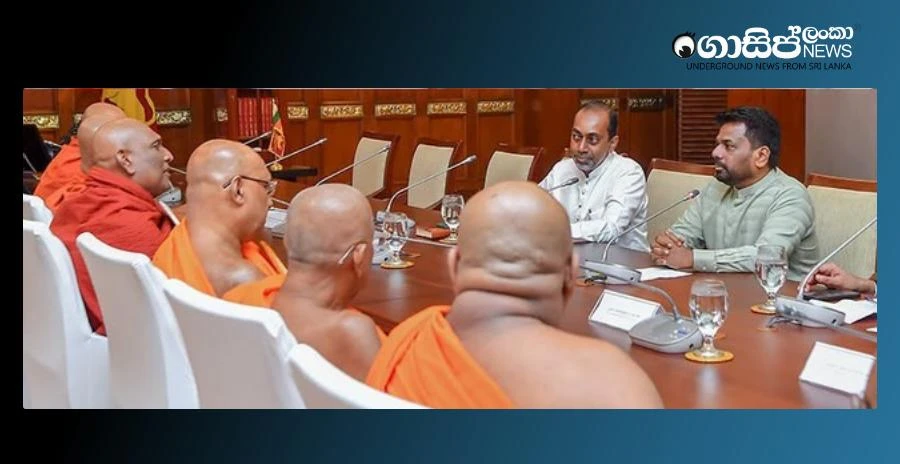
President Anura Kumara Dissanayake announced today (08) that a special committee would be appointed today itself to amend the existing laws regarding the detention of Buddhist monks in prisons and their transportation outside prisons, and to propose new standing orders and regulations.
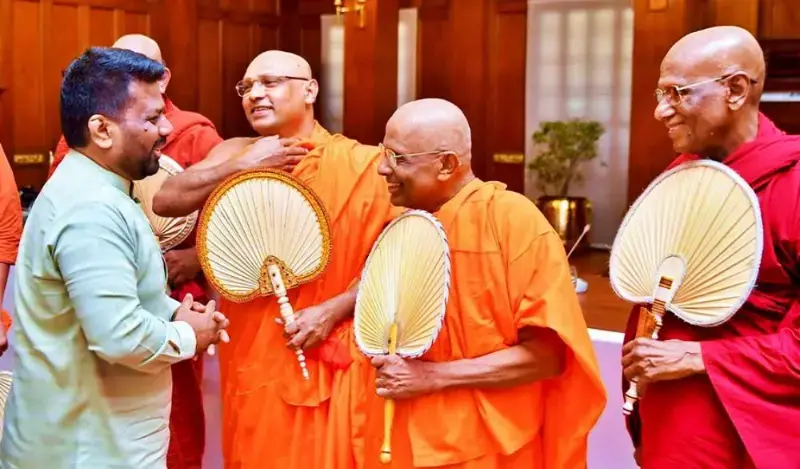
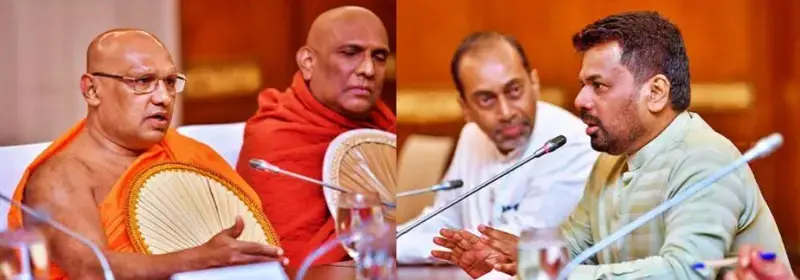
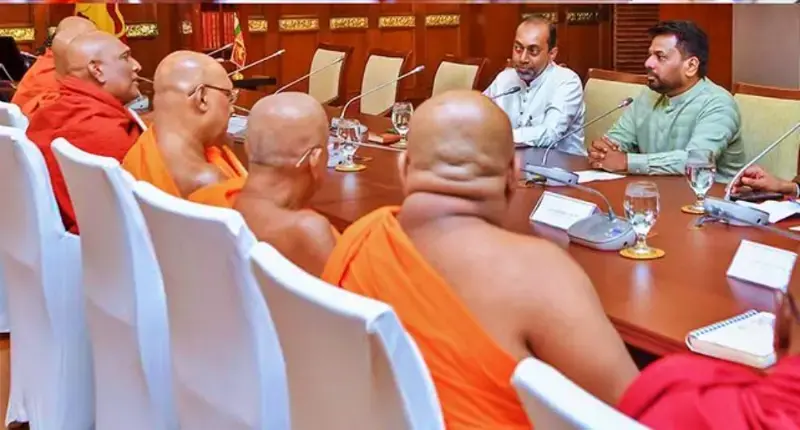
The President made this statement while participating in a special discussion held with the Maha Sangha (Buddhist clergy) at the Presidential Secretariat this afternoon.
The main purpose of this meeting was to discuss the letter sent by the Mahanayaka Theros (chief prelates) to the Commissioner General of Prisons regarding the presentation of Venerable Galagodaaththe Gnanasara Thero to court in prison attire without his robes, to de-escalate the controversial situation that arose in society due to this, and to discuss measures to prevent such situations from occurring in the future.
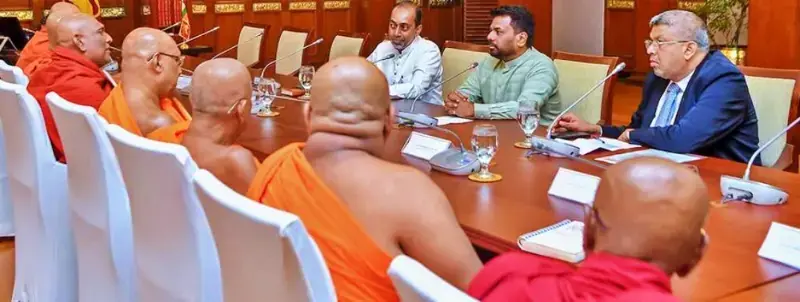
This committee, to be appointed with the participation of the Attorney General, the Ministry of Justice, the Ministry of Public Administration, the Ministry of Buddhist Affairs, prison officials, and the Commissioner General of Prisons, will be instructed to study the relevant matters and submit necessary amendments within two weeks. The President stated that a two-week period is sufficient as this does not conflict with a major law. The sections pertaining to Buddhist monks are also to be amended in consultation with the Maha Sangha.
The President pointed out that prisons are currently governed by the Prisons Ordinance enacted in 1877, which has been amended from time to time. Under Section 94 of that Ordinance, the Minister has the power to issue regulations, and regulations were also amended in 2022. Furthermore, subject to the Minister's approval, the Commissioner General of Prisons can issue standing orders for the daily administration of prisons. Accordingly, the prison system is governed by three pillars: the Ordinance, Ministerial Regulations, and Commissioner's Standing Orders.
The President stated that when these laws were formulated, attention was focused only on general prisoners, except for one or two instances, and Buddhist monks are specifically mentioned only in Regulation 216. He said that perhaps attention was not paid to this because it was not expected that Buddhist monks would be imprisoned, but since Buddhist monks have, to some extent, fallen victim to the breakdown in society today, appropriate legislation is necessary.
The President also explained the difference between those remanded and convicted prisoners. Buddhist monks in remand custody reside in prison and are presented to court wearing their robes. He cited as an example that several Buddhist monks arrested in Katunayake for drug trafficking are also remanded in this manner. However, the situation changes when one is convicted and sentenced. While there is an option to choose attire with the agreement of the prison superintendent for light labor sentences, the law states that everyone must wear the prescribed uniform provided by the prison for rigorous labor sentences, he said.
The President revealed that currently, about sixty-three Buddhist monks are imprisoned on various charges, and all of them reside in prison attire.
The President acknowledged that according to the letter from the Mahanayaka Theros, the issue has arisen more when monks are taken out of prison than when they are imprisoned. He stated that although the prison is not an open place, when they are taken outside, it is exposed to the media and the general public, so every instance of leaving the prison, not just for court proceedings, should be taken into consideration.
"When we see a monk whom we worshipped yesterday in a different light today, it creates a shock in the heart of every Buddhist. But this is the process that occurred," the President stated.
The President stated that laws are not things that remain unchanged forever, and that new laws are constantly being enacted while existing laws are repeatedly amended.
"In common politics, it is said that law is the will of the ruler. I am absolutely not willing to make the law my will. If the law becomes my will, then the law will be interpreted based on what I like and dislike. That is not appropriate," the President emphasized.
He further stated that it is not appropriate to issue orders to treat one monk in one way and other monks in another way within the existing legal framework, and if the law is not suitable for the present, it should be formally amended.
The President stated that other outdated aspects of existing laws also emerged during this discussion. He pointed out that the "release attire" given to prisoners leaving prison after release still exists according to European, Sinhala, Tamil, and Muslim models defined in 1947, and that no one wears such clothes today. Accordingly, the President emphasized that not only matters related to Buddhist monks but also many general prison regulations and standing orders need to be changed to align with the current situation.
The President also mentioned that this decision was reached after discussions with the Minister of Justice and the Minister of Buddha Sasana (Buddhist Affairs).
The President's statement video is published herewith.
