![Gossip Lanka News [English]](https://blogger.googleusercontent.com/img/a/AVvXsEhYm2aFFq-bIW1nWX-RrqnPFoIsVos6_VCVz8BpLt0QJi55GNXHXC2fugeRvL0qUStEuCfs7Sfu6ZiSlhrkldxfGuE_wzy5gitY6rMZ2KSi8VBbGvkgXLks37RwZV-4-HKbWiNLRxB8C_r1e4z3mpxFTMPDJPEADoG8E-bZteWFipeD5KNGbjvCfqEfKw=s300 "Gossip Lanka News [English]")
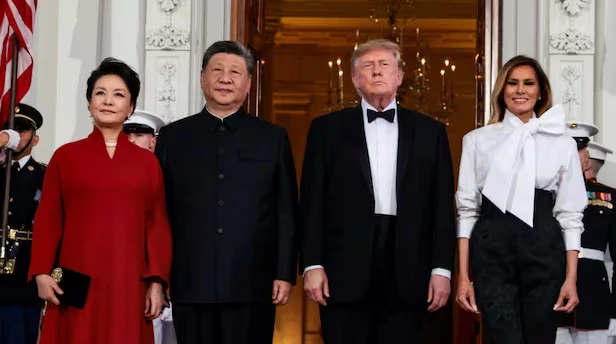
Chinese President Xi Jinping has departed back to China from Joint Base Andrews Airport, located near Washington D.C., concluding his three-day official state visit to the United States.
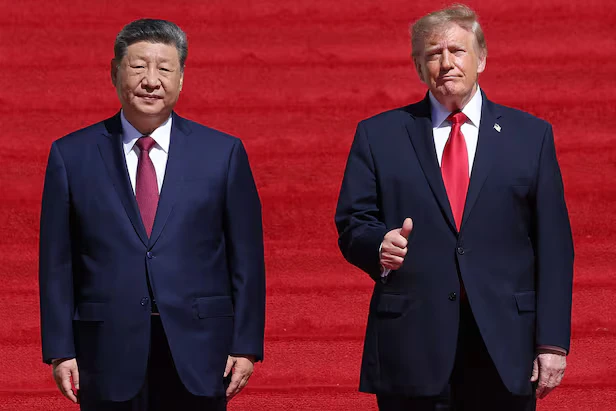
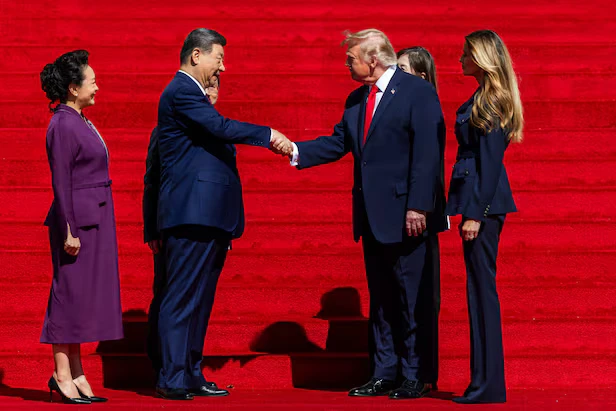
During this state visit, made by a Chinese president to the US after 11 years, American President Donald Trump came to the airport and welcomed him, and for the dinner held at the White House, heads of leading American technology companies such as Jensen Huang of Nvidia, Sam Altman of OpenAI, Mark Zuckerberg of Meta, and Sundar Pichai of Google were also present.During the official summit held at the White House between the leaders of the two countries, major bilateral issues including trade, artificial intelligence, the Taiwan crisis, and the Iran issue were discussed at length. On the last day of the visit, President Xi Jinping concluded his tour after joining President Trump and his wife for a tea party and then visiting the National Archives. Speaking to the media after the discussions, President Trump stated that this meeting was very successful and productive, and it would provide great relief to American farmers.
During the discussions on Artificial Intelligence (AI), both countries have agreed to use the term 'Super Intelligence' (SI) instead of 'Artificial Intelligence' to refer to emerging technologies, and have decided to establish the "US-China Super Intelligence Dialogue Council" to discuss its risks and benefits. While President Trump stated that regulations for artificial intelligence are unnecessary, President Xi Jinping pointed out that even amidst competition, both countries can cooperate with control by leveraging each other's strengths.
According to the maritime and regional agreements between the two countries, both leaders emphasized that no country or entity should be allowed to levy fees from international shipping lanes such as the Strait of Hormuz, and that Iran should under no circumstances possess nuclear weapons. Furthermore, President Trump's support has been secured for trilateral arms control talks between the US, Russia, and China, and the Chinese President requested that existing issues with Iran be resolved through dialogue.
Under bilateral trade relations, it has been decided to provide special tariff concessions for non-sensitive goods worth 30 billion US dollars, and China has agreed to import 10 million tons of coal per year from the United States between 2027 and 2028. The United States will export agricultural and fishery products, timber, cosmetics, and medical equipment to China, while electrical appliances and toys will be sent from China to the United States. Furthermore, steps have been taken to restore the supply of rare minerals needed by the United States, establish an investment committee, and intensify China's cooperation in combating illegal drugs, including 'Orphin' and 'Fentanyl'.
Commenting on the Taiwan crisis, President Xi Jinping clarified that the Taiwan issue is China's foremost red line, and therefore the United States must maintain its correct stance against 'Taiwanese independence'. China's 'People's Daily' newspaper points out that this meeting was instrumental in advancing relations between the two countries, based on cooperation, limited competition, and manageable disagreements.
The American President has accepted the invitation extended by the Chinese President to participate in the Asia-Pacific Economic Cooperation (APEC) Leaders' Summit to be held in Shenzhen, China, next November, and the G20 Summit to be held in Florida, USA, in December. Foreign policy analysts point out that this visit succeeded in temporarily easing the tense situation between the two countries, and the practical implementation of agreements regarding trade and minerals will determine the success of future diplomatic relations between the two countries.